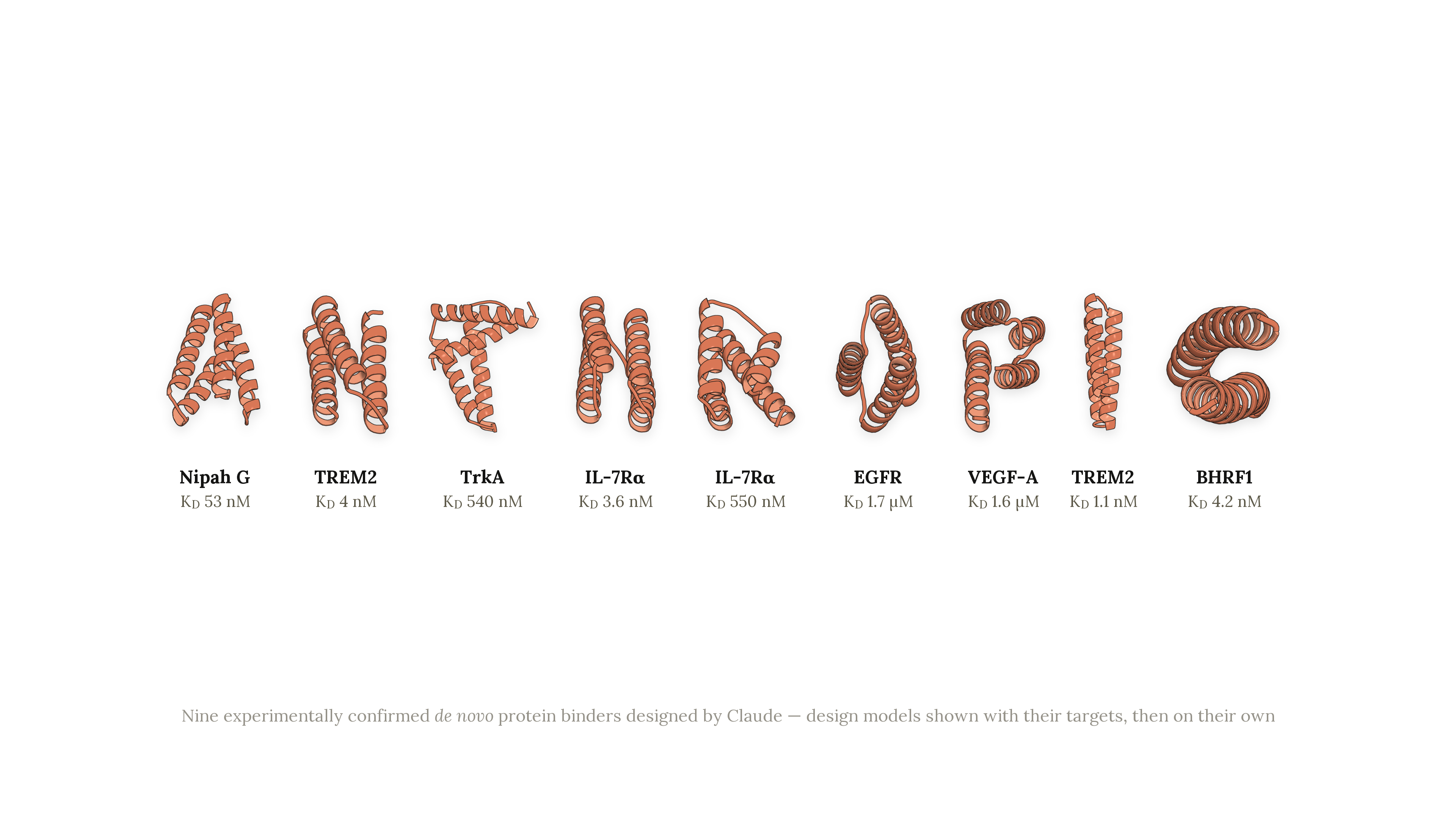
Two results show how Claude helps life sciences researchers speed up their work: designing protein binders from scratch and analyzing NMR and LC-MS data to speed chemical analysis.
Claude for Life Sciences
Discover how Claude accelerates life sciences research with new scientific connectors, skills, and improved performance for drug discovery and clinical work.
Claude for Science. Thursday, November 12, at the Niels Bohr Institute, University of Copenhagen. In September, Anthropic reported that Claude agents found a CRISPR-like enzyme system in… | Jacob Langvad Nilsson | 17 comments
Claude for Science. Thursday, November 12, at the Niels Bohr Institute, University of Copenhagen. In September, Anthropic reported that Claude agents found a CRISPR-like enzyme system in bacteriophage DNA. Earlier in the same month, another AI lab said its model had settled a question about the Navier-Stokes equations, one of the seven Millennium Prize Problems. Results like these don't come from a lucky afternoon with a chatbot. They come from years of method development, careful engineering and building on the work that came before. What has changed is how much of that work a model can now take on, and the speed of which it does it. The latest models read the literature, write and run their own code, and work through a dataset for hours without losing track. In the enzyme case, hundreds of Claude agents searched DNA data for 21 hours and flagged a pattern nobody had asked them to look for. The method still has to be sound. But a researcher with a good question can now test far more ideas in a week than before. That is what we want to show. How researchers here set up their work so that stronger models can move it forward. The evening is about how the Danish science community uses Claude to drive new research and breakthroughs. Four STEM researchers from academia and industry each show one case. What they asked Claude, how they worked, what they found, and what failed. The room is part of it. Niels Bohr lectured in Auditorium A, and in the 1930s Heisenberg and Pauli sat in the front row. We will meet in this historical auditorium and get a glimpse of frontier scientific research using Claude. ▪️ Doors open 15:30, programme 16:00 to 19:00 ▪️ Four case studies from Danish research ▪️ 50 seats on the original wooden benches ▪️ Registration by approval Thanks to Daniel Murnane for making this happen. Thanks to the Niels Bohr Institute and the University of Copenhagen for having us. To Katrin Hjorth Thordardottir for logistics. And thanks to Anthropic and the Claude Community team, Martine N., Cassie Baquero Mayes, Chiara Massironi for your continued support. Link to sign up in the first comment below. We are still confirming speakers. Which researcher in Denmark should I talk to? | 17 comments on LinkedIn

Claude discovers a novel enzyme system
In early results from our new life sciences research lab, Claude agents found an enzyme system whose function is still unknown.
Introducing Claude Design by Anthropic Labs
Claude Design lets you collaborate with Claude to create polished visual work like designs, prototypes, slides, and one-pagers.
Evaluating Claude with BioMysteryBench
BioMysteryBench tests Claude on 99 real bioinformatics problems. Opus 4.6 solved 77% of human-solvable questions and some that experts could not.

Biohub releases a world model of protein biology
Open AI models used for a wide range of scientific applications, including accelerating the design of therapeutic molecules.
Claude Science, an AI workbench for scientists
Claude Science integrates the tools researchers use most, produces auditable artifacts, and provides flexible access to computing resources.

Built with Claude: Life Sciences – Cerebral Valley
Tuesday, Jul 7, 2026 · Remote: Built with Claude: Life Sciences will bring together researchers, clinicians, and biotech builders for a week-long hackathon in…
Claude Science (beta)
Claude Science is your AI workbench for scientific research. Works through your research like a skilled scientist, running the analysis and tracing every step. Spend less time stitching pipelines together, and more time on the science.
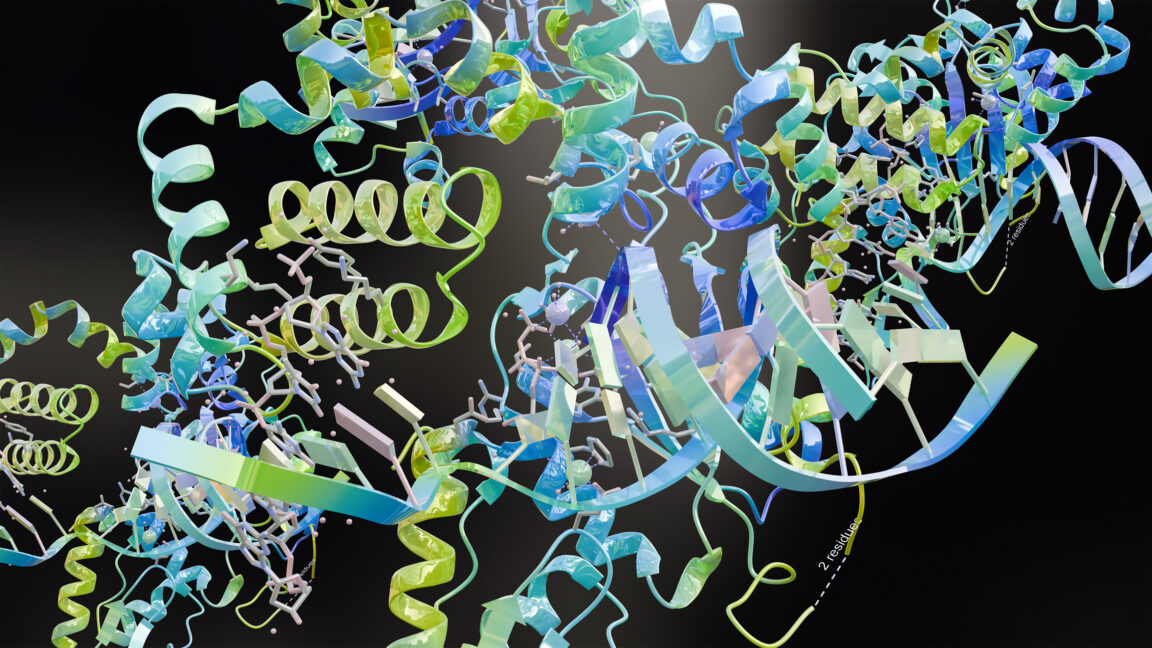
Google figures out how to watermark AI-designed proteins
Intended to help with biosecurity, it works with a popular AI protein design tool.
How Do Scientists Use Claude Code?
Measuring Claude Code adoption among 16,000 scientists on GitHub
brianell.in/atproto-claude-skill
A claude skill that has access to all of the atproto docs and reference implementations
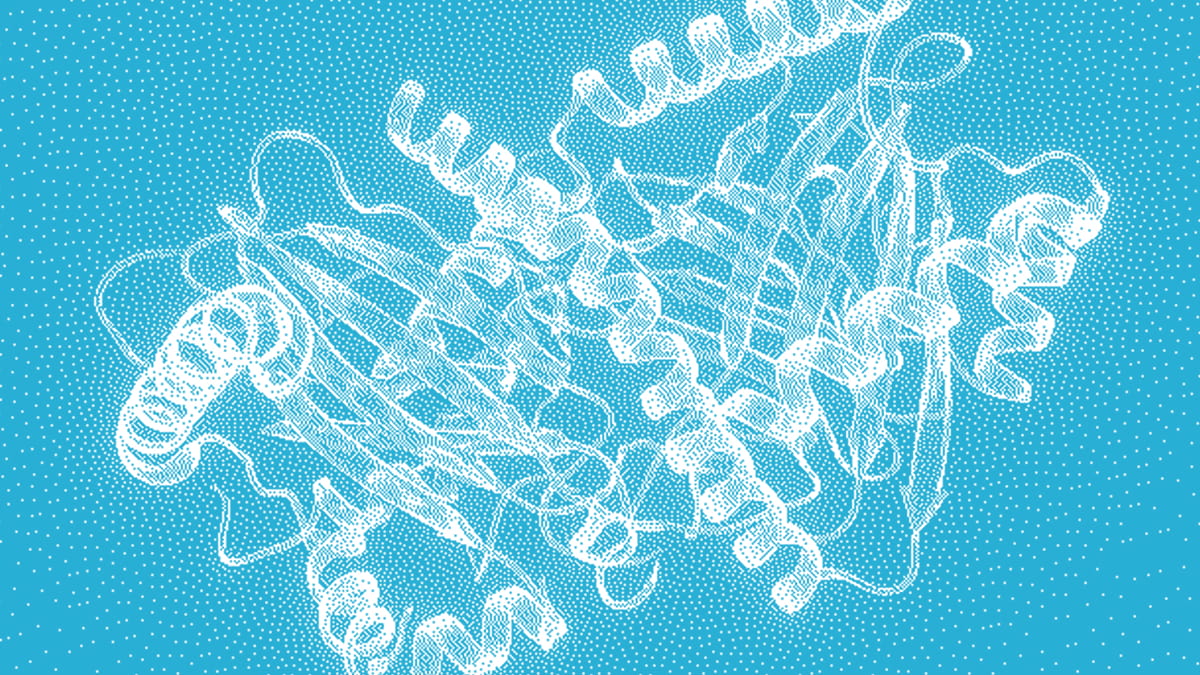
DISCO: Inventing Enzymes for Chemistry | FutureHouse
DISCO is a new multimodal generative model that co-designs protein sequence and 3D structure from scratch.
Claude on Twitter / X
Claude now connects to the tools creative professionals already use.With the new Blender connector, you can debug a scene, build new tools, or batch-apply changes across every object, directly from Claude. pic.twitter.com/Kc3cBHTNpV— Claude (@claudeai) April 28, 2026

AlphaFold2 @ CASP14: “It feels like one’s child has left home.”
The past week was a momentous occasion for protein structure prediction, structural biology at large, and in due time, may prove to be so for the whole of life sciences. CASP14, the conference for …

Introducing GPT-Rosalind for life sciences research
OpenAI introduces GPT-Rosalind, a frontier reasoning model built to accelerate drug discovery, genomics analysis, protein reasoning, and scientific research workflows.