

Matthew Schwartz describes what happened when he stopped fighting Claude and allowed Claude to find “Claude-shaped” problems. This led him to build BootLoops, a toolkit for exact calculations in quantitative science, which he has been applying across scientific fields alongside experts.
Claude Science (beta)
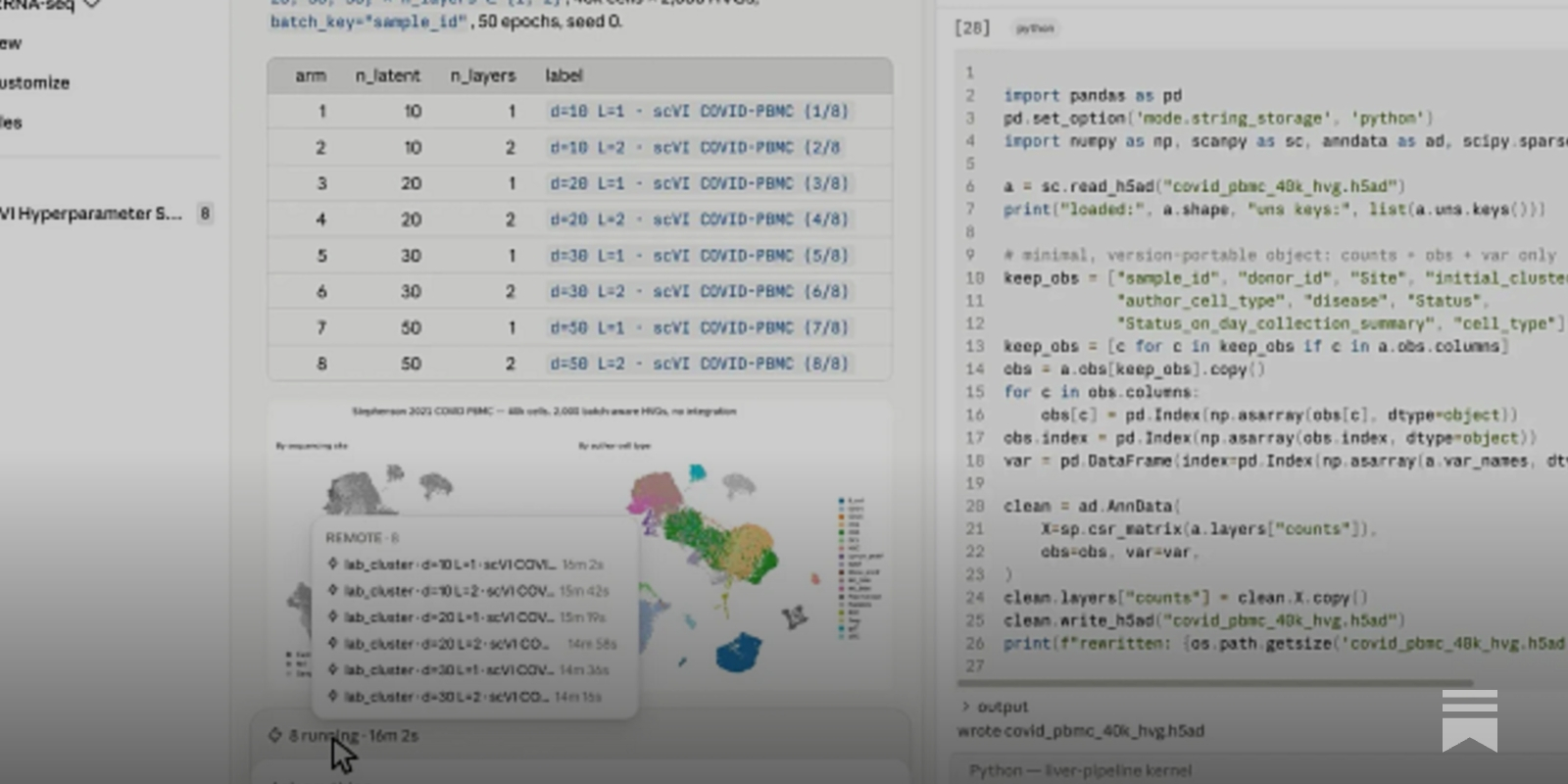
Claude Science is your AI workbench for scientific research. Works through your research like a skilled scientist, running the analysis and tracing every step. Spend less time stitching pipelines together, and more time on the science.
Claude for Life Sciences
Discover how Claude accelerates life sciences research with new scientific connectors, skills, and improved performance for drug discovery and clinical work.
Artificial Intelligence, Interactive Measurements, and Assemblage Theory
Fuck Heidegger.
What stories should we tell about scientific progress now?
In search of the mysterious fruits of basic science
Claude Science, an AI workbench for scientists
Claude Science integrates the tools researchers use most, produces auditable artifacts, and provides flexible access to computing resources.

Evaluating Claude with BioMysteryBench
BioMysteryBench tests Claude on 99 real bioinformatics problems. Opus 4.6 solved 77% of human-solvable questions and some that experts could not.

The Scientific Contribution Graph: Automated Literature-based Technological Roadmapping at Scale
Sir Isaac Newton famously wrote, “If I have seen further, it is by standing on the shoulders of giants”. Scientific contributions are rarely developed in isolation, but build upon prior contributions, such as problem framings, experimental methods, and empirical findings. Understanding these prerequisite relationships is important for studying scientific progress, and for automated scientific discovery systems that must reason about which existing capabilities can be used to develop new ones (e.g. Lu et al., 2024; Jansen et al., 2025b; Baek et al., 2025).
The load-bearing vocabulary of Claude
Test Driving Claude Science
Anthropic released Claude Science today. I tried it out for an AIxBio literature review and for an analysis using the IUCN Red List API with R.
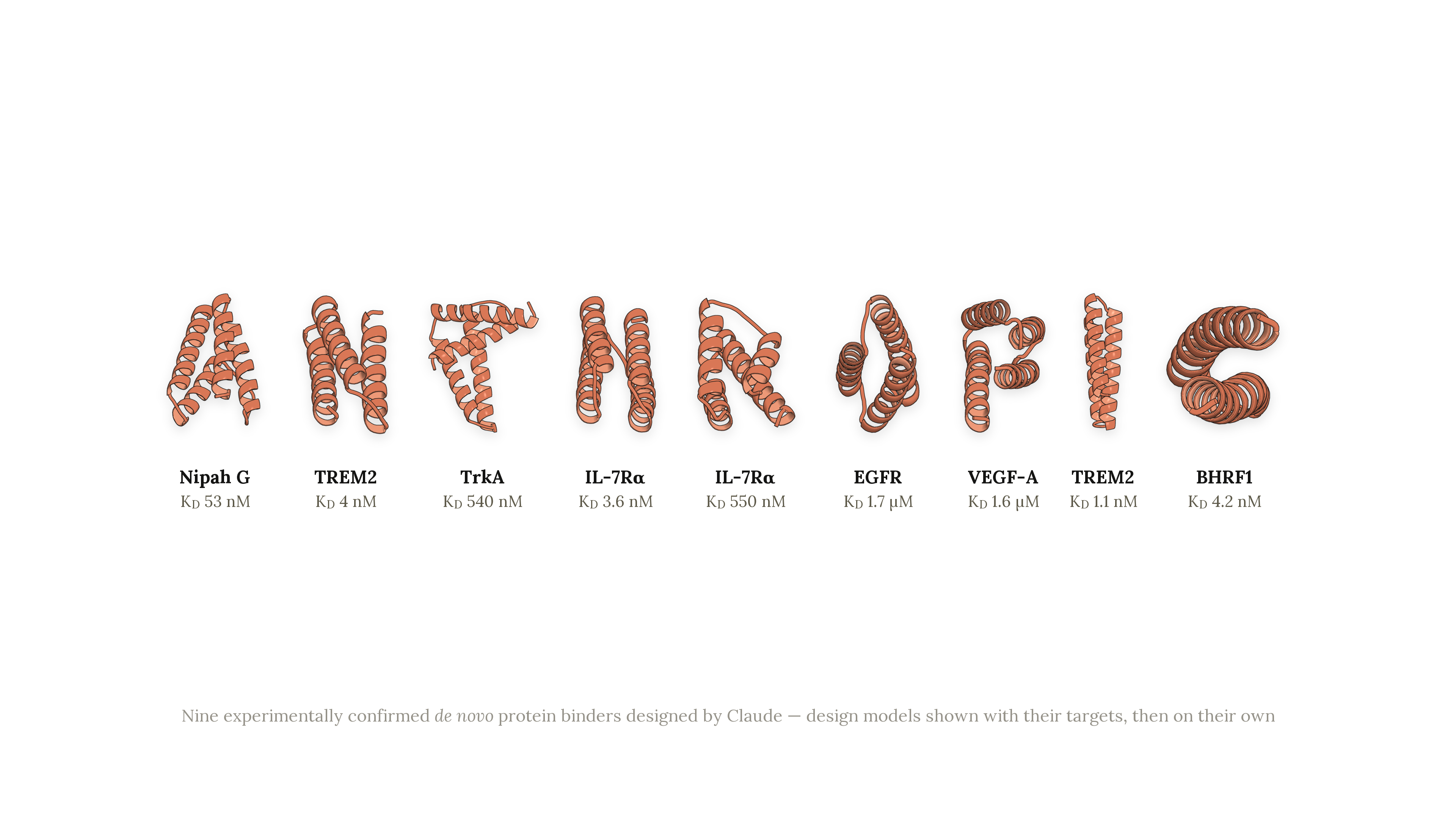
Claude accelerates protein design and analytical chemistry
Two results show how Claude helps life sciences researchers speed up their work: designing protein binders from scratch and analyzing NMR and LC-MS data to speed chemical analysis.
The lost art of mathematical modelling
We provide a critique of mathematical biology in light of rapid developments in modern machine learning. We argue that out of the three modelling activities – (1) formulating models; (2) analysing models; and (3) fitting or comparing models to data – inherent to mathematical biology, researchers currently focus too much on activity (2) at the cost of (1). This trend, we propose, can be reversed by realising that any given biological phenomenon can be modelled in an infinite number of different ways, through the adoption of a pluralistic approach, where we view a system from multiple, different points of view. We explain this pluralistic approach using fish locomotion as a case study and illustrate some of the pitfalls – universalism, creating models of models, etc. – that hinder mathematical biology. We then ask how we might rediscover a lost art: that of creative mathematical modelling.
How Do Scientists Use Claude Code?
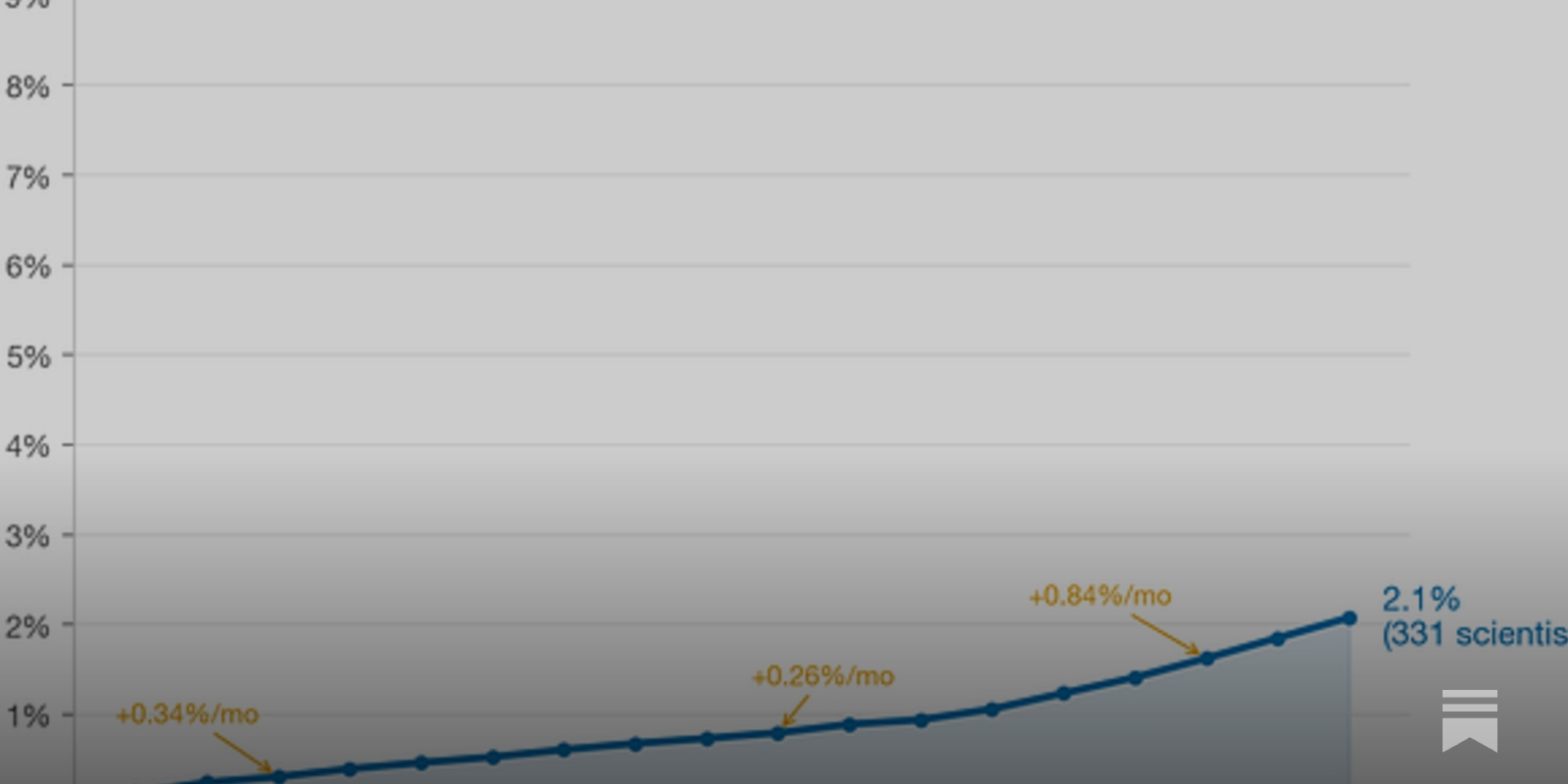
Measuring Claude Code adoption among 16,000 scientists on GitHub
Apple Foundation Models
Use Claude on Apple platforms through the Foundation Models framework with the Claude for Foundation Models Swift package.
Claude for Science. Thursday, November 12, at the Niels Bohr Institute, University of Copenhagen. In September, Anthropic reported that Claude agents found a CRISPR-like enzyme system in… | Jacob Langvad Nilsson | 17 comments
Claude for Science. Thursday, November 12, at the Niels Bohr Institute, University of Copenhagen. In September, Anthropic reported that Claude agents found a CRISPR-like enzyme system in bacteriophage DNA. Earlier in the same month, another AI lab said its model had settled a question about the Navier-Stokes equations, one of the seven Millennium Prize Problems. Results like these don't come from a lucky afternoon with a chatbot. They come from years of method development, careful engineering and building on the work that came before. What has changed is how much of that work a model can now take on, and the speed of which it does it. The latest models read the literature, write and run their own code, and work through a dataset for hours without losing track. In the enzyme case, hundreds of Claude agents searched DNA data for 21 hours and flagged a pattern nobody had asked them to look for. The method still has to be sound. But a researcher with a good question can now test far more ideas in a week than before. That is what we want to show. How researchers here set up their work so that stronger models can move it forward. The evening is about how the Danish science community uses Claude to drive new research and breakthroughs. Four STEM researchers from academia and industry each show one case. What they asked Claude, how they worked, what they found, and what failed. The room is part of it. Niels Bohr lectured in Auditorium A, and in the 1930s Heisenberg and Pauli sat in the front row. We will meet in this historical auditorium and get a glimpse of frontier scientific research using Claude. ▪️ Doors open 15:30, programme 16:00 to 19:00 ▪️ Four case studies from Danish research ▪️ 50 seats on the original wooden benches ▪️ Registration by approval Thanks to Daniel Murnane for making this happen. Thanks to the Niels Bohr Institute and the University of Copenhagen for having us. To Katrin Hjorth Thordardottir for logistics. And thanks to Anthropic and the Claude Community team, Martine N., Cassie Baquero Mayes, Chiara Massironi for your continued support. Link to sign up in the first comment below. We are still confirming speakers. Which researcher in Denmark should I talk to? | 17 comments on LinkedIn

Built with Claude: Life Sciences – Cerebral Valley
Tuesday, Jul 7, 2026 · Remote: Built with Claude: Life Sciences will bring together researchers, clinicians, and biotech builders for a week-long hackathon in…
The Mathocalypse
Last night my 9-year-old son was taunting my wife, complexity theorist Dana Moshkovitz, as follows: “mommy, I heard you got cooked! I heard that a robot solved the math problem you worked on …
