

Research from Anthropic on the ability of large language models to introspect
Understanding Understanding: A Pragmatic Framework Motivated by...
Motivated by the rapid ascent of Large Language Models (LLMs) and debates about the extent to which they possess human-level qualities, we propose a framework for testing whether any agent (be it...

Models overview
Claude is a family of state-of-the-art large language models developed by Anthropic. This guide introduces the available models and compares their performance.
Do language models accommodate their users? A study of linguistic convergence
While large language models (LLMs) are generally considered proficient in generating language, how similar their language usage is to that of humans remains understudied. In this paper, we test whether models exhibit linguistic convergence, a core pragmatic element of human language communication: do models adapt, or converge, to the linguistic patterns of their user? To answer this, we systematically compare model completions of existing dialogues to original human responses across sixteen language models, three dialogue corpora, and various stylometric features. We find that models strongly converge to the conversation's style, often significantly overfitting relative to the human baseline. While convergence patterns are often feature-specific, we observe consistent shifts in convergence across modeling settings, with instruction-tuned and larger models converging less than their pretrained and smaller counterparts. Given the differences in human and model convergence patterns, we hypothesize that the underlying mechanisms driving these behaviors are very different.
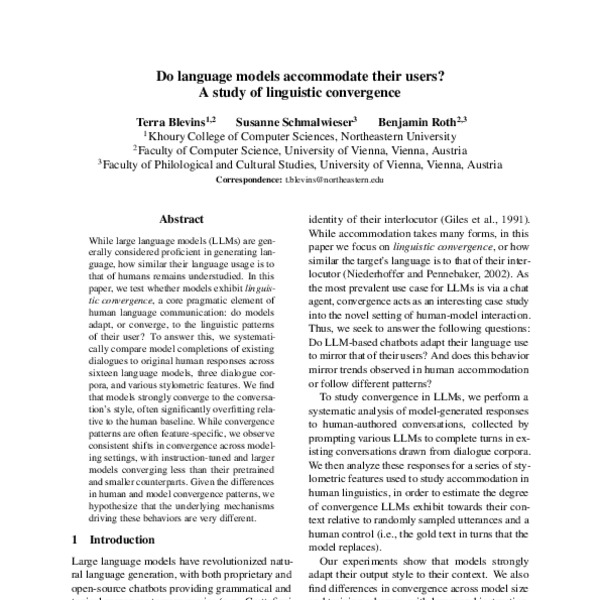
Do language models accommodate their users? A study of linguistic convergence
While large language models (LLMs) are generally considered proficient in generating language, how similar their language usage is to that of humans remains understudied. In this paper, we test whether models exhibit linguistic convergence, a core pragmatic element of human language communication: do models adapt, or converge, to the linguistic patterns of their user? To answer this, we systematically compare model completions of existing dialogues to original human responses across sixteen language models, three dialogue corpora, and various stylometric features. We find that models strongly converge to the conversation's style, often significantly overfitting relative to the human baseline. While convergence patterns are often feature-specific, we observe consistent shifts in convergence across modeling settings, with instruction-tuned and larger models converging less than their pretrained and smaller counterparts. Given the differences in human and model convergence patterns, we hypothesize that the underlying mechanisms driving these behaviors are very different.
Are AI Models on the Autism Spectrum? Exploring the Parallels
Large language models are celebrated for their ability to process information quickly and generate human-like responses. However, they…

Tracing the thoughts of a large language model
Anthropic's latest interpretability research: a new microscope to understand Claude's internal mechanisms
PoliSim@CHI 2026
Large Language Models are rapidly evolving from text generators into reasoning systems that can act as autonomous agents. When placed in social contexts, these agents display emergent behaviors such as forming coalitions, spreading information, and making collective decisions.
Large language models are cultural technologies. What might that mean?
Four different perspectives

The homogenizing effect of large language models on human expression and thought
AbstractCognitive diversity, reflected in variations of language, perspective, and reasoning, is essential to creativity and collective intelligence. This diversity is rich and grounded in culture, history, and individual experience. Yet, as large language models (LLMs) become deeply embedded in people's lives, they risk standardizing language and reasoning. We synthesize evidence across linguistics, psychology, cognitive science, and computer science to show how LLMs reflect and reinforce dominant styles while marginalizing alternative voices and reasoning strategies. We examine how their design and widespread use contribute to this effect by mirroring patterns in their training data and amplifying convergence as all people increasingly rely on the same models across contexts. Unchecked, this homogenization risks flattening the cognitive landscapes that drive collective intelligence and adaptability.

LLMs and World Models, Part 1
How do Large Language Models Make Sense of Their “Worlds”?

How Large Language Models Actually Work
The evolution of syntactic communication
Animal communication is typically non-syntactic, which means that signals refer to whole situations1,2,3,4,5,6,7. Human language is syntactic, and signals consist of discrete components that have their own meaning8. Syntax is a prerequisite for taking advantage of combinatorics, that is, “making infinite use of finite means”9,10,11. The vast expressive power of human language would be impossible without syntax, and the transition from non-syntactic to syntactic communication was an essential step in the evolution of human language12,13,14,15,16. We aim to understand the evolutionary dynamics of this transition and to analyse how natural selection can guide it. Here we present a model for the population dynamics of language evolution, define the basic reproductive ratio of words and calculate the maximum size of a lexicon. Syntax allows larger repertoires and the possibility to formulate messages that have not been learned beforehand. Nevertheless, according to our model natural selection can only favour the emergence of syntax if the number of required signals exceeds a threshold value. This result might explain why only humans evolved syntactic communication and hence complex language.

The homogenizing effect of large language models on human expression and thought
Cognitive diversity, reflected in variations of language, perspective, and reasoning, is essential to creativity and collective intelligence. This diversity is rich and grounded in culture, history, and individual experience. Yet, as large language models (LLMs) become deeply embedded in people’s lives, they risk standardizing language and reasoning. We synthesize evidence across linguistics, psychology, cognitive science, and computer science to show how LLMs reflect and reinforce dominant styles while marginalizing alternative voices and reasoning strategies. We examine how their design and widespread use contribute to this effect by mirroring patterns in their training data and amplifying convergence as all people increasingly rely on the same models across contexts. Unchecked, this homogenization risks flattening the cognitive landscapes that drive collective intelligence and adaptability.
The homogenizing effect of large language models on human expression and thought
Cognitive diversity, reflected in variations of language, perspective, and reasoning, is essential to creativity and collective intelligence. This diversity is rich and grounded in culture, history, and individual experience. Yet, as large language models (LLMs) become deeply embedded in people’s lives, they risk standardizing language and reasoning. We synthesize evidence across linguistics, psychology, cognitive science, and computer science to show how LLMs reflect and reinforce dominant styles while marginalizing alternative voices and reasoning strategies. We examine how their design and widespread use contribute to this effect by mirroring patterns in their training data and amplifying convergence as all people increasingly rely on the same models across contexts. Unchecked, this homogenization risks flattening the cognitive landscapes that drive collective intelligence and adaptability.
AI learns language from skewed sources. That could change how we humans speak – and think | Bruce Schneier
Large language models aren’t trained on real-life conversations. As we encounter their language, it could affect our own

Epistemological Fault Lines Between Human and Artificial Intelligence
Large language models (LLMs) are widely described as artificial intelligence, yet their epistemic profile diverges sharply from human cognition. Here we show that the apparent alignment between...