

We introduce "observed exposure," combining LLM capability with real Claude usage data, and share early evidence on employment effects.
Mind the Gap: AI Adoption in Europe and the U.S.
This paper combines international evidence from worker and firm surveys conducted in 2025 and 2026 to document large gaps in AI adoption, both between the US and Europe and across European countries. Cross-country differences in worker demographics and firm composition account for an important share of these gaps. AI adoption, within and across countries, is also closely linked to firm personnel management practices and whether firms actively encourage AI use by workers. Micro-level evidence suggests that AI generates meaningful time savings for many workers. At the macro level, in recent years industries with higher AI adoption rates have experienced faster productivity growth. While we do not establish causality, this relationship is statistically significant and similar in magnitude in Europe and the US. We do not find clear evidence that industry-level AI adoption is associated with employment changes. We discuss limitations of existing data and outline priorities for future data collection to better assess the productivity and labor market effects of AI.

Technological Disruption in the US Labor Market • The Aspen Institute Economic Strategy Group
DAVID DEMING, CHRISTOPHER ONG, LAWRENCE H. SUMMERS This paper explores past episodes of technological disruption in the US labor market, with the goal of learning lessons about the likely future impact of artificial intelligence (AI). The authors measure changes in the structure of the US labor market going back over a century in two ways. ...

The Anthropic Economic Index
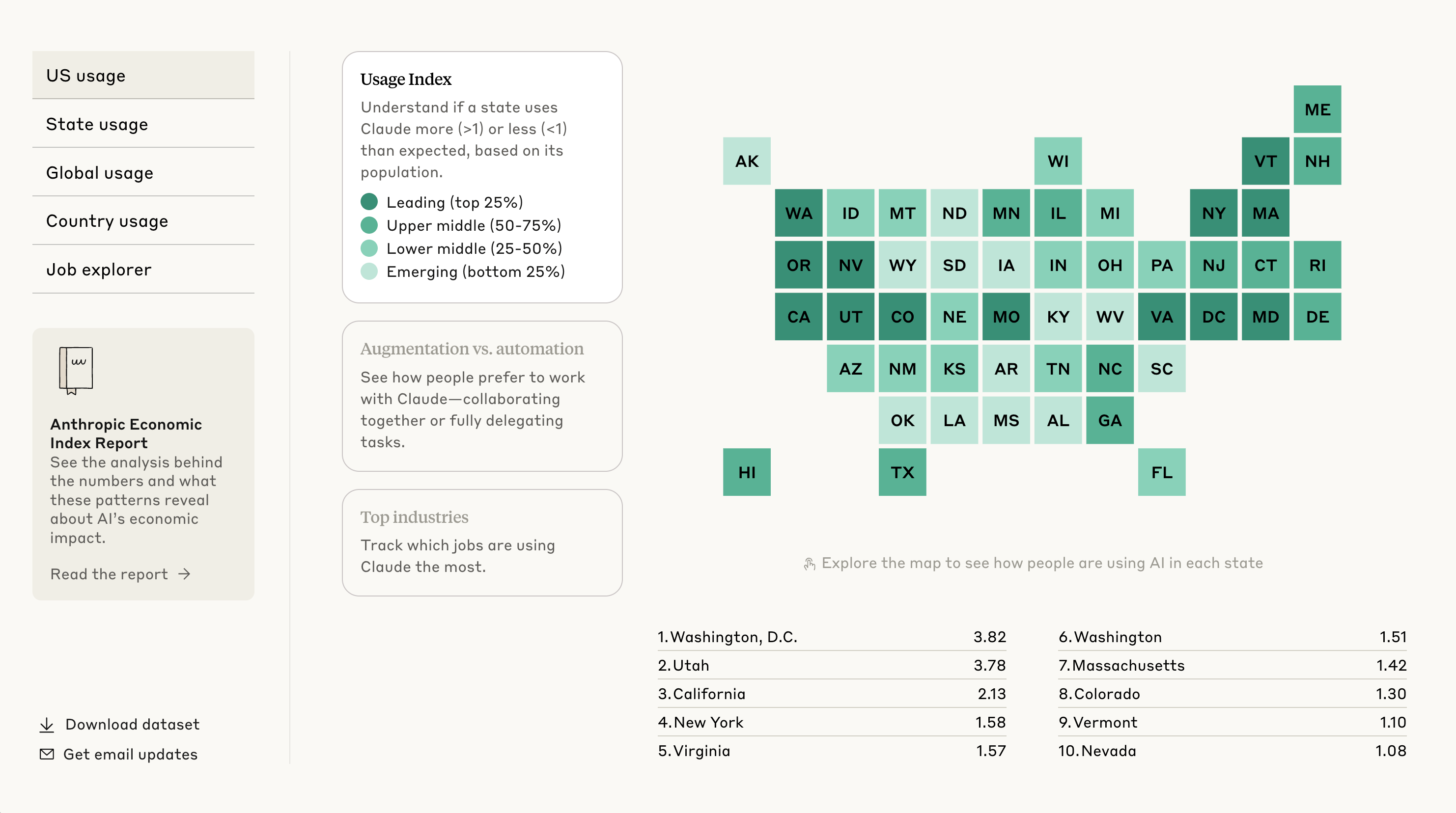
The Anthropic Economic Index reveals the shape of AI adoption across the world. Here, you can explore the data behind our research to understand how people are using Claude across every US state and hundreds of occupations. Track the topics that are trending where you live, and see how people are using AI to augment or automate their work—that is, whether they prefer to collaborate with, or delegate to, Claude.
Nathan Witkin on Twitter / X
Does anyone disagree that pretty much every piece of empirical evidence we have about actually existing AI points toward a labor-augmenting technology with a more-or-less ordinary risk profile (no worse than cars, guns, nuclear power, social media, etc.)?On the labor front, the…— Nathan Witkin (@NateWitkin) October 5, 2026
Still Waters, Rapid Currents: Early Labor Market Transformation under Generative AI
We study the early labor market impacts of AI chatbots by linking large-scale adoption surveys to administrative labor market records in Denmark. We document rapid currents: most employers in exposed occupations have adopted chatbot initiatives, workers report productivity benefits, and new AI-related tasks are widespread. Yet these currents have not broken the surface: using difference-indifferences, we estimate precise null effects on earnings and recorded hours at both the worker and workplace levels, ruling out effects larger than 2% two years after the launch of ChatGPT. What moves is the structure of work: employers absorb AI through task reorganization—including new tasks in content generation, AI oversight, and AI integration—and adopters transition into higher-paying occupations where AI chatbots are more relevant, though still too few to move average earnings. Technological change reshapes work well before it surfaces in earnings or hours.
Which Economic Tasks are Performed with AI? Evidence from Millions of Claude Conversations
Despite widespread speculation about artificial intelligence's impact on the future of work, we lack systematic empirical evidence about how these systems are actually being used for different tasks. Here, we present a novel framework for measuring AI usage patterns across the economy. We leverage a recent privacy-preserving system to analyze over four million Claude.ai conversations through the lens of tasks and occupations in the U.S. Department of Labor's O*NET Database. Our analysis reveals that AI usage primarily concentrates in software development and writing tasks, which together account for nearly half of all total usage. However, usage of AI extends more broadly across the economy, with approximately 36% of occupations using AI for at least a quarter of their associated tasks. We also analyze how AI is being used for tasks, finding 57% of usage suggests augmentation of human capabilities (e.g., learning or iterating on an output) while 43% suggests automation (e.g., fulfilling a request with minimal human involvement). While our data and methods face important limitations and only paint a picture of AI usage on a single platform, they provide an automated, granular approach for tracking AI's evolving role in the economy and identifying leading indicators of future impact as these technologies continue to advance.

Differences in AI adoption in Europe and the US: Explanations and implications for productivity growth
The economic impact of generative AI will depend on the speed and breadth of adoption by workers and firms. Drawing on a survey of workers in the US and six European countries and a firm survey covering 32 European countries, this column explores the speed of AI adoption across countries and whether an ‘AI gap’ will exacerbate existing productivity differences between the US and Europe. There are large differences in AI adoption across countries, much of which are accounted for by management practices. Higher AI adoption rates are associated with faster productivity growth but not with changes in employment.

AI Adoption and Inequality
There are competing narratives about artificial intelligence’s impact on inequality. Some argue AI will exacerbate economic disparities, while others suggest it could reduce inequality by primarily disrupting high-income jobs. Using household microdata and a calibrated task-based model, we show these narratives reflect different channels through which AI affects the economy. Unlike previous waves of automation that increased both wage and wealth inequality, AI could reduce wage inequality through the displacement of high-income workers. However, two factors may counter this effect: these workers’ tasks appear highly complementary with AI, potentially increasing their productivity, and they are better positioned to benefit from higher capital returns. When firms can choose how much AI to adopt, the wealth inequality effect is particularly pronounced, as the potential cost savings from automating high-wage tasks drive significantly higher adoption rates. Models that ignore this adoption decision risk understating the trade-off policymakers face between inequality and efficiency.
‘Deskilling’: a dangerous side effect of AI use
Workers are increasingly reliant on the new technology
Do AI-enabled companies need fewer people? | Seldo.com
AI-native startups are doing more with less — 40% smaller teams, 6x higher revenue per employee — and the data confirms it's not just hype. But the wave of new jobs I predicted hasn't materialized so far. Compute is replacing labor. Will that change?
The ‘productivity paradox’ of AI adoption in manufacturing firms | MIT Sloan
Companies that adopt industrial artificial intelligence see productivity losses before longer-term gains, according to new research.

What AI coding costs you | Tom Wojcik
What's the effect of the prolonged AI usage among coders and is it tracked correctly, if it all?
AI can cost more than human workers now
When AI labs raise prices, big spending on AI could shift from a flex to a liability.

Thousands of CEOs admit AI had no impact on employment or productivity—and it has economists resurrecting a paradox from 40 years ago | Fortune
In the 1980s, economist Robert Solow made an observation that reminded economists of today’s AI boom: “You can see the computer age everywhere but in the productivity statistics.”

Thousands of CEOs just admitted AI had no impact on employment or productivity—and it has economists resurrecting a paradox from 40 years ago | Fortune
In the 1980s, economist Robert Solow made an observation that reminded economists of today’s AI boom: “You can see the computer age everywhere but in the productivity statistics.”
The HALO Effect - kwokchain
Notes on the recent trend of “Hire and License Out” deals in AI Over the last year, a new breed of deal structure has emerged in AI: an alternative to acquisitions and hiring that shares traits of both yet isn’t quite either. Companies like Inflection, Character AI, Adept, Covariant and most recently Windsurf have used … Continue reading The HALO Effect →
