Sharing progress on a powerful type of cryptographic proof known as a zkSNARK, which is uniquely fit for provable inference.
Mathematics with large language models as provers and verifiers
During 2024 and 2025 the discussion about the theorem-proving capabilities of large language models started reporting interesting success stories, mostly to do with difficult exercises (such as problems from the International Mathematical Olympiad), but also with conjectures [Feldman & Karbasi, arXiv:2509.18383v1] formulated for the purpose of verifying whether the artificial intelligence could prove it. In this paper we report a theorem proving feat achieved by ChatGPT by using a protocol involving different prover and verifier instances of the gpt-5 model working collaboratively. To make sure that the produced proofs do not suffer from hallucinations, the final proof is formally verified by the lean proof assistant, and the conformance of premises and conclusion of the lean code is verified by a human. Our methodology is by no means complete or exact. It was nonetheless able to solve five out of six 2025 IMO problems, and close about a third of the sixty-six number theory conjectures in [Cohen, Journal of Integer Sequences, 2025].
ZKPROV: A Zero-Knowledge Approach to Dataset Provenance for Large Language Models
As large language models (LLMs) are used in sensitive fields, accurately verifying their computational provenance without disclosing their training datasets poses a significant challenge, particularly in regulated sectors such as healthcare, which have strict requirements for dataset use. Traditional approaches either incur substantial computational cost to fully verify the entire training process or leak unauthorized information to the verifier. Therefore, we introduce ZKPROV, a novel cryptographic framework allowing users to verify that the LLM's responses to their prompts are trained on datasets certified by the authorities that own them. Additionally, it ensures that the dataset's content is relevant to the users' queries without revealing sensitive information about the datasets or the model parameters. ZKPROV offers a unique balance between privacy and efficiency by binding training datasets, model parameters, and responses, while also attaching zero-knowledge proofs to the responses generated by the LLM to validate these claims. Our experimental results demonstrate sublinear scaling for generating and verifying these proofs, with end-to-end overhead under 3.3 seconds for models up to 8B parameters, presenting a practical solution for real-world applications. We also provide formal security guarantees, proving that our approach preserves dataset confidentiality while ensuring trustworthy dataset provenance.
Hypothesis generation and updating in large language models
Large language models (LLMs) increasingly help people solve problems, from debugging code to repairing machinery. This process requires generating plausible hypotheses from partial descriptions,...
Advancing Mathematics Research with AI-Driven Formal Proof Search
Large language models (LLMs) increasingly excel at mathematical reasoning, but their unreliability limits their utility in mathematics research. A mitigation is using LLMs to generate formal proofs in languages like Lean. We perform the first large-scale evaluation of this method's ability to solve open problems. Our most capable agent autonomously resolved 9 of 353 open Erdős problems at the per-problem cost of a few hundred dollars, proved 44/492 OEIS conjectures, and is being deployed in combinatorics, optimization, graph theory, algebraic geometry, and quantum optics research. A basic agent alternating LLM-based generation with Lean-based verification replicated the Erdős successes but proved costlier on the hardest problems. These findings demonstrate the power of AI-aided formal proof search and shed light on the agent designs that enable it.
An Observation on Generalization
ANNEX B - Zero Knowledge Proofs for the Age Verification Solution - European Age Verification Solution
Zero-knowledge proofs (ZKPs) are cryptographic techniques that enable one party (the User) to prove to another party (the Relying Party) that a statement is true without disclosing any additional information beyond the statement’s validity. This allows the User to demonstrate knowledge without revealing the knowledge itself.
The LLM Reasoning Debate Heats Up
Three recent papers examine the robustness of reasoning and problem-solving in large language models

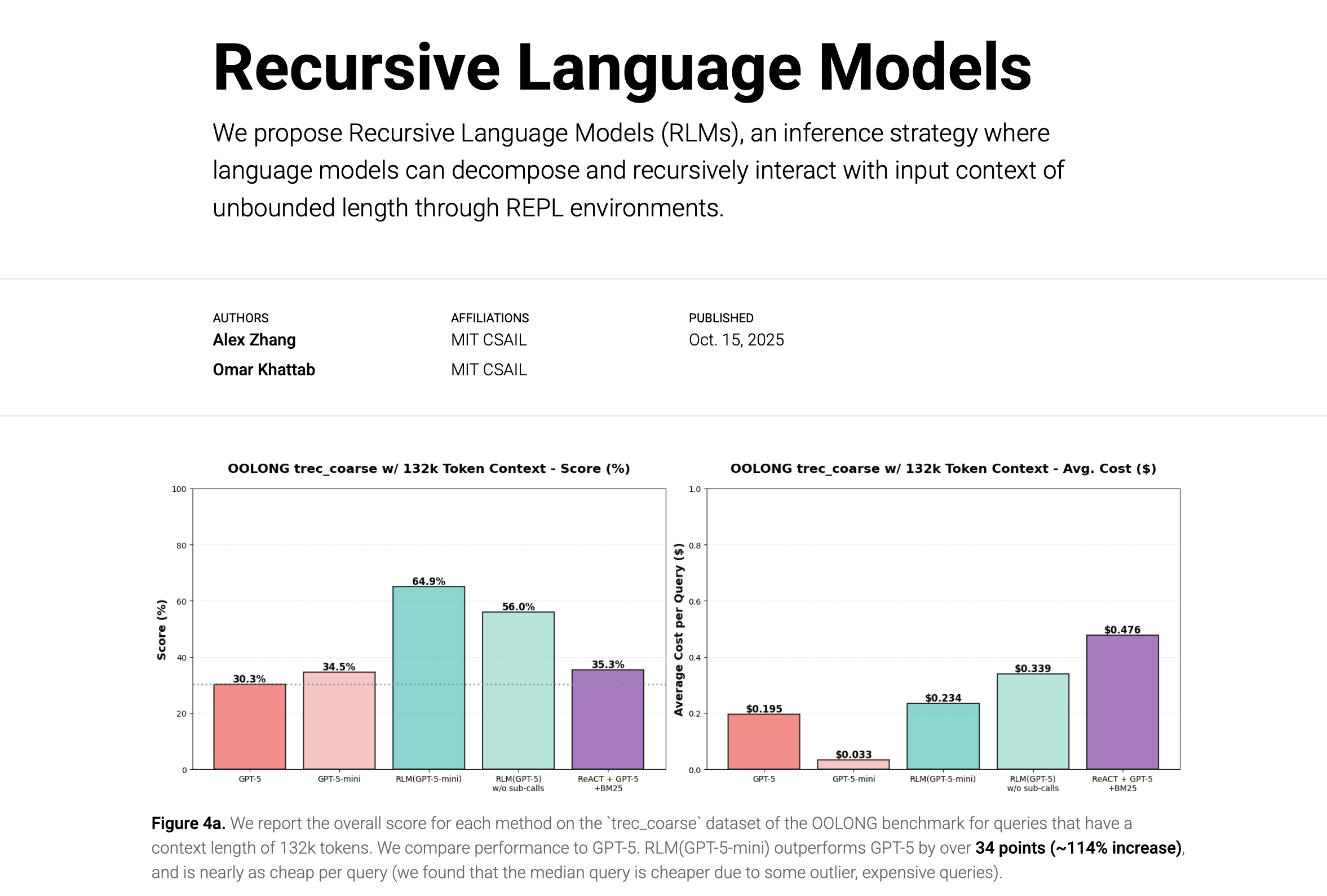
Recursive Language Models
We propose Recursive Language Models (RLMs), an inference strategy where language models can decompose and recursively interact with input context of unbounded length through REPL environments.
Automated Verification of Proofs in the Universal Composability Framework with Markov Decision Processes
Designing cryptographic protocols and proving these rigorously secure is an arduous and challenging task. Among the methods commonly used to prove security of cryptographic protocols, formalizing it in Canneti's Universal Composability (UC) Framework offers several benefits: (1) Modular design, (2) demonstrating that security remains under arbitrary composition and concurrent execution, (3) the security against any computationally polynomially bound adversary. However, working within the UC Framework can be cumbersome, requires a long time commitment by the prover, and it is prone to errors. While utilization of proof assistants in Cryptography and IT Security is a prominent research area, proof assistants for UC are still in their infancy. Here we show our ongoing work to utilize model checking for verification of proofs in the UC Framework, which to the best of our knowledge is the first attempt to do so. In this work we (1) formally create a Markov Decision Process (MDP) encoding a given proof in the UC Framework, (2) define and proof notions of soundness and completeness for the constructed MDP, (3) implement a proof of concept and (4) demonstrate practical feasibility through experimental evaluation. In summary, in this work we lay out the formal foundations for model checking UC proofs and create a tool that can not only be used for proof verification but also as an assistant for developing proofs in the UC Framework.

Muse Glimmer: Meta’s 30B Model Built for Efficient Inference
Inside Meta’s 30B local reasoning model and its tiny KV cache

Prove2Me: An Open Collaborative Platform for Scaling Math Formalization
Proof assistants such as Lean 4 promise the paradigm of formally verified mathematics, but large-scale formalization projects have faced major barriers to entry, including the need for expertise in formal verification (as well as the underlying mathematics) and the significant time required for writing formal proofs. AI coding agents have dramatically reduced these barriers; human users can now use natural language to prompt agents to write complex proofs in Lean. This opens up the intriguing possibility of internet-scale mathematical collaboration involving both humans and AI agents, where correctness is machine-checked. To realize this possibility, we introduce Prove2Me (https://prove2.me), an open collaborative platform for formalizing mathematics. Users launch formalization "missions", to which AI agents contribute formal proofs toward completion. We designed mechanisms and a specialized harness in Prove2Me that enable large-scale collaboration so that agents can build on one another's work and freely reuse existing results. In doing so, Prove2Me aims to turn math formalization into a scalable, crowd-sourced effort open to anyone with an agent.
LLM in a Flash: Efficient Large Language Model Inference with Limited Memory
Large language models (LLMs) are central to modern natural language processing, delivering exceptional performance in various tasks…