


We show you how to use Arcee's MergeKit to extract LoRA adapters from fine-tuned models, then leverage the Hugging Face Hub to create a library of general and task-specific LoRA adapters.
Arcee AI | Arcee AI and mergekit unite
Several months ago, I stumbled upon an innovative technique in the world of language model training known as Model Merging. This SOTA approach involves the fusion of two or more LLMs into a singular, cohesive model, presenting a novel and experimental method for creating sophisticated models at a fraction of
Sakana AI on Twitter / X
We’re excited to introduce Doc-to-LoRA and Text-to-LoRA, two related research exploring how to make LLM customization faster and more accessible.https://t.co/wGKDNhBcJXBy training a Hypernetwork to generate LoRA adapters on the fly, these methods allow models to instantly… pic.twitter.com/gId3J6hgEr— Sakana AI (@SakanaAILabs) February 27, 2026
Arcee AI | March is Merge Madness
To celebrate Arcee’s recent merger with mergekit, we’re bringing you a month of resources and knowledge on model merging.
.webp)
Sakana AI on Twitter / X
We’re excited to introduce Text-to-LoRA: a Hypernetwork that generates task-specific LLM adapters (LoRAs) based on a text description of the task. Catch our presentation at #ICML2025!Paper: https://t.co/2FRiVF1UXJCode: https://t.co/rx4G7dq1SWBiological systems are capable of… pic.twitter.com/UdUYfqRXBS— Sakana AI (@SakanaAILabs) June 12, 2025
Osaurus — All your AI. One app.
Chat with GPT-5, Claude, Llama, and more — or download local MLX models from Hugging Face. Supercharge Cursor with powerful tools. Open source and built for Mac.
Arcee AI | Announcing the Arcee Model Engine Public Beta
Get direct access to the small language models (SLMs) that power Arcee Orchestra, our new end-to-end, SLM-powered agentic AI platform. Sign up for the public beta of the Arcee Model Engine today.
.webp)
Ellora: Enhancing LLMs with LoRA - Standardized Recipes for Capability Enhancement
A Blog post by Asankhaya Sharma on Hugging Face

swyx on Twitter / X
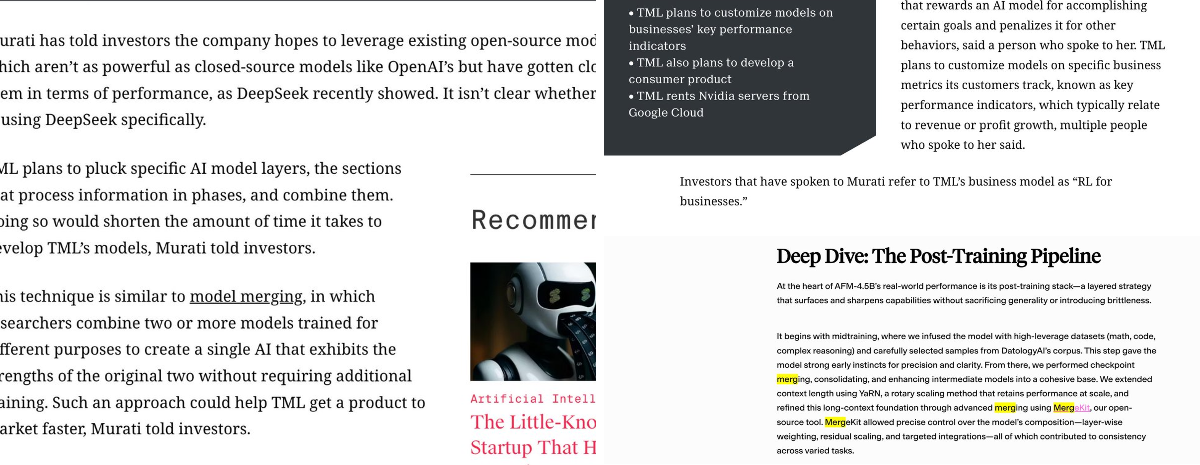
whoa so @thinkymachines is doing model merging + customized RLquite a come-up for merging in the past couple weeks, with @arcee_ai mergekit also featuring heavily in AFM. credit due to @jeremyphoward for being the first to make me take modelmerging seriously pic.twitter.com/DtXjX8li4t— swyx (@swyx) June 24, 2025
Seeed-Solution/MeshClaw
Bring AI to the Mesh — OpenClaw plugin for Meshtastic LoRa · No Internet Required
**An Edge-First Generalized LLM LoRA Fine-Tuning Framework for Heterogeneous GPUs**
A Blog post by QVAC on Hugging Face


12britz/awesome-free-models
A curated list of free AI models, APIs, and tools you can use without paying a cent.
ikaijua/Awesome-AITools
Collection of AI-related utilities. Welcome to submit pull requests /收藏AI相关的实用工具,欢迎提交pull requests
Maintain the unmaintainable - a Hugging Face Space by transformers-community
This application visualizes how over 400 machine learning models in the Transformers library are connected and related to each other. Users can see which models are derived from or import features ...
We are excited to introduce Doc-to-LoRA and Text-to-LoRA, two related papers exploring how to make LLM customization faster. By training a hypernetwork to generate LoRA adapters on the fly, models instantly internalize new info. Blog: pub.sakana.ai/doc-to-lora/ Doc-to-LoRA: arxiv.org/abs/2602.15902
