

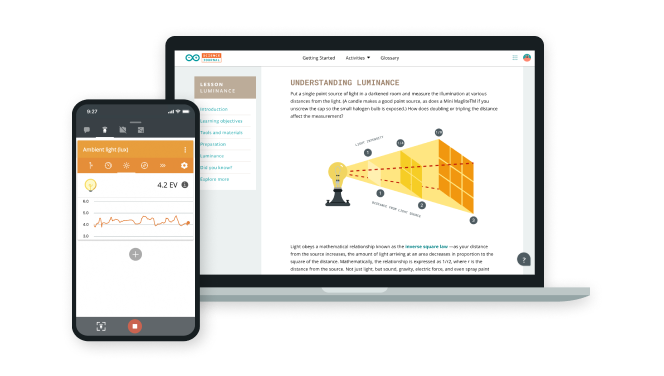
Transform your mobile device into a science tool! Use sensors to record data, document your observations, and experiment like a real scientist.
Gemini for Science: AI experiments and tools for a new era of discovery
Gemini for Science is a new collection of science tools and experiments to expand the scale and precision of scientific exploration.

Science Works on Twitter / X
London AI × Science Hackathon 👾Science Works × @inherent_labs • Oct 16-18Lots of scientific software is outdated, hard to use, and isn't interoperable – let alone making use of (or ready to interface with) AI.Or it's expensive. Join us to build better for the community pic.twitter.com/42Qq528DDw— Science Works (@sci_works) September 30, 2026
PRISM: Capturing the Invisible Art of Scientific Practice
A New Tool for Recording and Scaling Laboratory Expertise

How and When to Involve Crowds in Scientific Research | James Evans
The lone academic in a basement lab is an endangered species. Years ago I asked Paul Ginsparg, who founded arXiv, what features his machine-learning filter used to flag speculative submissions. The top three: single-authored, submitted on a weekend, and heavy citation of Newton and Einstein. Science is a contact sport now. Marion Poetz and Henry Sauermann's How and When to Involve Crowds in Scientific Research (https://lnkd.in/g5pwVbfD) is the field manual. What crowds can do: Volume. Zooniverse mobilizes 2.7 million people to classify galaxies and court records. Galaxy Zoo's co-founder hand-classified 50,000 galaxies in one week before concluding that isolation would break him. Reach. NASA spent years failing to predict solar flares, then broadcast the problem. The winner was a semi-retired radio engineer in rural New Hampshire who swapped satellite data for radio data. Experience. Patients and caregivers asked to generate research questions produced 826 that scientists had missed, including the link between aging and wound healing. Bench-to-bedside runs backward. One caution the book underplays: an open call is not an inclusive one. Participation costs in time, money, and access screen people out. Self-selection can narrow the very diversity that makes crowds thrive. As AI floods the labor supply of routine, homogeneous cognition, human crowds become more valuable, not less. Machines process. People notice what nobody thought to ask. Check out my review @ https://lnkd.in/gkzvWrRC and the book @ https://lnkd.in/g5pwVbfD!

Push-button science
Technological advances change not only what we can learn as scientists, but also how science is conducted. Here we explore how automation and outsourcing are affecting the act of doing science.
LabFolio
The most complete and granular data collection of scientist activities and the platform to share and collaborate with other scientists.
The new way we’ll do science
Papers should become human-readable views over a graph of data, tools, results, and certificates.
The Modern Electronic Lab Notebook (ELN) - LabArchives
Easily organize, search and share your scientific data in a powerful electronic laboratory notebook (ELN) trusted by the world’s leading research organizations.
The Engine of Scientific Discovery: How New Methods and Tools Spark Major Breakthroughs
Abstract. How do we spark new scientific discoveries? Why do some breakthroughs seem even accidental? And most importantly, how can we accelerate them and
A low-carbon computing platform from your retired phones
Jennifer Switzer, Visiting Postdoctoral Researcher, and David Patterson, Fellow, Google

AI for science: What can it do? Can it do things? Let’s find out!
A what we’re reading spotlight
Mobile Data Collection and Collaboration App
Collect accurate, real-time data. Evident mobile helps you to be faster, more efficient and more productive.
Edison Scientific | The AI Platform for Scientific Discovery
Edison is an AI scientist that autonomously reads, reasons, and experiments across disciplines. Accelerate your research with the world’s first unified AI platform for scientific discovery.
Excited for this! Just today I met with an open science builder who told me that he thinks "Slack for science" could be a killer app... Just imagine the potential for a Slack for science that also interoperates with the full atproto stack 🚀

Erlend Sogge Heggen
Developed by @meri.garden, sponsored by @cosmik.network on behalf of the @atproto.science Roomy community, we present to you: Cross-space federation of channels 💞
Super cool! Imagining how something like this could be used for @atproto.science "journal" publishing

Standard Reader
New Feature: Collections on Standard Reader. Curate articles from across the network into magazine editions. Include your editorial intro, notes on each piece, a closing statement and a theme. Publish as a series readers can follow. Tell a story. Check out the first one 👇
After reading about ATProto stuff this morning I realised that one possible future for science publishing, within something like @atproto.science, is that every scientist becomes their own journal. The key realisation is that a paper published to my own PDS can be published in many journals.

