Mazes in general (and hence algorithms to create Mazes) can be organized along seven different classifications. These are: Dimension, Hyperdimension, Topology, Tessellation, Routing, Texture, and Focus. A Maze can take one item from each of the classes in any combination.
Self-organizing systems: what, how, and why?
I present a personal account of self-organizing systems, framing relevant questions to better understand self-organization, information, complexity, and emergence. With this aim, I start with a notion and examples of self-organizing systems (what?), continue with their properties and related concepts (how?), and close with applications (why?) in physics, chemistry, biology, collective behavior, ecology, communication networks, robotics, artificial intelligence, linguistics, social science, urbanism, philosophy, and engineering.
Reticulum Network
For the better part of a generation, we have been taught to visualize the digital world through the lens of hierarchy. The mental maps we carry are dominated by a single, misleading image: The Cloud.
Organize Layers
Organizes all layers on the current page based on layer name; useful for organizing a page of components. Optionally customize how layers are grouped, and set the space between layers. Fund my work on Figma plugins →
Alpaca – Algorithmic Pattern Catalogue
The Alpaca 2025 festival and conference on algorithmic patterns in the creative arts is happening this September 2025. Please see…
NeuroAI
Neuroscience, cognitive science, and AI are all questing for principles that help generalization. Learn more through a live, synchronous program designed for focused, hands-on learning.
Cozy Kingdoms Generation
Cozy Kingdoms is the marriage of a procedural map generation method, a really good tileset, and a name generation algorithm. It looks a bit ...

Sorting Things Out: Classification and Its Consequences
Classification and Its Consequences
Pluralistic: Big Tech’s “attention rents” (03 Nov 2023) – Pluralistic: Daily links from Cory Doctorow
The thing is, any feed or search result is "algorithmic." "Just show me the things posted by people I follow in reverse-chronological order" is an algorithm. "Just show me products that have this SKU" is an algorithm. "Alphabetical sort" is an algorithm. "Random sort" is an algorithm.
7 Types of Communities Explained (With Examples)
Learn the 7 main types of communities — from interest and action to place and practice — and the key activities that make each type thrive. With examples.
Room-based maps
There are a couple of different ways to go about creating room-based maps. We'll look at doing this by generating random rectangles, by using random BSP trees and Waveform Function Collapse (WFC).
Agent Memory Patterns
A short HOW TO guide for agent memory systems. Especially the difference between blocks, files and skills.

The Global Brain Algorithm
<p>This is a collection of explanations on the global brain algorithm. We explain core concepts in simple terms that help to understand the algorithms as a whole.</p>
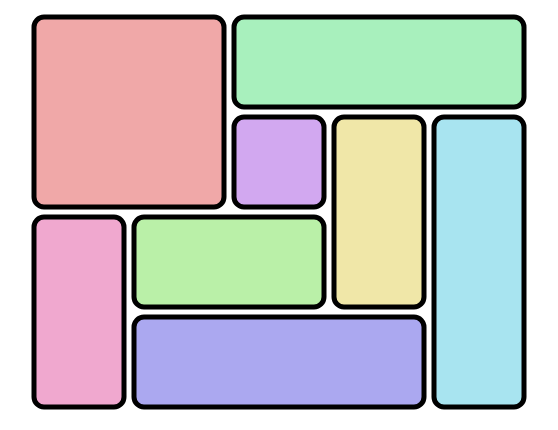
Exploring Rectangle Subdivisions
Last week, I saw a talk on Vuntra City, a procedurally generated city with a fully explorable city. Developer Larissa Davidova explained that she settled on using Recursive Subdivision for the city…
Alpaca Conference
Alpaca conference will feature 35 speakers and workshop leaders exploring algorithmic patterns in the creative arts, showcasing pattern-based work across music, textiles, dance and more.