Temperature records were smashed in June - and scientists warn this is a sign of things to come.
Did the hot summer make more people worry about climate change? Here’s what the latest indications show
Around 65% of the British public are now concerned about climate change.

Summer’s new normal is a hazard that’s testing Europe’s climate resilience
As people across Europe are having to acclimatise to an unprecedented heatwave, coordinated responses for tackling extreme heat need to come from the top, and there’s no time to lose.
World’s seas have hit hottest temperature on record for July, say scientists
Average sea surface temperature outside polar regions was highest on record for July, beating previous high in 2023

Show Your Stripes
Visualising how the climate has changed for every country across the globe
Brutal June heat wave killed as many as 14,000 Europeans
POLITICO calculations show thousands of excess deaths across six worst-hit countries.

Visualising Climate 2026 — Conference
A global conference on climate data visualization, storytelling, and science. Bologna, Italy • 4–6 November 2026.

It’s 90 degrees in the Arctic right now
The Arctic is heating faster than the rest of the planet. New data illustrate how dire that is

Belgium had the highest excess mortality rate in Europe during June heatwave
People living in poorer regions were hit hardest by the extreme heat.

The Arctic Is in Dire Straits, 20 Years of Reporting Show
The Arctic has changed dramatically in the past 20 years, a new report shows, as temperatures skyrocket and ice rapidly melts
This El Niño is set to be the largest on record by a ‘mind-blowing margin’
Forecasters predict that the monster climate pattern will combine with global warming to push global temperatures in 2027 to new heights.
Climate Models Are Running Red Hot, and Scientists Don’t Know Why
The simulators used to forecast warming have suddenly started giving us less time.

We mapped the world’s hottest data centers
In 21 countries, all data centers are located in climates that are too hot.

Why Climateflation Will Drive Food Prices More Than War
Economists expect this summer's heatwaves to drive 2027 food prices more than the Iran war. Climateflation, explained: from your grocery bill to your mortgage rate.

RETRACTED ARTICLE: The economic commitment of climate change
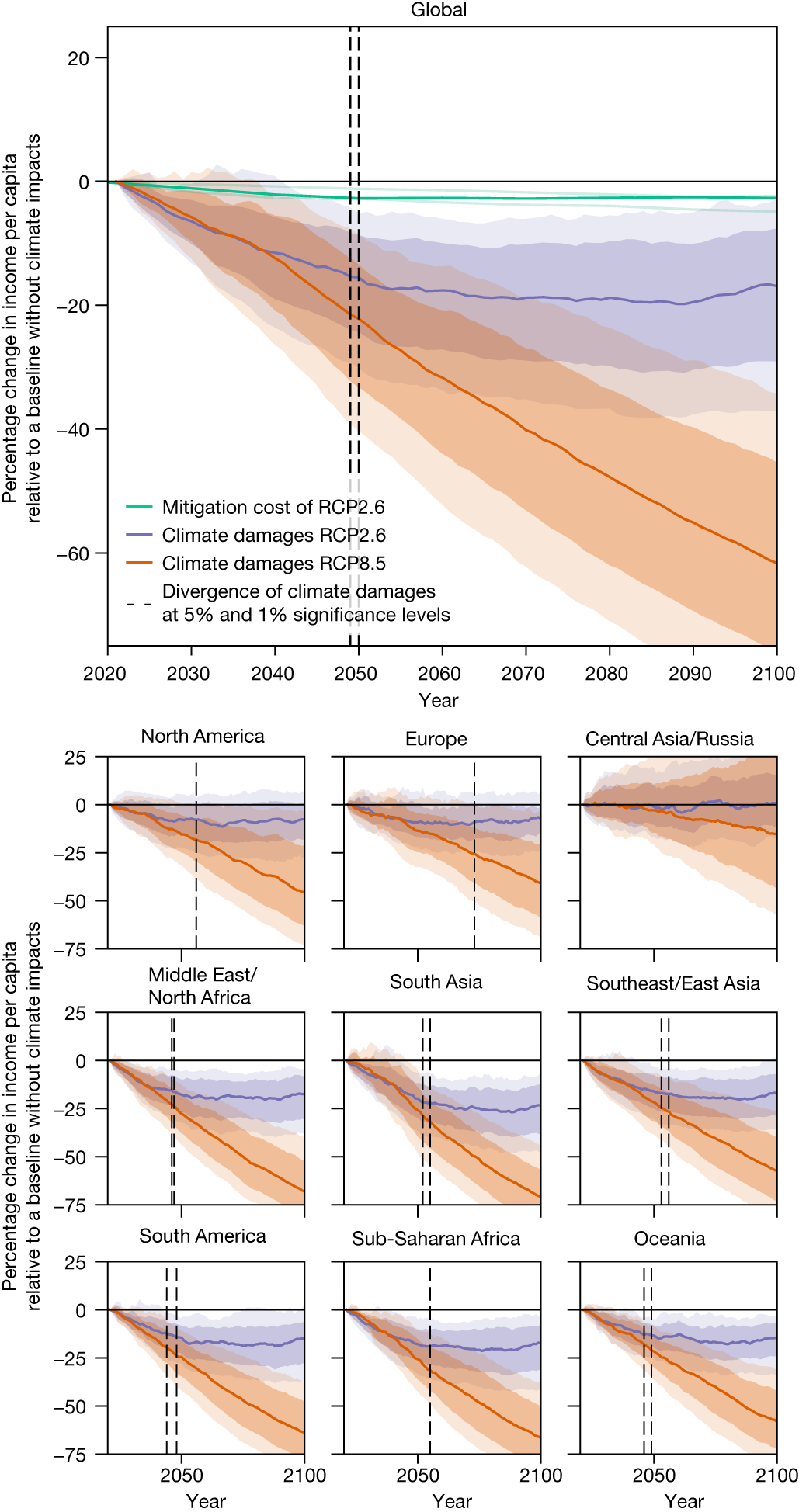
Global projections of macroeconomic climate-change damages typically consider impacts from average annual and national temperatures over long time horizons1–6. Here we use recent empirical findings from more than 1,600 regions worldwide over the past 40 years to project sub-national damages from temperature and precipitation, including daily variability and extremes7,8. Using an empirical approach that provides a robust lower bound on the persistence of impacts on economic growth, we find that the world economy is committed to an income reduction of 19% within the next 26 years independent of future emission choices (relative to a baseline without climate impacts, likely range of 11–29% accounting for physical climate and empirical uncertainty). These damages already outweigh the mitigation costs required to limit global warming to 2 °C by sixfold over this near-term time frame and thereafter diverge strongly dependent on emission choices. Committed damages arise predominantly through changes in average temperature, but accounting for further climatic components raises estimates by approximately 50% and leads to stronger regional heterogeneity. Committed losses are projected for all regions except those at very high latitudes, at which reductions in temperature variability bring benefits. The largest losses are committed at lower latitudes in regions with lower cumulative historical emissions and lower present-day income.