

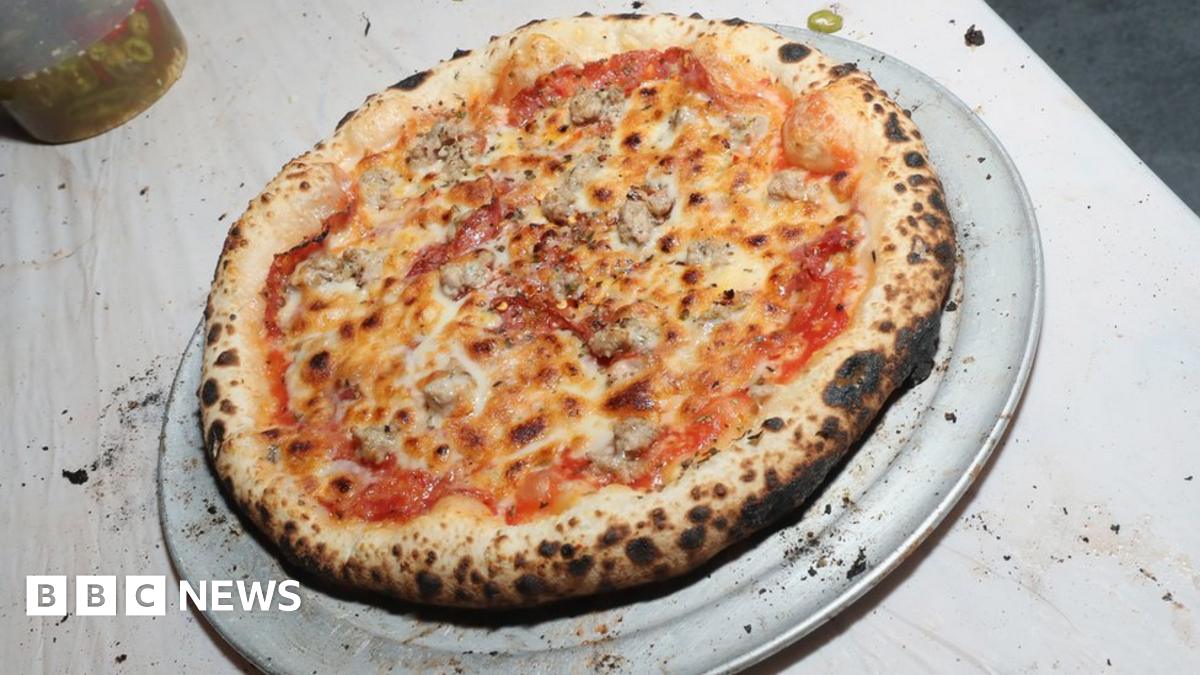
Thousands of people are spreading a false rumour about a Washington pizza restaurant and a child sex ring. But why?
Why Trump Wants You to Think All Dissent Is a “Conspiracy”
What Pizzagate, election fraud lies, and Trump’s crackdown on antifa have in common.

The Plot to Subvert an Election: Unraveling the Russia Story So Far (Published 2018)
For two years, Americans have tried to absorb the details of the 2016 attack: spies, leaked emails, social media fraud — and President Trump’s claims that it’s all a hoax. The Times explores what we know and what it means.

The day that CBS News became literally ‘fake news’ for America | Will Bunch
An unverified, unlikely story about the Minneapolis ICE shooter exposes the new CBS News team as Trump's state media.

Fakebook: Using Data Science to Spot Fake News
As fake news permeates throughout social media outlets (like Facebook), it's more important than ever to identify what is fact vs. fiction. This is especially true in the age of COVID where the spread of misinformation can impact the spread of the virus. Data scientists are emerging on the front lines of this fight, using programs to help them identify fake news sources. Led by Dr. Teon Brooks, Josh Modeste, and Steven Azeka from the Gotham Data Clinic (fka CiELabs), this workshop will explore the “life cycle” of scientific research and how scientists come to consensus about how we interpret data. We’ll examine what to look for in credible news sources, and the consequences of leaning on not-so-trusty pseudoscientific sources. Then you’ll put that knowledge to work by developing a rubric for identifying fake news. No experience necessary! https://www.eventbrite.com/e/fakebook-using-data-science-to-spot-fake-news-tickets-137833492687
The Conspiracy Theory About Wayfair Is Spreading Quickly Among Lifestyle Influencers On Instagram
The theory plays into the bigger QAnon conspiracy theory, which baselessly claims that the world is controlled by a secret cabal of pedophiles that President Trump is actively fighting against.

Conspiracy Theory GIF - Conspiracy Theory Explaining - Discover & Share GIFs
Click to view the GIF

The Media Can't Stop Propping Up Elon Musk's Phony Supergenius Engineer Mythology
"CEO said a thing!" journalism is now utterly pervasive, and includes parroting billionaire and CEO claims with a total disregard for whether or not anything being said is actually true.

The spreading of misinformation online
Significance The wide availability of user-provided content in online social media facilitates the aggregation of people around common interests, worldviews, and narratives. However, the World Wide Web is a fruitful environment for the massive diffusion of unverified rumors. In this work, using a massive quantitative analysis of Facebook, we show that information related to distinct narratives––conspiracy theories and scientific news––generates homogeneous and polarized communities (i.e., echo chambers) having similar information consumption patterns. Then, we derive a data-driven percolation model of rumor spreading that demonstrates that homogeneity and polarization are the main determinants for predicting cascades’ size. , The wide availability of user-provided content in online social media facilitates the aggregation of people around common interests, worldviews, and narratives. However, the World Wide Web (WWW) also allows for the rapid dissemination of unsubstantiated rumors and conspiracy theories that often elicit rapid, large, but naive social responses such as the recent case of Jade Helm 15––where a simple military exercise turned out to be perceived as the beginning of a new civil war in the United States. In this work, we address the determinants governing misinformation spreading through a thorough quantitative analysis. In particular, we focus on how Facebook users consume information related to two distinct narratives: scientific and conspiracy news. We find that, although consumers of scientific and conspiracy stories present similar consumption patterns with respect to content, cascade dynamics differ. Selective exposure to content is the primary driver of content diffusion and generates the formation of homogeneous clusters, i.e., “echo chambers.” Indeed, homogeneity appears to be the primary driver for the diffusion of contents and each echo chamber has its own cascade dynamics. Finally, we introduce a data-driven percolation model mimicking rumor spreading and we show that homogeneity and polarization are the main determinants for predicting cascades’ size.

Fake news spreads like an epidemic. Here’s how to stop it.
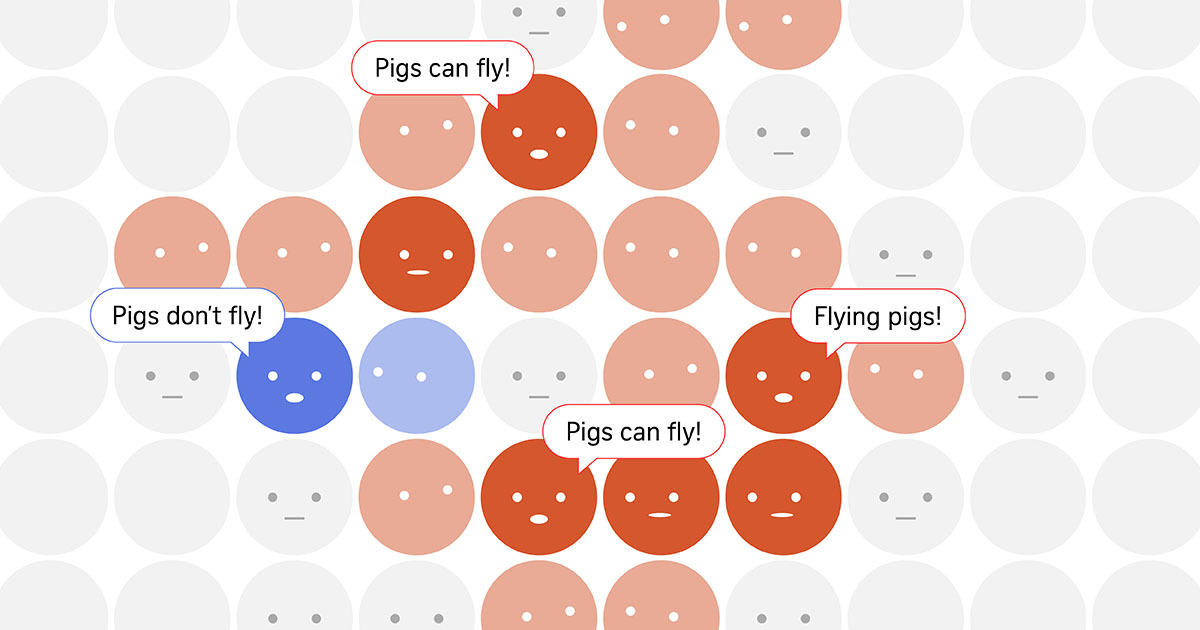
Researchers study fake news the same way they study the spread of disease. When misinformation “goes viral”, it is not just a metaphor. It is what’s actually happening. via @straits_times str.sg/viz-misinformation
Maybe You Missed It, but the Internet ‘Died’ Five Years Ago
A conspiracy theory spreading online says the whole internet is now fake. It’s ridiculous, but possibly not that ridiculous?

Conspiracy Brokers: Understanding the Monetization of YouTube Conspiracy Theories
DOI: https://doi.org/10.1145/3485447.3512142 WWW '22: Proceedings of the ACM Web Conference 2022, Virtual Event, Lyon, France, April 2022
Fakebook: Using Data Science to Spot Fake News
Elon Musk's Grok AI Is Pushing Misinformation and Legitimizing Conspiracies
Grok's selling point is real-time access to news, but Motherboard found that it generated inaccurate information about Israel-Palestine and lent credence to conspiracy theories.

Fact-Checking False Claims about our Gender Identity Coverage | The New York Times Company
A recent post from Trans News Network included numerous falsehoods about New York Times stories on gender identity and maligned some of the journalists involved in the work. Our coverage is guided by…

it does actually sound like taylor farms and the white house teamed up to try and blame taco bell for the outbreak. unprecedented corruption

Jessica Nix
NEW: As cyclosporiasis cases jumped, the company linked to the outbreak - Taylor Farms - effectively delayed a recall that mounted in consumer confusion. Gift link for @business bloomberg.com/news/articles/2026-07-21/as-p…
it does actually sound like taylor farms and the white house teamed up to try and blame taco bell for the outbreak. unprecedented corruption
Jessica Nix
NEW: As cyclosporiasis cases jumped, the company linked to the outbreak - Taylor Farms - effectively delayed a recall that mounted in consumer confusion. Gift link for @business bloomberg.com/news/articles/2026-07-21/as-p…
