

Close to three quarters of all the adults on earth now have a smartphone, and most of the rest will get one in the next few years. However, the use of this connectivity is still only just beginning. Ecommerce is still only a small fraction of retail spending, and many other areas that will be transf
The Second Smartphone Revolution - AVC
Benedict Evans tweeted out this chart yesterday: We sometimes think of the shift to mobile as finished, or almost finished. It isn’t. pic.twitter.com/l5gaiMlaoU — Benedict Evans (@BenedictEvans) March 12, 2016 The first 2.5bn smartphones brought us Instagram, Snapchat, Uber, Whatsapp, Kik, Venmo, Duolingo, and most importantly, drove the big web apps to build world class […]
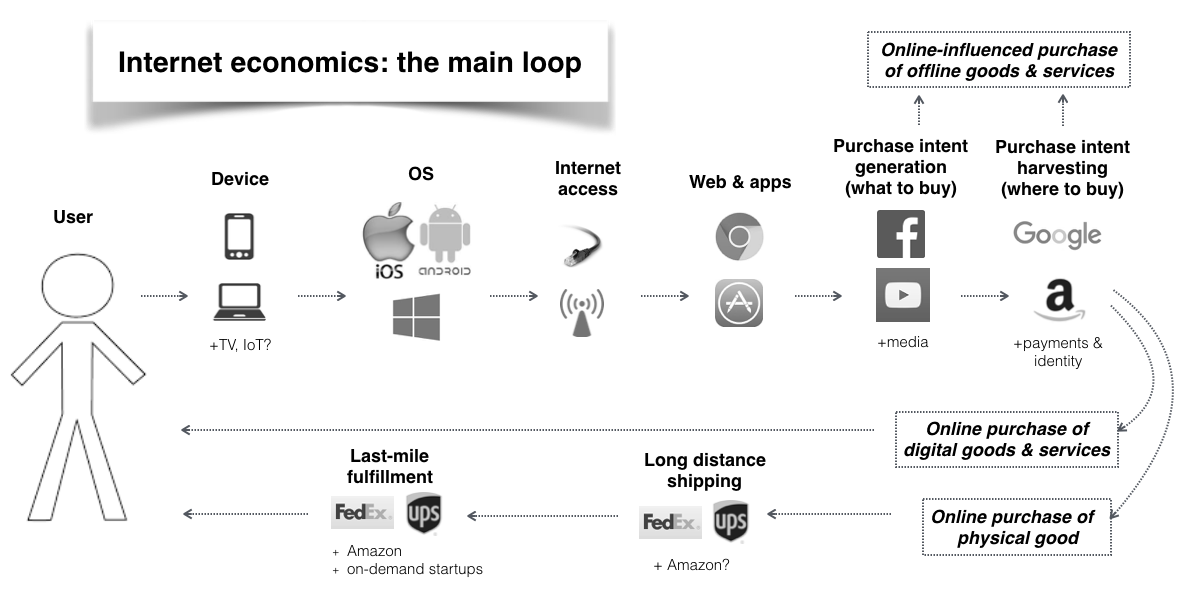
The Internet Economy
We are living in an era of bundling. The big five consumer tech companies — Google, Apple, Facebook, Amazon, and Microsoft — have moved far…
Decentralizing My Smartphone With Single Purpose Devices
Lately, I’ve become nostalgic for the days before smartphones, when the internet was a place we went to deliberately, and not a place that lived on all of ou...

Tim Sweeney on Twitter / X
Google is opening up Android all the way with robust support for competing stores, competing payments, and a better deal for all developers. So, we've settled all of our disputes worldwide. THANKS GOOGLE! https://t.co/Dq6eXNnZd0— Tim Sweeney (@TimSweeneyEpic) March 4, 2026
Coopting Disruption
Our economy is dominated by five aging tech giants – Alphabet, Amazon, Apple, Meta, and Microsoft. In the last twenty years, no company has commercialized a new

Platform wars: the final score — Benedict Evans
The platform wars and over and Apple and Google both won. So, what's the score, how many smartphones and tablet are out there, and what should we think about next?
Pluralistic: Web apps could de-monopolize mobile devices (13 Dec 2022) – Pluralistic: Daily links from Cory Doctorow
Mobile tech is a duopoly run by two companies – Google and Apple – with a combined market cap of $3.5 trillion. Each company uses a combination of tech, law, contract and market power to force sellers to do commerce via an app, and each one extracts a massive commission on all in-app sales – 15-30%!

Brad Neuberg on Twitter / X
Y Combinator is predicated on startups that require low capitalization since most of the technology they depend on is already mostly developed. This was true pre-2015 where startups depended on commodity open source software, the smartphone capitalized by Apple and others, cloud…— Brad Neuberg (@bradneuberg) September 16, 2024
How Silicon Valley missed the next wave of e-commerce
There are lots of exciting retail companies — just not in the U.S.

FinTech Adoption Across Generations: Financial Fitness in the Information Age
This paper analyzes how better access to financial information via new technology changes use of consumer credit and affects financial fitness. We exploit the introduction of a smartphone application for personal financial management as a source of exogenous variation. FinTech adoption reduces financial fee payments and penalties, but differs cross-sectionally in the population. After adopting the new technology, Millennials and members of Generation X incur fewer financial fees and penalties, whereas Baby Boomers do not benefit from the technological advance. Millennials and Gen Xers save fees by using their credit cards rather than overdrafts to manage short-term liabilities. Moreover, Millennials shift some of their spending to discretionary entertainment, whereas members of Generation X remain more austere. Finally, while men tend to adopt new technology and access information at a higher rate, the economic impact of access is larger for women.

The End of the Revolutionary Internet
The revolutionary internet is over, and we don’t have much to show for it. A new start is out there, somewhere.
Minimum Viable Infrastructure
Minimum Viable Infrastructure Innovation often emerges not solely from brilliant ideas but from the infrastructure readiness that makes those ideas viable. Consider the progression of mobile consumer internet applications over the past two decades: Twitter, Instagram, Snapchat, TikTok. Their lau...

Fairphone
Nearly three years ago, we started a crowdfunding campaign to finance the creation of our first-ever phone. We had a

Amazon and Walmart’s rivalry is reshaping how we’ll buy everything in the future
The retail war is expanding to cloud computing, grocery delivery, and streaming video
