

Framing the issues: UC Berkeley professor George Lakoff tells how conservatives use language to dominate politics
Metaphor and the Political War
Metaphor and the Political War
Tucker Carlson
Tucker Carlson is a veteran television personality who emerged in 2016 as one of the most influential figures of the authoritarian, anti-democracy, right-wing movement that rose to prominence around the political career of former President Donald J. Trump. Carlson’s propaganda, which obsessively portrays white men as being victims of a corrupt, feminist, multicultural system, often mirrors the talking points found in fringe internet spaces where extremists congregate. He injects these talking points into his commentary on current events, giving extremists both an audience and a TV-ready polish that would be otherwise difficult to obtain. Carlson is undoubtedly the most listened-to pundit the anti-immigrant movement in America has ever seen and is regarded as a heroic figure to white supremacists and other admirers of fascism. Outside of Trump himself, arguably no single figure has proven to be more influential in radicalizing the right in the 21st century.
How Social Media Tricks our Brains — and Destroys our Politics - Aaron Ross Powell's Blog
Capitalism, Democracy, and Du Bois’s <em>Two</em> Proletariats
[epq-quote align="align-right"]"What can be more radical or liberating than freedom and justice for all?"[/epq-quote] As an ideal, liberal democracy has great appeal. What can be more radical or liberating than...
We Have Always Been Action TheoristsToward a Critical Theory of Language for the Era of “Large Language Models”
Scholars of literature and culture understandably place themselves among the world’s premiere experts on matters of language. But they also know that fields like linguistics and communication have their own ways of studying how people express themselves through speech and written media. A key difference concerns the theories and methodologies...
The social media discourse of engaged partisans is toxic even when politics are irrelevant
Abstract. Prevailing theories of partisan incivility on social media suggest that it derives from disagreement about political issues or from status compet
The social media discourse of engaged partisans is toxic even when politics are irrelevant
Abstract. Prevailing theories of partisan incivility on social media suggest that it derives from disagreement about political issues or from status compet
Social media is populist and polarising; AI may be the opposite
Large language models elevate expert consensus and moderate views, in sharp contrast to social platforms

Sharing without clicking on news in social media
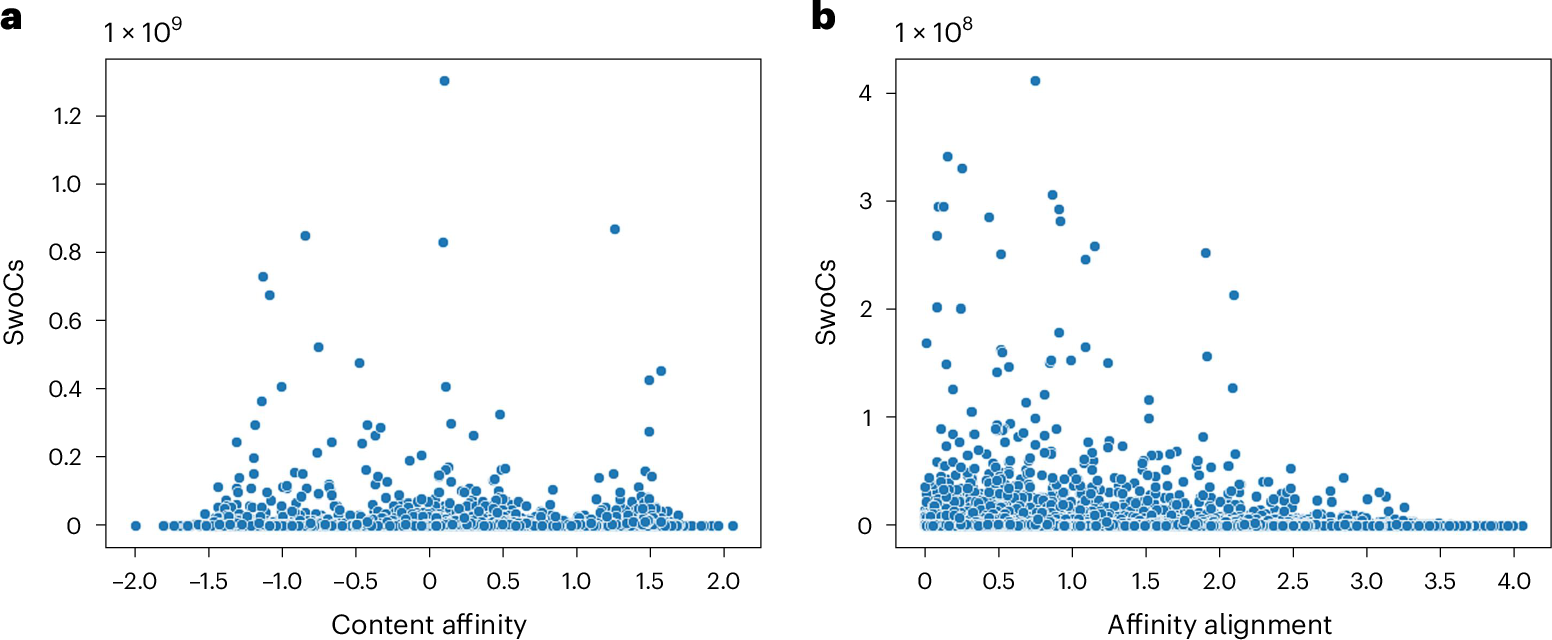
Social media have enabled laypersons to disseminate, at scale, links to news and public affairs information. Many individuals share such links without first reading the linked information. Here we analysed over 35 million public Facebook posts with uniform resource locators shared between 2017 and 2020, and discovered that such ‘shares without clicks’ (SwoCs) constitute around 75% of forwarded links. Extreme and user-aligned political content received more SwoCs, with partisans engaging in it more than politically neutral users. In addition, analyses with 2,969 false uniform resource locators revealed higher shares and, hence, SwoCs by conservatives (76.94%) than liberals (14.25%), probably because, in our dataset, the vast majority (76–82%) of them originated from conservative news domains. Findings suggest that the virality of political content on social media (including misinformation) is driven by superficial processing of headlines and blurbs rather than systematic processing of core content, which has design implications for promoting deliberate discourse in the online public sphere.
Charlie Kirk, Ezra Klein, and the Cost of Civility-Theater Liberalism
“Talking across divides” is laudable—until it becomes a license to launder antidemocratic and dehumanizing ideas.

Political Quizzes | The Paper Pilot
The Paper Pilot's digital garden of thoughts on philosophy, politics, and sociology
Language Models Trained on State Media Sources Launder Propaganda
Tech Policy Press is a nonprofit media and community venture intended to provoke new ideas, debate and discussion at the intersection of technology and democracy. We publish opinion and analysis.

Left & Right: The Psychological Significance of a Political Distinction
This book brings together for the first time an updated, revised collection of influential essays and articles that capture some of the most exciting scientific and scholarly contributions to the topic ...

AI Large Language Model Training: The Potential Risks of Ideological Skewing — PSG Consulting
LLMs (AI Large Language Models) have become part of everyday life. Systems such as ChatGPT, Claude, Gemini, Meta AI (Llama) and X.ai's Grok handle billions of interactions daily. They increasingly shape what information people encounter and in what order, subtly deciding what's important and even what is true, sometimes without users realizing it. Because LLMs wield growing power over information exposure, it is vital to recognize the political and ideological structures at multiple stages of their design, and to identify manipulation risks.

The social media discourse of engaged partisans is toxic even when politics are irrelevant
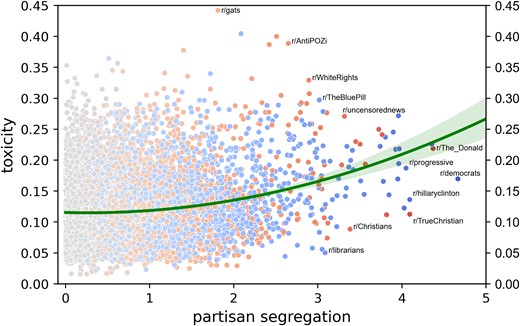
Abstract Prevailing theories of partisan incivility on social media suggest that it derives from disagreement about political issues or from status competition between groups. This study—which analyzes the commenting behavior of Reddit users across diverse cultural contexts (subreddits)—tests the alternative hypothesis that such incivility derives in large part from a selection effect: Toxic people are especially likely to opt into discourse in partisan contexts. First, we examined commenting behavior across over 9,000 unique cultural contexts (subreddits) and confirmed that discourse is indeed more toxic in partisan (e.g. r/progressive, r/conservatives) than in nonpartisan contexts (e.g. r/movies, r/programming). Next, we analyzed hundreds of millions of comments from over 6.3 million users and found robust evidence that: (i) the discourse of people whose behavior is especially toxic in partisan contexts is also especially toxic in nonpartisan contexts (i.e. people are not politics-only toxicity specialists); and (ii) when considering only nonpartisan contexts, the discourse of people who also comment in partisan contexts is more toxic than the discourse of people who do not. These effects were not driven by socialization processes whereby people overgeneralized toxic behavioral norms they had learned in partisan contexts. In contrast to speculation about the need for partisans to engage beyond their echo chambers, toxicity in nonpartisan contexts was higher among people who also comment in both left-wing and right-wing contexts (bilaterally engaged users) than among people who also comment in only left-wing or right-wing contexts (unilaterally engaged users). The discussion considers implications for democratic functioning and theories of polarization.