


Artificial intelligence has advanced from analyzing experimental data to autonomously generating hypotheses, designing experiments, and coordinating closed loop discovery. Yet the translation from computational reasoning to physical execution remains bottlenecked by the experimental protocol, which in biology still relies on ambiguous natural-language descriptions: a medium other engineering disciplines abandoned decades ago in favor of compiler verified specification languages. This deficit fragments reproducibility along three axes: protocol accuracy, pre execution verification, and cross platform portability. Existing formalisms address only subsets of these challenges, trading expressiveness for rigor, portability for standardization, or usability for provenance. Here we introduce the Biology Protocol Language (BPL), a domain specific language with a biology-native type system in which every quantity carries physical units, every reagent declares its physical form, and every container maintains compiler-tracked state, so that implicit assumptions must be stated explicitly and physically impossible operations are rejected at compile time. We further develop BPL-COGEN, a pipeline that couples a fine tuned 30 billion parameter language model with the deterministic compiler in a closed generate validate repair loop, iteratively correcting the translation from natural language SOPs to BPL through compiler diagnostics until all physical, dimensional, and state constraints are satisfied. On a benchmark of 300 published Nature Protocols papers, BPL COGEN achieved an overall fidelity score of 95.1 against the source protocols as ground truth. Wet-lab experiment and cross-platform validation in GFP expression library construction and HPLC to UHPLC method translation confirmed that a single BPL source yielded reproducible execution across manual and liquid handler assisted contexts. The results established a novel pipeline that generates compiler-verified protocols, which is an essential prerequisite for physically embodied AI in biology.
Can AI Agents Synthesize Scientific Conclusions?
Scientific AI agents increasingly retrieve evidence, reason across sources, and synthesize conclusions used in consequential decisions. Yet, their ability to do so in high-stakes domains such as health remains unclear. We introduce SciConBench, a large-scale live benchmark of 9.11K questions and expert-written conclusions from systematic reviews to evaluate open-domain scientific conclusion synthesis. The benchmark draws on an expert-validated automated evaluation pipeline that decomposes conclusions into atomic facts and measures correctness and comprehensiveness via factual precision and recall. To mitigate data leakage, we further introduce SciConHarness, a clean-room evaluation harness that equips agents with controlled web interaction to ensure valid measurement. Evaluating 8 frontier models and deep research agents, we find that factual quality remains low: under clean-room settings, the best agent achieves only a factual F1 of 0.337. Our clean-room setting consistently reduces performance relative to unconstrained evaluation, suggesting that leakage inflates estimates of models' true synthesis capabilities. Finally, we audit consumer-facing agents (e.g., Google AI Overview, OpenEvidence) and find they frequently generate incomplete and sometimes contradictory conclusions, even when the ground-truth answer is available. Overall, our results show that reliable synthesis of scientific conclusions remains an open challenge, and that clean-room evaluation is essential for assessing open-domain AI agents.

A Coming Revolution in Metaprogramming | Will Crichton
A single programming language is no longer enough. I predict that soon, the best programmers will fluently move between languages and the best languages will interoperate well with others. This interoperability will likely stem from strong metaprogramming facilities. I examine how we might build a programmable compiler and look at recent work toward that end.
Agentic systems are adept at solving well-scoped, verifiable problems in computational biology
We introduce CompBioBench, a benchmark of 100 diverse tasks for evaluating agentic systems in computational biology. Unlike mathematics and programming, which more readily admit systematic verification, biological data are inherently noisy and open to interpretation.
ScienceIDE: Turning World's Scientific Codebase into Agent Learnable Environments
Scientific code repositories encode decades of human knowledge in executable models, methods, and tools. Yet fragmented toolchains, implicit domain conventions, and specialized correctness criteria make this knowledge difficult to convert into reliable learning experience-a challenge we call the scientific experience bottleneck. We introduce ScienceIDE, infrastructure for turning the world's scientific code into programmable environments for scientific agents. Guided by expert-defined scientific cases and acceptance criteria, agents transform repositories into executable environments that support task generation, execution, and scientific verification. These environments provide a shared foundation for supervised fine-tuning, reinforcement learning, and evaluation. Using verified interaction trajectories, we train PhAI-IDE-72B, PhAI-IDE-9B, and PhAI-IDE-4B. The model family shows gains in held-out scientific-code repair and across selected general-purpose benchmarks in code, reasoning, and knowledge, providing evidence of positive transfer from scientific experience to broader capabilities. ScienceIDE lays the foundation for an integrated workspace for agent learning and scientific practice, making humanity's scientific software a shared substrate for developing scientific intelligence. Code: https://github.com/aitofound/ScienceIDE
Prove2Me: An Open Collaborative Platform for Scaling Math Formalization
Proof assistants such as Lean 4 promise the paradigm of formally verified mathematics, but large-scale formalization projects have faced major barriers to entry, including the need for expertise in formal verification (as well as the underlying mathematics) and the significant time required for writing formal proofs. AI coding agents have dramatically reduced these barriers; human users can now use natural language to prompt agents to write complex proofs in Lean. This opens up the intriguing possibility of internet-scale mathematical collaboration involving both humans and AI agents, where correctness is machine-checked. To realize this possibility, we introduce Prove2Me (https://prove2.me), an open collaborative platform for formalizing mathematics. Users launch formalization "missions", to which AI agents contribute formal proofs toward completion. We designed mechanisms and a specialized harness in Prove2Me that enable large-scale collaboration so that agents can build on one another's work and freely reuse existing results. In doing so, Prove2Me aims to turn math formalization into a scalable, crowd-sourced effort open to anyone with an agent.
FlowBench: separating planning, fault recovery and interpretation in agentic bioinformatics
Agentic large language model (LLM) systems are being deployed in bioinformatics faster than they are understood, and single-metric evaluations conflate capabilities that fail independently. We introduce FlowBench, a benchmark that decomposes agentic bioinformatics performance into planning, fault recovery, biological interpretation, and end-to-end output-fidelity. Existing systems achieve high plan completeness, but their closed, single-provider designs prevent attribution of performance to scaffolding versus the underlying model. We therefore built FlowAgent, a modular, provider-agnostic framework whose components can be selectively disabled and whose backbone model can be swapped across providers on a shared harness, and used it to evaluate 23 models from three main providers. Three findings emerge. First, generating a valid workflow plan from a named toolchain is largely solved, whereas inferring an appropriate toolchain from biological intent alone is uniformly difficult regardless of model tier, compressing all models into a narrow 44–57% pass-rate band. Second, ablation shows that the dependency-structured plan and a completeness-reflection step drive performance, while adding a same-context validator-driven retry makes structural quality worse. Third, fault recovery and data-grounded interpretation remain unsolved. Models frequently propose fixes that force a clean exit while leaving the underlying data invalid, and data-grounded interpretation lags internal-knowledge recall by a consistent margin. Safety does not emerge from capability, and reasoning-tier models were among the least reliable at recognising unrecoverable faults. Once planning saturates, agent architecture and refusal calibration, not model scale, are the productive frontier. Availability and implementation FlowAgent and FlowBench are available under a GPLv3 licence at <https://github.com/EnteloBio/flowagent> Contact adam{at}entelo.bio ### Competing Interest Statement The authors are current employees of Entelo Bio, with APC holding equity.
SYNTHETIC-1: Scaling Distributed Synthetic Data Generation for Verified Reasoning
Introducing SYNTHETIC-1, a collaborative effort to create the largest open-source dataset of verified reasoning traces for math, coding and science, leveraging DeepSeek-R1.

An Interpretable Automated Mechanism Design Framework with Large Language Models
Mechanism design has long been a cornerstone of economic theory, with traditional approaches relying on mathematical derivations. Recently, automated approaches, including differentiable economics with neural networks, have emerged for designing payments and allocations. While both analytical and automated methods have advanced the field, they each face significant weaknesses: mathematical derivations are not automated and often struggle to scale to complex problems, while automated and especially neural-network-based approaches suffer from limited interpretability. To address these challenges, we introduce a novel framework that reformulates mechanism design as a code generation task. Using large language models (LLMs), we generate heuristic mechanisms described in code and evolve them to optimize over some evaluation metrics while ensuring key design criteria (e.g., strategy-proofness) through a problem-specific fixing process. This fixing process ensures any mechanism violating the design criteria is adjusted to satisfy them, albeit with some trade-offs in performance metrics. These trade-offs are factored in during the LLM-based evolution process. The code generation capabilities of LLMs enable the discovery of novel and interpretable solutions, bridging the symbolic logic of mechanism design and the generative power of modern AI. Through rigorous experimentation, we demonstrate that LLM-generated mechanisms achieve competitive performance while offering greater interpretability compared to previous approaches. Notably, our framework can rediscover existing manually designed mechanisms and provide insights into neural-network based solutions through Programming-by-Example. These results highlight the potential of LLMs to not only automate but also enhance the transparency and scalability of mechanism design, ensuring safe deployment of the mechanisms in society.
Verification in the Age of AI Scientists
AI Scientists now operate at a scale that outpaces human capacity for manual review. Systems such as Sakana’s AI Scientist write entire workshop papers end-to-end. Lila Sciences runs autonomous ``AI Science Factories’’ that hypothesize, experiment, and iterate without human guidance. FutureHouse’s Kosmos and Robin generate thousands of candidate hypotheses in a single run, and Google’s Co-Scientist proposes testable experiments at a rate no laboratory can fully evaluate. Each of these systems emphasizes verified results, yet that standard ranges from near-perfect formal proof in mathematics to decade-long clinical trials in medicine, with no shared framework for judging sufficiency across domains. As outputs scale beyond what humans can manually inspect, the question of which results to trust becomes as hard as generating them. The bottleneck for AI for Science is no longer hypothesis generation, it is verification.
Coeffects: a calculus of context-dependent computation
The notion of context in functional languages no longer refers just to variables in scope. Context can capture additional properties of variables (usage patterns in linear logics; caching requirements in dataflow languages) as well as additional resources or properties of the execution environment (rebindable resources; platform version in a cross-platform application). The recently introduced notion of coeffects captures the latter, whole-context properties, but it failed to capture fine-grained per-variable properties.We remedy this by developing a generalized coeffect system with annotations indexed by a coeffect shape. By instantiating a concrete shape, our system captures previously studied flat (whole-context) coeffects, but also structural (per-variable) coeffects, making coeffect analyses more useful. We show that the structural system enjoys desirable syntactic properties and we give a categorical semantics using extended notions of indexed comonad.The examples presented in this paper are based on analysis of established language features (liveness, linear logics, dataflow, dynamic scoping) and we argue that such context-aware properties will also be useful for future development of languages for increasingly heterogeneous and distributed platforms.

Propose, Solve, Verify: Self-Play Through Formal Verification
Training models through self-play alone (without any human data) has been a longstanding goal in AI, but its effectiveness for training large language models remains unclear, particularly in code generation where rewards based on unit tests are brittle and prone to error propagation. We study self-play in the verified code generation setting, where formal verification provides reliable correctness signals. We introduce Propose, Solve, Verify (PSV) a simple self-play framework where formal verification signals are used to create a proposer capable of generating challenging synthetic problems and a solver trained via expert iteration. We use PSV to train PSV-Verus, which across three benchmarks improves pass@1 by up to 9.6x over inference-only and expert-iteration baselines. We show that performance scales with the number of generated questions and training iterations, and through ablations identify formal verification and difficulty-aware proposal as essential ingredients for successful self-play.
Self-Instruct: Aligning Language Models with Self-Generated Instructions
Large "instruction-tuned" language models (i.e., finetuned to respond to instructions) have demonstrated a remarkable ability to generalize zero-shot to new tasks. Nevertheless, they depend heavily on human-written instruction data that is often limited in quantity, diversity, and creativity, therefore hindering the generality of the tuned model. We introduce Self-Instruct, a framework for improving the instruction-following capabilities of pretrained language models by bootstrapping off their own generations. Our pipeline generates instructions, input, and output samples from a language model, then filters invalid or similar ones before using them to finetune the original model. Applying our method to the vanilla GPT3, we demonstrate a 33% absolute improvement over the original model on Super-NaturalInstructions, on par with the performance of InstructGPT-001, which was trained with private user data and human annotations. For further evaluation, we curate a set of expert-written instructions for novel tasks, and show through human evaluation that tuning GPT3 with Self-Instruct outperforms using existing public instruction datasets by a large margin, leaving only a 5% absolute gap behind InstructGPT-001. Self-Instruct provides an almost annotation-free method for aligning pre-trained language models with instructions, and we release our large synthetic dataset to facilitate future studies on instruction tuning. Our code and data are available at https://github.com/yizhongw/self-instruct.
SciToolAgent: a knowledge-graph-driven scientific agent for multitool integration
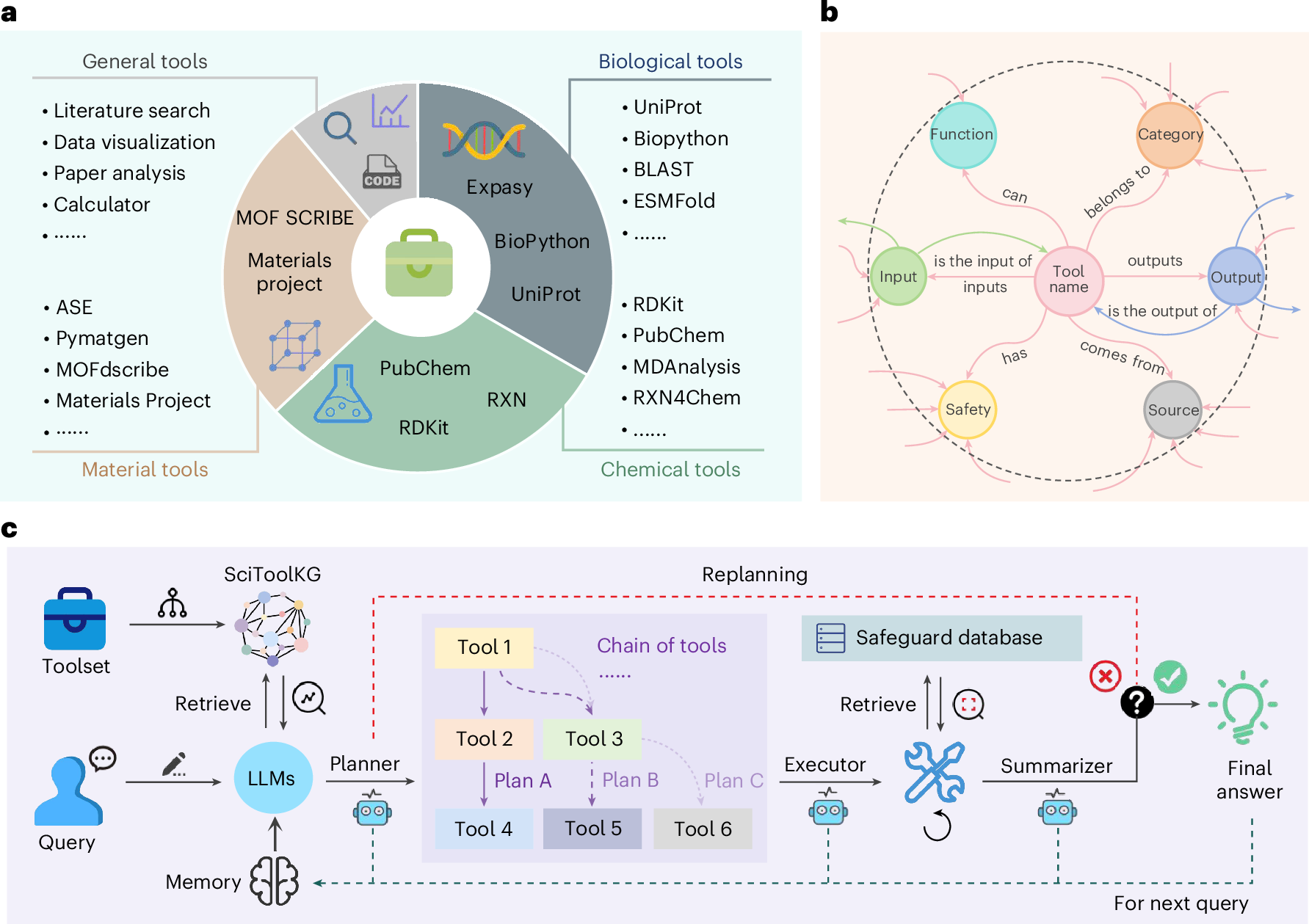
Scientific research increasingly relies on specialized computational tools, yet effectively utilizing these tools requires substantial domain expertise. While large language models show promise in tool automation, they struggle to seamlessly integrate and orchestrate multiple tools for complex scientific workflows. Here we present SciToolAgent, a large language model-powered agent that automates hundreds of scientific tools across biology, chemistry and materials science. At its core, SciToolAgent leverages a scientific tool knowledge graph that enables intelligent tool selection and execution through graph-based retrieval-augmented generation. The agent also incorporates a comprehensive safety-checking module to ensure responsible and ethical tool usage. Extensive evaluations on a curated benchmark demonstrate that SciToolAgent outperforms existing approaches. Case studies in protein engineering, chemical reactivity prediction, chemical synthesis and metal–organic framework screening further demonstrate SciToolAgent’s capability to automate complex scientific workflows, making advanced research tools accessible to both experts and nonexperts.
#bioinformatics #computationalbiology #aiforscience #singlecell #spatialtranscriptomics #opensource #codex #claudecode #mcp #agenticai | Herry Z.
BioNexus: A Scientific Reliability Layer for Agentic Biology As coding agents such as OpenAI Codex, Claude Code, and Cursor become increasingly capable of running bioinformatics workflows, a new problem emerges: Knowing how to run an analysis does not mean knowing when that analysis is scientifically valid. BioNexus is an open-source project exploring a reliability layer for biological coding agents rather than another standalone AI scientist. Its current architecture focuses on: Machine-readable Capability Contracts — define input semantics, scientific preconditions, canonical backends, refusal conditions, and evidence requirements. EvidenceCard 2.1 — separates execution state from scientific evidence and grades conclusions as PRELIMINARY, SUPPORTED, ROBUST, REPLICATED, FRAGILE, or ABSTAIN. Scientific Intent & Invariant Routing — detects invalid analyses such as pseudoreplication, incompatible data representations, or missing backends. BioNexus Eval — evaluates routing, unsafe claims, refusal behavior, and scientific outcomes. RunBundle Artifact Contract — packages inputs, parameters, results, provenance, environment, and evidence into reproducible machine-readable runs. The long-term goal is simple: Make scientific reliability a first-class infrastructure layer for agentic biology. BioNexus is still evolving, and I am actively looking for contributors in bioinformatics, single-cell/spatial omics, scientific benchmarking, MCP, reproducibility, and AI coding agents. PRs, issues, benchmark datasets, scientific critiques, and failure cases are especially welcome. GitHub: HERRY423/BioNexus #Bioinformatics #ComputationalBiology #AIForScience #SingleCell #SpatialTranscriptomics #OpenSource #Codex #ClaudeCode #MCP #AgenticAI
