


Agentic large language model (LLM) systems are being deployed in bioinformatics faster than they are understood, and single-metric evaluations conflate capabilities that fail independently. We introduce FlowBench, a benchmark that decomposes agentic bioinformatics performance into planning, fault recovery, biological interpretation, and end-to-end output-fidelity. Existing systems achieve high plan completeness, but their closed, single-provider designs prevent attribution of performance to scaffolding versus the underlying model. We therefore built FlowAgent, a modular, provider-agnostic framework whose components can be selectively disabled and whose backbone model can be swapped across providers on a shared harness, and used it to evaluate 23 models from three main providers. Three findings emerge. First, generating a valid workflow plan from a named toolchain is largely solved, whereas inferring an appropriate toolchain from biological intent alone is uniformly difficult regardless of model tier, compressing all models into a narrow 44–57% pass-rate band. Second, ablation shows that the dependency-structured plan and a completeness-reflection step drive performance, while adding a same-context validator-driven retry makes structural quality worse. Third, fault recovery and data-grounded interpretation remain unsolved. Models frequently propose fixes that force a clean exit while leaving the underlying data invalid, and data-grounded interpretation lags internal-knowledge recall by a consistent margin. Safety does not emerge from capability, and reasoning-tier models were among the least reliable at recognising unrecoverable faults. Once planning saturates, agent architecture and refusal calibration, not model scale, are the productive frontier. Availability and implementation FlowAgent and FlowBench are available under a GPLv3 licence at https://github.com/EnteloBio/flowagent Contact adam{at}entelo.bio
#bioinformatics #computationalbiology #aiforscience #singlecell #spatialtranscriptomics #opensource #codex #claudecode #mcp #agenticai | Herry Z.
BioNexus: A Scientific Reliability Layer for Agentic Biology As coding agents such as OpenAI Codex, Claude Code, and Cursor become increasingly capable of running bioinformatics workflows, a new problem emerges: Knowing how to run an analysis does not mean knowing when that analysis is scientifically valid. BioNexus is an open-source project exploring a reliability layer for biological coding agents rather than another standalone AI scientist. Its current architecture focuses on: Machine-readable Capability Contracts — define input semantics, scientific preconditions, canonical backends, refusal conditions, and evidence requirements. EvidenceCard 2.1 — separates execution state from scientific evidence and grades conclusions as PRELIMINARY, SUPPORTED, ROBUST, REPLICATED, FRAGILE, or ABSTAIN. Scientific Intent & Invariant Routing — detects invalid analyses such as pseudoreplication, incompatible data representations, or missing backends. BioNexus Eval — evaluates routing, unsafe claims, refusal behavior, and scientific outcomes. RunBundle Artifact Contract — packages inputs, parameters, results, provenance, environment, and evidence into reproducible machine-readable runs. The long-term goal is simple: Make scientific reliability a first-class infrastructure layer for agentic biology. BioNexus is still evolving, and I am actively looking for contributors in bioinformatics, single-cell/spatial omics, scientific benchmarking, MCP, reproducibility, and AI coding agents. PRs, issues, benchmark datasets, scientific critiques, and failure cases are especially welcome. GitHub: HERRY423/BioNexus #Bioinformatics #ComputationalBiology #AIForScience #SingleCell #SpatialTranscriptomics #OpenSource #Codex #ClaudeCode #MCP #AgenticAI

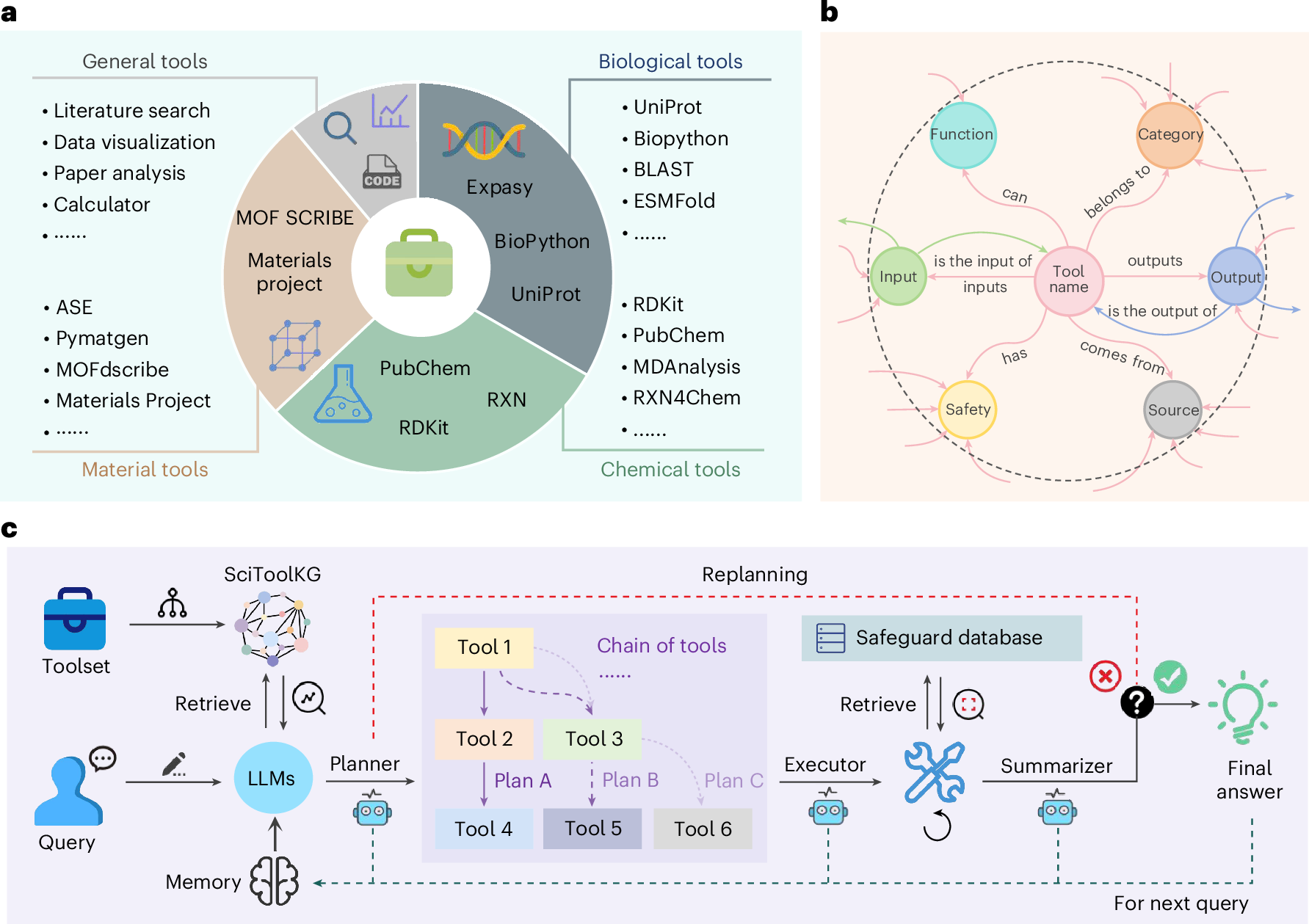
SciToolAgent: a knowledge-graph-driven scientific agent for multitool integration
Scientific research increasingly relies on specialized computational tools, yet effectively utilizing these tools requires substantial domain expertise. While large language models show promise in tool automation, they struggle to seamlessly integrate and orchestrate multiple tools for complex scientific workflows. Here we present SciToolAgent, a large language model-powered agent that automates hundreds of scientific tools across biology, chemistry and materials science. At its core, SciToolAgent leverages a scientific tool knowledge graph that enables intelligent tool selection and execution through graph-based retrieval-augmented generation. The agent also incorporates a comprehensive safety-checking module to ensure responsible and ethical tool usage. Extensive evaluations on a curated benchmark demonstrate that SciToolAgent outperforms existing approaches. Case studies in protein engineering, chemical reactivity prediction, chemical synthesis and metal–organic framework screening further demonstrate SciToolAgent’s capability to automate complex scientific workflows, making advanced research tools accessible to both experts and nonexperts.
SWE-Bench Pro: Can AI Agents Solve Long-Horizon Software Engineering Tasks?
Large Language Model (LLM) agents have been widely adopted in modern software development workflows. SWE-bench [13] and related works [23, 24, 22, 25, 15] establish the task of issue resolution as a de-facto standard for assessing their capability and usefulness. In this setting, an agent is given an entire codebase, a task description (e.g., a bug report or feature request) in natural language and is instructed to produce a code patch that resolves the issue and passes the repository’s test suite. These benchmarks have been instrumental in demonstrating both the substantial potential and the persistent limitations of current models as SWE agents.
Optimizing Agentic Workflows using Meta-tools
Agentic AI enables LLM to dynamically reason, plan, and interact with tools to solve complex tasks. However, agentic workflows often require many iterative reasoning steps and tool invocations,...

SlopCodeBench: Benchmarking How Coding Agents Degrade Over Long-Horizon Iterative Tasks
Software development is iterative, yet agentic coding benchmarks hide design issues through their single-shot setup. Recent iterative benchmarks attempt to remedy this but heavily constrain an agent's design decision space, making it impossible to faithfully measure how their decisions shape future extensions. We introduce SlopCodeBench, a benchmark of 36 problems and 196 checkpoints where agents repeatedly extend their own solutions. Unlike prior iterative benchmarks, our evolving specifications demand architectural decisions but leave internal structure to the agent. We measure two forms of degradation: structural erosion (concentrated complexity) and verbosity (redundant code). Evaluating 15 coding agents across open and closed models, we find that no agent fully solves any problem end-to-end, and the best agent passes 14.8% of checkpoints. Quality degrades across checkpoints, with structural erosion rising in 77% of trajectories and verbosity in 75.5%. Compared to 473 open-source Python repositories, agent code is 2.3x more verbose and 2.0x more eroded, and the human repositories degrade less often and by smaller margins across their git histories. Explicit quality guidance reduces initial verbosity and erosion by up to a third, without affecting degradation rates. SlopCodeBench provides the first measurement of code degradation under iterative extension, revealing that agents pass checkpoints while producing code that erodes and bloats with each turn.
SlopCodeBench: Benchmarking How Coding Agents Degrade Over Long-Horizon Iterative Tasks
Software development is iterative, yet agentic coding benchmarks overwhelmingly evaluate single-shot solutions against complete specifications. Code can pass the test suite but become progressively harder to extend. Recent iterative benchmarks attempt to close this gap, but constrain the agent’s design decisions too tightly to faithfully measure how code quality shapes future extensions. We introduce SlopCodeBench, a language-agnostic benchmark comprising 20 problems and 93 checkpoints, in which agents repeatedly extend their own prior solutions under evolving specifications that force architectural decisions without prescribing internal structure. We track two trajectory-level quality signals: verbosity, the fraction of redundant or duplicated code, and structural erosion, the share of complexity mass concentrated in high-complexity functions. No agent solves any problem end-to-end across 11 models; the highest checkpoint solve rate is 17.2%. Quality degrades steadily: erosion rises in 80% of trajectories and verbosity in 89.8%. Against 48 open-source Python repositories, agent code is 2.2x more verbose and markedly more eroded. Tracking 20 of those repositories over time shows that human code stays flat, while agent code deteriorates with each iteration. A prompt-intervention study shows that initial quality can be improved, but it does not halt degradation. These results demonstrate that pass-rate benchmarks systematically undermeasure extension robustness, and that current agents lack the design discipline iterative software development demands.
InsightEval: An Expert-Curated Benchmark for Assessing Insight Discovery in LLM-Driven Data Agents
Data analysis has become an indispensable part of scientific research. To discover the latent knowledge and insights hidden within massive datasets, we need to perform deep exploratory analysis to realize their full value. With the advent of large language models (LLMs) and multi-agent systems, more and more researchers are making use of these technologies for insight discovery. However, there are few benchmarks for evaluating insight discovery capabilities. As one of the most comprehensive existing frameworks, InsightBench also suffers from many critical flaws: format inconsistencies, poorly conceived objectives, and redundant insights. These issues may significantly affect the quality of data and the evaluation of agents. To address these issues, we thoroughly investigate shortcomings in InsightBench and propose essential criteria for a high-quality insight benchmark. Regarding this, we develop a data-curation pipeline to construct a new dataset named InsightEval. We further introduce a novel metric to measure the exploratory performance of agents. Through extensive experiments on InsightEval, we highlight prevailing challenges in automated insight discovery and raise some key findings to guide future research in this promising direction.
Towards autonomous biology: Compiler-Verified Protocols as a Foundation for Real-World AI Execution
Artificial intelligence has advanced from analyzing experimental data to autonomously generating hypotheses, designing experiments, and coordinating closed loop discovery. Yet the translation from computational reasoning to physical execution remains bottlenecked by the experimental protocol, which in biology still relies on ambiguous natural-language descriptions: a medium other engineering disciplines abandoned decades ago in favor of compiler verified specification languages. This deficit fragments reproducibility along three axes: protocol accuracy, pre execution verification, and cross platform portability. Existing formalisms address only subsets of these challenges, trading expressiveness for rigor, portability for standardization, or usability for provenance. Here we introduce the Biology Protocol Language (BPL), a domain specific language with a biology-native type system in which every quantity carries physical units, every reagent declares its physical form, and every container maintains compiler-tracked state, so that implicit assumptions must be stated explicitly and physically impossible operations are rejected at compile time. We further develop BPL-COGEN, a pipeline that couples a fine tuned 30 billion parameter language model with the deterministic compiler in a closed generate validate repair loop, iteratively correcting the translation from natural language SOPs to BPL through compiler diagnostics until all physical, dimensional, and state constraints are satisfied. On a benchmark of 300 published Nature Protocols papers, BPL COGEN achieved an overall fidelity score of 95.1 against the source protocols as ground truth. Wet-lab experiment and cross-platform validation in GFP expression library construction and HPLC to UHPLC method translation confirmed that a single BPL source yielded reproducible execution across manual and liquid handler assisted contexts. The results established a novel pipeline that generates compiler-verified protocols, which is an essential prerequisite for physically embodied AI in biology.
Accelerating scientific discovery with Co-Scientist
Scientific discovery is driven by scientists generating novel hypotheses for complex problems that undergo rigorous experimental validation. To augment this process, we introduce Co-Scientist, a multi-agent AI system built on Gemini for structured scientific thinking and hypothesis generation. Co-Scientist aims to help scientists discover new original knowledge. Conditioned on their research objectives and prior scientific evidence, it formulates demonstrably novel research hypotheses for experimental verification. The system's design involves agents continuously generating, critiquing and refining hypotheses accelerated by scaling test-time compute. Key contributions include: (1) a multi-agent architecture with an asynchronous task execution framework for flexible compute scaling; (2) a tournament evolution process for self-improving hypotheses generation. Automated evaluations show continued benefits of test-time compute scaling, improving hypothesis quality over time. While general purpose, we focus the validation in three biomedical applications: drug repurposing, novel target discovery, and explaining mechanisms of anti-microbial resistance. Specifically, Co-Scientist helped identify new drug repurposing candidates and synergistic combination therapies for acute myeloid leukemia, which were validated through in vitro experiments. These real-world validations demonstrate the potential of Co-Scientist to accelerate scientific discovery and usher in an era of AI empowered scientists.
Agentic systems are adept at solving well-scoped, verifiable problems in computational biology
We introduce CompBioBench, a benchmark of 100 diverse tasks for evaluating agentic systems in computational biology. Unlike mathematics and programming, which more readily admit systematic verification, biological data are inherently noisy and open to interpretation.
NeuralBench: A Unifying Framework to Benchmark NeuroAI Models | Hubert Banville
🧠 NeuralBench is now open source. Today we're releasing NeuralBench, a unified framework for benchmarking foundation models of brain activity, developed by the Brain & AI team at FAIR, Meta. 💻 Code: https://lnkd.in/dNJsgBgM 📄 White paper: https://lnkd.in/dvWMg7rx Brain foundation models are starting to show positive transfer to a range of downstream tasks, from brain-computer interfacing to clinical classification. But systematically evaluating them is hard: heterogeneous preprocessing pipelines, input structures, and adaptation methodologies make results difficult to compare. Most prior work also focuses on a narrow set of downstream tasks. NeuralBench addresses this by defining each task end-to-end with config files (data source, preprocessing, splits, optimiser, metrics, architecture) so all models can be evaluated on the same footing. What's in our first release, NeuralBench-EEG v1.0: ⚡ 36 EEG tasks across 94 public datasets, spanning motor imagery, clinical classification, cognitive decoding, and phenotype prediction. 🤖 Task-specific deep learning architectures (EEGNet, Deep4, EEGConformer, CTNet, ...) benchmarked side-by-side with recent EEG foundation models (BENDR, LaBraM, BIOT, CBraMod, LUNA, REVE). 🧩 Extensible to other neuroimaging modalities: the framework already runs MEG and fMRI tasks, leveraging our NeuralSet ecosystem for accessing brain imaging data and the broader neuroscientific software stack. 📜 Released under the MIT license. Help us make it better. Through our white paper, we invite the community to contribute new tasks, datasets, and models, especially for fMRI, MEG, and iEEG. The long-term goal is a fully unified benchmark across neuroimaging tasks and modalities. 🙏🙏🙏 This was a big team effort with Stéphane d'Ascoli, Simon Dahan, Jérémy RAPIN, Marlène Careil, Yohann Benchetrit, Jarod Lévy, Saarang P., Antoine Ratouchniak, Lucy (Mingfang) Zhang, Elisa Cascardi, Katie Begany, Teon Brooks, and Jean-Rémi King. Special thanks to Alexandre Gramfort, Thomas Moreau, Arnaud Delorme, Bruno A. and Pierre Guetschel for feedback and support. #Neuroscience #AI #NeuroAI #Python #OpenSource

Recursive Self-Improvement through Multi-Agent Self-Supervision
Recursive self-improvement (RSI) of a model on non-verifiable tasks, such as open-ended research, faces a supervision bottleneck when its outputs exceed what even human experts can reliably assess, leaving the model itself (optimizee) as the best available optimizer and evaluator. However, a single model instance struggles to critique and improve its own complex reasoning under this homogeneous loop. To address this, we propose Multi-Agent Self-Supervision (MASS), an RSI method that alternates between evolutionary workflow optimization and supervised fine-tuning on self-generated trajectories. Guided by early findings that multi-agent topologies excel at complex reasoning, MASS prompts a single base model to iteratively propose, execute, and self-evaluate multi-agent workflows. Through an evolutionary search constrained by structural guardrails, the model optimizes these computational-graph-like orchestrations, discovering the most effective distinct roles and information routing for a given task. Over two MASS cycles with Qwen3.6-27B, the model achieves 1.2-1.6x higher performance per output tokens on four open-ended public benchmarks. Because the improved model subsequently acts as a better optimizer and evaluator, this alternating framework enables a continuous, recursive bootstrapping of the model's capabilities. Moreover, multi-agent traces are also more training-efficient: a student trained on them outperforms a single-agent student trained on 1.4x more training tokens. These findings suggest that jointly learning orchestration and bounded subagent execution from multi-agent trajectories can provide an effective signal for RSI.
Agentic Laboratories of the Future: Towards World Models for Scientific Discovery
Scientific discovery is fundamentally a problem-solving process involving distributed intelligence. Human intuition, computational reasoning, and experimental execution are distributed across people, instruments, and software systems, limiting the speed and scale of discovery. Although automation, high-throughput experimentation, foundation models, and cloud infrastructure have accelerated individual stages of the scientific workflow, they have not unified the discovery process. We hypothesize that the next generation of laboratories will be agentic: environments in which scientists, AI systems, and robotic platforms operate as collaborative discovery partners, with humans contributing the parts of discovery that remain hardest to make explicit: asking the right questions and holding provisional mechanistic models of how a system works. The key missing layer is an agentic harnessing layer that continuously integrates hypothesis, literature-derived evidence, experimental data, uncertainty, and experimental state into a shared “laboratory world model”—a dynamic representation of the scientific system and its evolving context. By maintaining and updating this lab world model, the agentic harnessing layer enables coordinated decision-making, adaptive planning, and increasingly autonomous scientific workflows across humans and machines. A central challenge is that much of the scientific research process remains inaccessible to machines, including tacit knowledge, human observations, adaptive decision-making, and evolving experimental context. Advances in multimodal AI and immersive interfaces may help bridge this gap, allowing humans, agents, and robotic systems to collaborate seamlessly in scientific discovery rather than simply automating isolated tasks. Agentic laboratories could provide a new architecture for science, integrating human, artificial, and physical intelligence into a unified discovery system.

Rethinking bioinformatics expertise in the era of artificial intelligence
Artificial intelligence (AI) is often framed as replacing scientific expertise, especially in bioinformatics. We argue instead that AI is a powerful accelerant whose value depends on expert guidance in design, data curation, interpretation, and governance. Because AI cannot judge biological meaning or verify scientific validity, bioinformaticians remain essential. Their role is shifting from workflow execution toward AI design, complex discovery, and responsible institutional leadership across research, translation, and clinical practice.
An Interpretable Automated Mechanism Design Framework with Large Language Models
Mechanism design has long been a cornerstone of economic theory, with traditional approaches relying on mathematical derivations. Recently, automated approaches, including differentiable economics with neural networks, have emerged for designing payments and allocations. While both analytical and automated methods have advanced the field, they each face significant weaknesses: mathematical derivations are not automated and often struggle to scale to complex problems, while automated and especially neural-network-based approaches suffer from limited interpretability. To address these challenges, we introduce a novel framework that reformulates mechanism design as a code generation task. Using large language models (LLMs), we generate heuristic mechanisms described in code and evolve them to optimize over some evaluation metrics while ensuring key design criteria (e.g., strategy-proofness) through a problem-specific fixing process. This fixing process ensures any mechanism violating the design criteria is adjusted to satisfy them, albeit with some trade-offs in performance metrics. These trade-offs are factored in during the LLM-based evolution process. The code generation capabilities of LLMs enable the discovery of novel and interpretable solutions, bridging the symbolic logic of mechanism design and the generative power of modern AI. Through rigorous experimentation, we demonstrate that LLM-generated mechanisms achieve competitive performance while offering greater interpretability compared to previous approaches. Notably, our framework can rediscover existing manually designed mechanisms and provide insights into neural-network based solutions through Programming-by-Example. These results highlight the potential of LLMs to not only automate but also enhance the transparency and scalability of mechanism design, ensuring safe deployment of the mechanisms in society.