

This book offers a comprehensive introduction to the central ideas that underpin deep learning. It is intended both for newcomers to machine learning and for those already experienced in the field.
Unsupervised Feature Learning and Deep Learning Tutorial
Stanford CS231N Deep Learning for Computer Vision | Spring 2025 | Lecture 1: Introduction
Deep Learning - The Biggest Data Science Breakthrough of the Decade - O'Reilly Media Free, Live Events
Machine learning and AI have appeared on the front page of the New York Times three times in recent memory: 1) When a computer beat the world's #1 chess player 2) When Watson beat the world's best Jeopardy players 3) When deep learning algorithms won a chemo-informatics Kaggle...

Algorithmic Data Minimization for Machine Learning over...
Machine learning can analyze vast amounts of data generated by IoT devices to identify patterns, make predictions, and enable real-time decision-making. By processing sensor data, machine learning...

Understanding Deep Learning Algorithms that Leverage Unlabeled Data, Part 2: Contrastive Learning
Theoretical analysis of contrastive learning algorithms for leveraging unlabeled data.
An Introduction to Transformers
The transformer is a neural network component that can be used to learn useful representations of sequences or sets of data-points. The transformer has driven recent advances in natural language processing, computer vision, and spatio-temporal modelling. There are many introductions to transformers, but most do not contain precise mathematical descriptions of the architecture and the intuitions behind the design choices are often also missing. Moreover, as research takes a winding path, the explanations for the components of the transformer can be idiosyncratic. In this note we aim for a mathematically precise, intuitive, and clean description of the transformer architecture. We will not discuss training as this is rather standard. We assume that the reader is familiar with fundamental topics in machine learning including multi-layer perceptrons, linear transformations, softmax functions and basic probability.
On Network Science and Mutual Information for Explaining Deep Neural Networks
View recent discussion. Abstract: In this paper, we present a new approach to interpret deep learning models. By coupling mutual information with network science, we explore how information flows through feedforward networks. We show that efficiently approximating mutual information allows us to create an information measure that quantifies how much information flows between any two neurons of a deep learning model. To that end, we propose NIF, Neural Information Flow, a technique for codifying information flow that exposes deep learning model internals and provides feature attributions.
ImageNet Classification with Deep Convolutional Neural Networks
We trained a large, deep convolutional neural network to classify the 1.3 million high-resolution images in the LSVRC-2010 ImageNet training set into the 1000 different classes. On the test data, we achieved top-1 and top-5 error rates of 39.7\% and 18.9\% which is considerably better than the previous state-of-the-art results. The neural network, which has 60 million parameters and 500,000 neurons, consists of five convolutional layers, some of which are followed by max-pooling layers, and two globally connected layers with a final 1000-way softmax. To make training faster, we used non-saturating neurons and a very efficient GPU implementation of convolutional nets. To reduce overfitting in the globally connected layers we employed a new regularization method that proved to be very effective.
Deep learning with convolutional neural networks for EEG decoding and visualization
Deep learning with convolutional neural networks (deep ConvNets) has revolutionized computer vision through end-to-end learning, that is, learning from the raw data. There is increasing interest in u...

Deep Learning with Python
Start building deep learning applications with Python and Keras today!

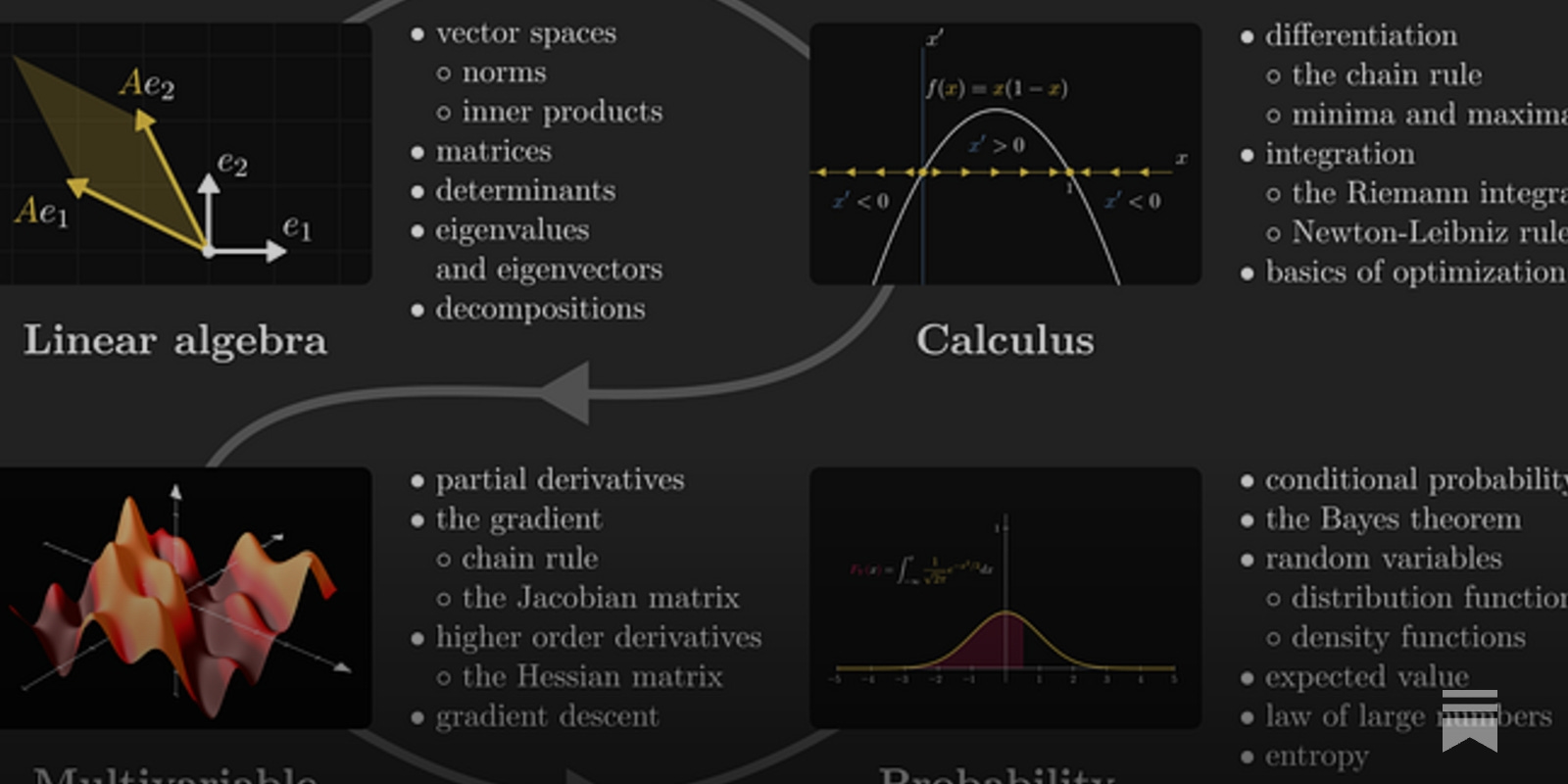
The Roadmap of Mathematics for Machine Learning
A complete guide to linear algebra, calculus, and probability theory
Introducing beginners to the mechanics of machine learning – Miriam Posner
Every year, I spend some time introducing students to the mechanics of machine learning with neural nets. I definitely don’t go into great depth; I usually only have one class for this. But I try to unpack at least some of the major concepts, so that ML isn’t quite such a black box.
Simple Pricing | Machine Learning Infrastructure | Deep Infra
We provide only pay-what-you-use pricing with no long-term contracts or upfront costs for our machine learning models and infrastructure. Learn more!
Deep learning for assisting the process of music composition (part 1)
This is part 1 of my explorations of using deep learning for assisting the process of music composition. In this part, I look at some almost-winning output of a model trained by deep learning metho…

DeepSeek_V4.pdf · deepseek-ai/DeepSeek-V4-Pro at main
We’re on a journey to advance and democratize artificial intelligence through open source and open science.