

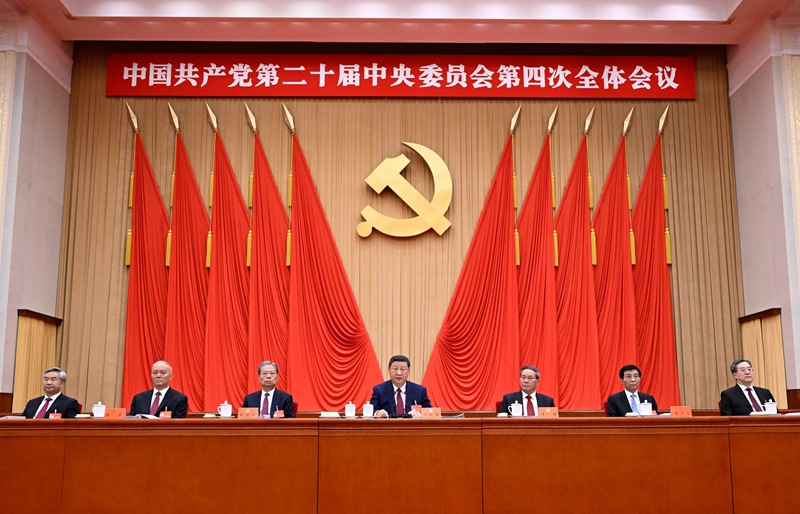
The Five-Year Plans provide a rare form of certainty in China, in a world of increasing uncertainty

Are Council contenders ready for "big freaking deal" changes to the Official Plan?
City Hall Watcher #388: Damien Moule on the "largest change to municipal land use planning in Ontario in decades", plus CITY HALL WATCHER LIVE lets you reflect on 15+ years of Council coverage
Project 2025 Tracker
A comprehensive, community-driven initiative to track the implementation of Project 2025's policy proposals
The Future, Made in China
Beijing is competing with the U.S. for tech supremacy. Who wins will have huge political implications.

Who’s Afraid of Chinese Models? (Stratechery Article 7-20-2026)
China releases document on vision, actions for Belt and Road cooperation in next decade
China on Friday published a document titled "Vision and Actions for High-Quality Belt and Road Cooperation: Brighter Prospects for the Next Decade."
Countries of the Belt and Road Initiative (BRI) – Green Finance & Development Center
By May 2025, the number of countries that have joined the Belt and Road Initiative (BRI) by signing a Memorandum of Understanding (MoU) with China and have not exited the BRI is 150. However, due to uncertainties on MoU**, it can be said that
Our Uncertain Uncertainties
Even the experts inventing AI don’t know what will happen next.

Exclusive-Beijing is looking at curbing overseas access to China's top AI models, sources say - AOL
By Fanny Potkin SINGAPORE, July 7 (Reuters) - Chinese authorities have held meetings with top tech firms over the past month about potentially restricting overseas access to China's most advanced AI

The Expert Trap and the Next War
what forecasting failure tells us about the future

February 2026 Global Dialogues Survey | Windfall Trust
Windfall Trust is bringing together tech pioneers, economists, and policymakers to plan for a future where no one is left behind.
Green economic planning as ‘directed entanglement’
Sustainability transformations depend on ambitious state action. We propose green economic planning as a framework for states to set ambitious climate plans and ensure policy coherence across three dimensions: inputs (sources of information, planning directors, and political regimes), processes (technical expertise and political negotiation), and outputs (monetary-financial, fiscal, and state ownership strategies). To capture how green economic planning works across democratic and authoritarian institutions, we conducted a comparative case study of three countries. France’s intersectoral non-green and Denmark’s sectoral green planning covers democratic institutions, while China’s intersectoral green planning covers authoritarian institutions. Through these cases, we show that 1) green economic planning is both feasible and adaptable across diverse political economies, 2) effective planning requires balancing decentralized information flow with strong central coordination, 3) successful planning depends on managing tensions between autonomous planning agencies, market discipline, and long-term political legitimacy. We term this ‘directed entanglement,’ positioning it as a cornerstone for the emerging research agenda on green economic planning—a blueprint for navigating the use of the state to steer a green transition under capitalism.n analytical framework of elite and resistant imaginaries to trace how these actors construct competing futures of platform labour in EU regulation. These imaginaries transpire in response to the reorganisation of labour relations amidst the digital transformation of socioeconomic institutions. They reveal how platform infrastructures challenge institutional boundaries and reshape the governance of work in the EU. Through a qualitative methodology that combines critical thematic and discourse analysis of stakeholder submissions, the study investigates the frictions that transpire when elite and resistant imaginaries encounter one another. The inductive framework of ‘elite’ and ‘resistant’ imaginaries of platform work illuminates the strategic negotiation of categories and its evolution throughout the policymaking process. The research contributes to scholarship on digital labour and the governance of platforms and algorithmic systems within the EU by offering a critical communications account of how competing imaginaries interact within the regulatory infrastructures of the digital economy. The central empirical contribution of the project lies in re-situating regulatory arbitrage through the analytical lens of elite/resistant imaginaries and discursive friction. The analysis demonstrates how BusinessEurope takes advantage of longstanding techniques of regulatory escape, such as burden shifting and legal fragmentation, and combines them with the systemic structural asymmetries within the European single market to incentivise lenience for platform self-governance models and soft law (Scharpf, 1999). By analysing digital transformation and status classification, the thesis demonstrates how the future of the platform labour economy is co-constructed through frictions that culminate in a sophisticated arbitrage strategy, organised around the ontological construction of the platform as an ‘intermediary’ (Gillespie, 2010). The next chapter discusses the conceptual map of regulatory arbitrage in the PWD as a critical output of the research and considers the limitations of this project, and the future trajectory of trade union discourse on platform work.
Gauging the Strength of China’s Economy in Uncertain Times
An update on China’s recent economic performance and policy changes, focusing on aggregate credit as a measure to gauge policy stimulus.


