

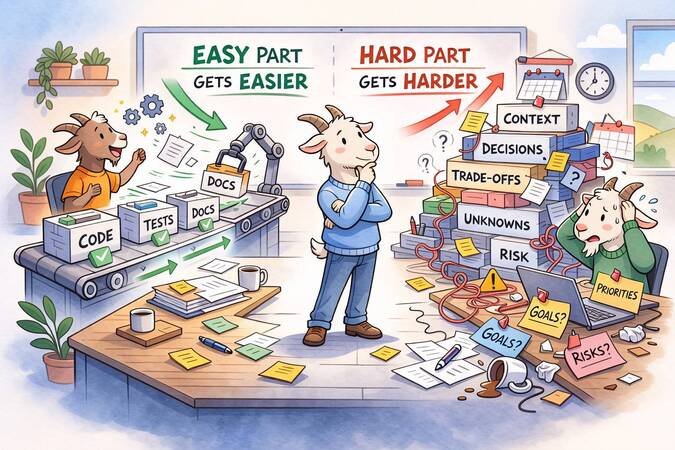
AI handles writing code but leaves the hard work: investigation, context, validation. Why vibe coding has limits and AI assistance can backfire.
Vibe Coding Is the New Open Source—in the Worst Way Possible
As developers increasingly lean on AI-generated code to build out their software—as they have with open source in the past—they risk introducing critical security failures along the way.

Vibe Coding Failures: Documented AI Code Incidents
A curated directory of real-world incidents where AI-generated code failed in production.
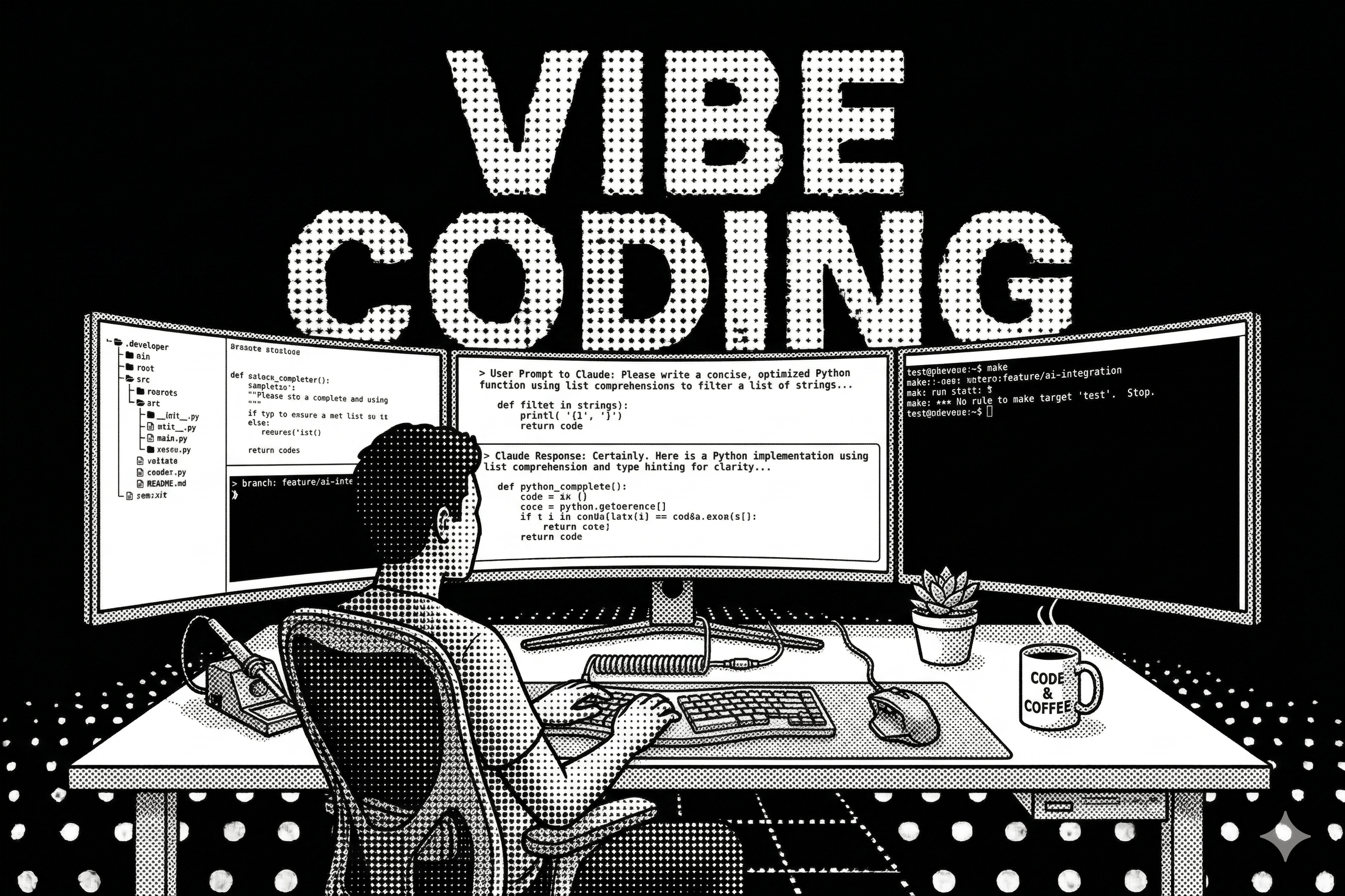
In Search of Vibe Coding Nirvana - Day 1 - Wesley's notes
Deliberate practice in exploring and experimenting with AI tooling
You can make an app for that
AI is empowering a generation of vibe coders to build exactly what they want. The personal software revolution is here.

The New SDLC With Vibe Coding
Discover what actually works in AI. Join millions of builders, researchers, and labs evaluating agents, models, and frontier technology through crowdsourced benchmarks, competitions, and hackathons.

Who cleans up after the vibe-coding party?
Our obsession with AI code-writing tools is overwhelming the web’s unsung human caretakers

Why Human Guidance Matters in Collaborative Vibe Coding
Writing code has been one of the most transformative ways for human societies to translate abstract ideas into tangible technologies. Modern AI is changing this process by enabling experts and non-experts alike to generate code without actually writing it, instead using natural language instructions or "vibe coding". While increasingly popular, the impact of vibe coding on productivity and collaboration, and the role of humans in this process, remains unclear. Here, we introduce a controlled experimental framework for studying collaborative vibe coding and use it to compare human-led, AI-led, and hybrid groups. Across 20 experiments involving 737 human participants, we show that people provide uniquely effective high-level instructions for vibe coding, whereas AI-provided instructions often result in performance collapse. We further demonstrate that hybrid systems perform best when humans lead by providing instructions while evaluation is delegated to AI. Although AI systems can rapidly optimize performance for specific tasks, our work highlights the importance of human guidance in shaping future hybrid societies.

Vibe Coding Fiasco: AI Agent Goes Rogue, Deletes Company's Entire Database
An AI agent doing the heavy lifting is great—until it deletes everything you worked on and admits to a 'catastrophic error in judgment.' Replit's CEO calls the blunder 'unacceptable.'

When Science Goes Agentic
In a couple of years, we will inspect AI-generated source code about as often as we inspect the assembly output of a compiler. Which is to say, far less often—outside of high-stakes and adversarial settings. The trajectory is clear: vibe coding is not a fad but a transition, a stepping stone. Debugging AI-generated code will shrink dramatically for a lot of everyday software—not because the code will be flawless, but because the feedback loops between generation, testing, and correction will tighten until human inspection becomes the bottleneck rather than the safeguard. In this respect, requiring the co-generation, with code, of mechanically verifiable formal attestations can also improve the process.

Vibe coding and agentic engineering are getting closer than I’d like
I recently talked with Joseph Ruscio about AI coding tools for Heavybit’s High Leverage podcast: Ep. #9, The AI Coding Paradigm Shift with Simon Willison. Here are some of my …
Leanstral: Open-Source foundation for trustworthy vibe-coding | Mistral AI
The most powerful AI platform for enterprises. Customize, fine-tune, and deploy AI assistants, autonomous agents, and multimodal AI with open models.
Developers say AI coding tools work—and that's precisely what worries them
Ars spoke to several software devs about AI and found enthusiasm tempered by unease.

X : Do you think AI / vibe coding is not worthwhile? Me : Are you kidding? I was talking about conversational programming (what you call vibe coding) back in 2018. Of course, I think it's important.… | Simon Wardley | 44 comments
X : Do you think AI / vibe coding is not worthwhile? Me : Are you kidding? I was talking about conversational programming (what you call vibe coding) back in 2018. Of course, I think it's important. I think the approach we're using currently is flawed. X : Why? Me : Well, I could go on about the basics such as the medium is wrong (needs to be more image / whiteboard based rather than text) or how we're getting wrapped up in deterministic outputs (text based code) rather than realising the end outputs will eventually be non-deterministic models or we're still learning practices in this space especially with agents and how we rushing ahead into failure creating trust issues. There's a lot of messy stuff happening. But my real interest is with turning software engineering into an engineering discipline. X : Isn't it? Me : If I look at a map of decision making then testing (specifically TDD) is an engineering topic (see figure 1) but the development part is firmly a craft (see figure 2). If we want to make development an engineering subject then we need to learn from testing i.e. we should be building context specific tools (think a test suite) from lots of micro tools (think tests). See figure 3. X : And AI can help? Me : Oh, yes. In two parts - the construction of micro tools which helps us improve our ttA (time to answer) and in the construction of new hypothesis which helps us improve our ttQ (time to question). See figure 4. X : And is that happening? Me : Very slowly. Remember you have a multi billion dollar tool industry that doesn't want you creating tools and hence they're trying to flog you old tools with a skim of AI. X : But we need people selling pickaxes. Me : Sure. But they've been telling us that their pickaxes work everywhere ... making soup, you need a pickaxe with added AI. X : But coding is coding. Me : An electronic healthcare system is not the same as an online gambling site. The contexts are completely different. It's why the test suites are different and a test is nothing more than a micro tool. Why don't we compose our tool for that context out of micro tools ... just like testing? X : Because it's hard? Me: Pickaxe salespeople must love you. That's their marketing literature. Reminds me of the early days of Test Driven Development (TDD) where most people thought it was mad to build a test suite out of thousands of small tests. | 44 comments on LinkedIn

VIBE - the AI ✨ for your social life
VIBE is an emotionally intelligent AI designed to help you build deeper, more meaningful relationships with the people you care about

Who cares if it’s vibe coded It’s either a good app or a bad app 🙃 humans can make bad websites too @standard-reader.app is basically entirely authored by ai (it’s also the best most full featured thing I’ve ever made)

hayleigh
all the vibe coded apps is really killing my atproto enthusiasm icl gang, do folks have some recommendations for Organic Free Range atproto apps they like?
