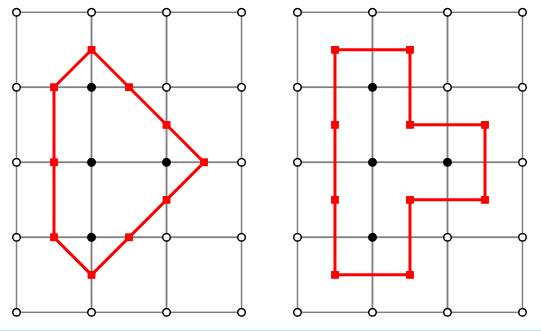
How to create a sharp mesh from a function without even trying In part 1 and part 2 of the series, we looked at the Marching Cubes algorithm, and how it can turn any function into a grid based mesh…
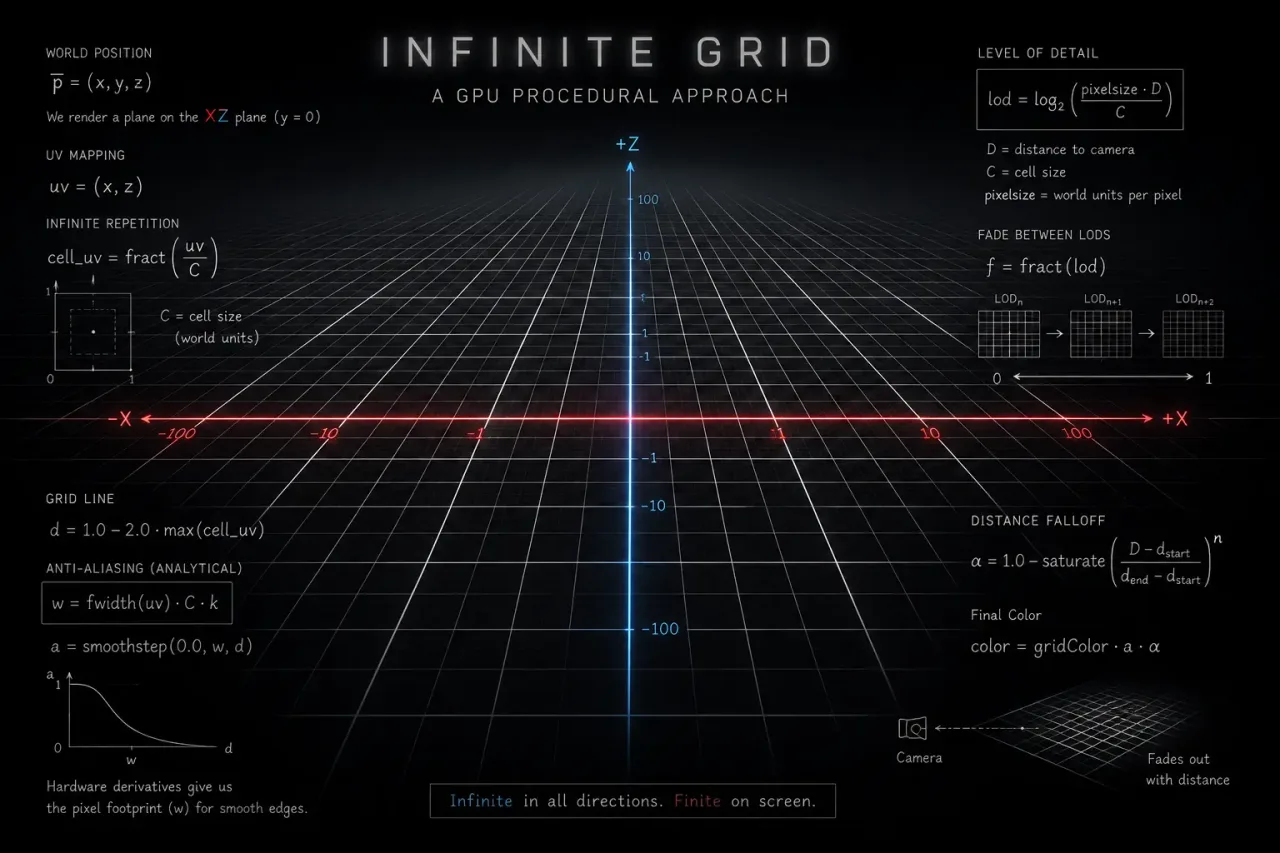
Infinite Grid Shader
Learning to create an infinite grid procedurally using GLSL shaders. This post contains my notes, lessons and findings, and is intended for personal reference. Therefore, you might find errors, misjudgments, and other issues, which are fine by me because my intention was to learn by teaching myself. In a way, I was being my own rubber duck.
Discontinuity-Aware 2D Neural Fields
Neural image representations offer the possibility of high fidelity, compact storage, and resolution-independent accuracy, providing an attractive alternative to traditional pixel- and grid-based representations. However, coordinate neural networks fail to capture discontinuities present in the image and tend to blur across them; we aim to address this challenge. In many cases, such as rendered images, vector graphics, diffusion curves, or solutions to partial differential equations, the locations of the discontinuities are known. We take those locations as input, represented as linear, quadratic, or cubic \bez curves, and construct a feature field that is discontinuous across these locations and smooth everywhere else. Finally, we use a shallow multi-layer perceptron to decode the features into the signal value. To construct the feature field, we develop a new data structure based on a curved triangular mesh, with features stored on the vertices and on a subset of the edges that are marked as discontinuous. We show that our method can be used to compress a 100,000^2-pixel rendered image into a 25MB file; can be used as a new diffusion-curve solver by combining with Monte-Carlo-based methods or directly supervised by the diffusion-curve energy; or can be used for compressing 2D physics simulation data.
Nicole Feng
We introduce a method for approximating the signed distance function (SDF) of geometry corrupted by holes, noise, or self-intersections. The method implicitly defines a completed version of the shape, rather than explicitly repairing the given input. Our starting point is a modified version of the heat method for geodesic distance, which diffuses normal vectors rather than a scalar distribution. This formulation provides robustness akin to generalized winding numbers (GWN), but provides distance function rather than just an inside/outside classification. Our formulation also offers several features not common to classic distance algorithms, such as the ability to simultaneously fit multiple level sets, a notion of distance for geometry that does not topologically bound any region, and the ability to mix and match signed and unsigned distance. The method can be applied in any dimension and to any spatial discretization, including triangle meshes, tet meshes, point clouds, polygonal meshes, voxelized surfaces, and regular grids. We evaluate the method on several challenging examples, implementing normal offsets and other morphological operations directly on imperfect curve and surface data. In many cases we also obtain an inside/outside classification dramatically more robust than the one obtained provided by GWN.
Nicole Feng
We describe a method for computing signed distance to point clouds that allows fast pointwise evaluation at arbitrary spatial resolution. As input, our method takes a point cloud with normals; as output, it provides an analytical parameterization that allows queries of signed distance to the approximate underlying surface at arbitrary points — simultaneously providing reconstruction and distance. Our key idea is to reconstruct shapes by locally fitting point clouds with tori, which have closed-form signed distance functions. Tori are fitted in a feed-forward manner, using a pre-trained network to output per-point curvature and shift parameters. Importantly, our method does not require costly global optimization or spatial discretization, and is easily parallelizable. Underlying our method is a new theory that unifies signed distance with the classic reconstruction methods of winding numbers and Poisson surface reconstruction. We use our method to compute signed distance to point clouds arising from photogrammetry, meshes, 3D Gaussians, and neural implicits. Our method allows point clouds to be used directly in applications, without explicit surface reconstruction: as examples, we take offsets of point clouds, apply morphological and Boolean operations, and directly visualize offset surfaces using sphere tracing.
Bezier Curve as Easing Function In C++
It’s been a while since my last guest post on Adam’s blog, but I’m back with something short and practical—think of it as an epilogue to this earlier post on Bézier curves in animation. The last post focused on the theory and mathematics behind Bézier curves. What it lacked was a practical perspective—an opportunity to see the implementation in action. I wanted to share with you a simple library that I have created. Its purpose is to directly represent cubic Bézier Curves as Easing Functions.
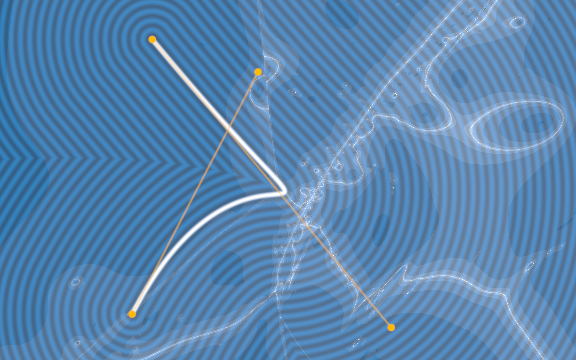
Fast calculation of the distance to cubic Bezier curves on the GPU
Bézier curves are a core building block of text and 2D shapes rendering. There are several approaches to rendering them, but one especially challenging problem, both mathematically and technically, is computing the distance to a Bézier curve. For quadratic curves (one control point), this is fairly accessible, but for cubic (two control points) we're going to see why it is so hard.
Lindenmayer Systems
Let me show you how to use Lindenmayer systems to produce beautiful images like this one:
Evaluating and Sampling Glinty NDFs in Constant Time
Geometric features between the micro and macro scales produce an expressive family of visual effects grouped under the term 'glints'. Efficiently rendering these effects amounts to finding the highlights caused by the geometry under each pixel. To allow for fast rendering, we represent our faceted geometry as a 4D point process on an implicit multiscale grid, designed to efficiently find the facets most likely to cause a highlight. The facets' normals are generated to match a given micro-facet normal distribution such as Trowbridge-Reitz (GGX) or Beckmann, to which our model converges under increasing surface area. Our method is simple to implement, memory-and-precomputation-free, allows for importance sampling and covers a wide range of different appearances such as anisotropic as well as individually colored particles. We provide a base implementation as a standalone fragment shader.
Massively Parallel Rendering of Complex Closed-Form Implicit Surfaces
Figure 1: An assortment of implicit surfaces rendered using our technique. Left: an extruded text string, rotated and rendered as a heightmap. Center: a bear head sculpted using smooth blending operations, with normals found by automatic differentiation. Right: a complex architectural model rendered with screen-space ambient occlusion and perspective. All models are rendered directly from their mathematical representations, without triangulation or raytracing.
A guide to fast voxel ray tracing using sparse 64-trees
If you have ever tried to ray trace voxels before, you might have heard about Sparse Voxel Octrees. They are one of those ideas that are just simple and clever enough to be intriguing, but not so great to hold in practice at the basic premise.
mmeshy - make beautiful mesh gradients
Design buttery smooth mesh gradients in the browser and export high-res images. All for free.
Bézier Spline Simplification Using Locally Integrated Error Metrics
This summary was generated using automated tools and was not authored or reviewed by the article's author(s). It is provided to support discovery, help readers assess relevance, and assist readers from adjacent research areas in understanding the work. It is intended to complement the author-supplied abstract, which remains the primary summary of the paper. The full article remains the authoritative version of record. Click here to learn more.

Voxel Displacement Renderer — Modernizing the Retro 3D Aesthetic
This is the first of two posts about a renderer I have been developing, focusing on what I've built and how it works. The second post discusses why I've built it and my plans for the future. I've been developing a custom real-time renderer which uses very small voxels to produce a distinctive visual style that modernizes the look and feel of classic 90's 3D games. By approaching the problem of rendering voxels in an unusual way, I'm able to produce these visuals from conventional art assets — low-poly triangle meshes and textures — that are familiar and efficient to create. [...]

The mathematical beauty of hyperbezier curves
The mathematical beauty of hyperbezier curves