


Elite impunity has fueled the fantasy that catastrophes are for other people.
Why Being Wrong Can Be Right: Magical Warfare Technologies and the Persistence of False Beliefs
Across human societies, one sees many examples of deeply rooted and widely held beliefs that are almost certainly untrue. Examples include beliefs about witchcraft, magic, ordeals, and superstitions. Why are such incorrect beliefs so prevalent and how do they persist? We consider this question through an examination of superstitions and magic associated with conflict in the Eastern Democratic Republic of the Congo. Focusing on superstitions related to bullet-proofing, we provide theory and case-study evidence showing how these incorrect beliefs persist. Although harmful at the individual-level, we show that they generate Pareto efficient outcomes that have group-level benefits.
People Are Losing Loved Ones to AI-Fueled Spiritual Fantasies
Marriages and families are falling apart as people are sucked into fantasy worlds of spiritual prophecy by AI tools like OpenAI's ChatGPT


The Joy of Becoming Worthless…except to each other — Douglas Rushkoff
My last piece, The Intentional Collapse, seems to have agitated a few people. I know it came off a bit dark. I talked about how the Uber wealthy believe the world as we know it is ending and that there won’t be enough essential resources to go around, so they need to take control of as much money and stuff and land as possible in order to position themselves for the end of days.
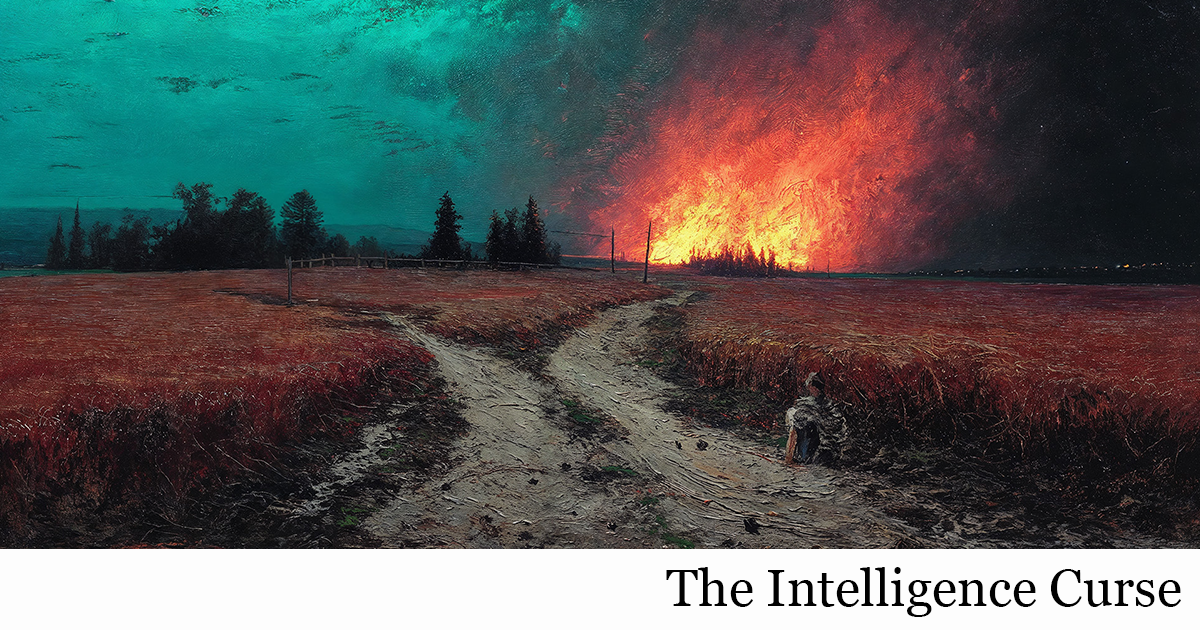
The Intelligence Curse
This series examines the incoming crisis of human irrelevance and provides a map towards a future where people remain the masters of their destiny.
Imagination: a manifesto
One of The Millions's Most-Anticipated Books of Winter 2024 In this revelatory work, Ruha Benjamin calls on us to take imagination seriously as a site of struggle and a place of possibility for reshaping the future

Nicky Case: The Attractors Behind Disasters
The Age of Wonders and Terrors
Twenty years ago, when the idea of AI taking over the world in our lifetimes still struck most of us as the unconstrained fantasy of those who knew too much science fiction and too little science, …

The sad decline of effective altruism
A once wholesome and inspiring movement has become entangled with cults and has lost years chasing dead-end ideas

Resource recs on AI catastrophic risk
If nothing magic is happening in the human brain, things could get weird


Michel Bauwens on Twitter / X
This is the deeper motivation that inspires Caitlin's work:< " It is possible for the human organism to liberate itself from its habituated creation of the ego through the process commonly referred to as spiritual enlightenment. It is also possible for humanity as a species to… https://t.co/smsjPAnNFr— Michel Bauwens (@mbauwens) June 18, 2026
‘Self-termination is most likely’: the history and future of societal collapse
An epic analysis of 5,000 years of civilisation argues that a global collapse is coming unless inequality is vanquished

Serenity and the Myth of "Getting Out the Signal" - Reactor
We want to believe that knowledge will change the world for the better, but it's not always that simple.

This, and even more - to get super-rich almost requires *suppressing* the cultivation of a self or interiority. “Our system produces, elevates, and rewards psychopaths.” x.com/uTobian/status/20412132683884…

Levi Stahl
The empty boredom of the super-rich who never had to cultivate a self or interiority is the root cause of so many of our problems.

