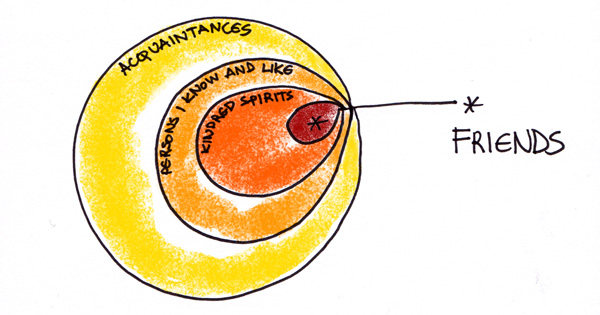
Exploring the concentric circles of human connection through the lens of our ideal and real selves.
You have more ways to connect than ever, but deep friendship feels hard to find – here’s how to build better connections
Despite being more connected than any previous generation, many young people report struggling to build friendships that provide a genuine sense of closeness.

We've Lost the Spaces That Foster Friendship
We keep offering individual fixes for loneliness while ignoring the disappearance of the spaces where adults once built real relationships.

Shared Reality: Experiencing Commonality with others' Inner States about the World
Humans have a fundamental need to experience a shared reality with others. We present a new conceptualization of shared reality based on four conditions. We posit (a) that shared reality involves a (subjectively perceived) commonality of individuals' inner states (not just observable behaviors); (b) that shared reality is about some target referent; (c) that for a shared reality to occur, the commonality of inner states must be appropriately motivated; and (d) that shared reality involves the experience of a successful connection to other people's inner states. In reviewing relevant evidence, we emphasize research on the saying-is-believing effect, which illustrates the creation of shared reality in interpersonal communication. We discuss why shared reality provides a better explanation of the findings from saying-is-believing studies than do other formulations. Finally, we examine relations between our conceptualization of shared reality and related constructs (including empathy, perspective taking, theory of mind, common ground, embodied synchrony, and socially distributed knowledge) and indicate how our approach may promote a comprehensive and differentiated understanding of social-sharing phenomena.

What Does it Mean to be Friends?
This issue explores what friendship and social connection mean across fragmented digital platforms, using the technical architecture of Bluesky as a lens for understanding why we perform different…
What Does it Mean to be Friends?
This issue explores what friendship and social connection mean across fragmented digital platforms, using the technical architecture of Bluesky as a lens for understanding why we perform different…
The Innovation of Loneliness
What is the connection between Social Networks and Being Lonely? Quoting the words of Sherry Turkle from her TED talk - Connected, But Alone. (http://www.ted.com/talks/sherry_turkle_alone_together.html) Also Based on Dr. Yair Amichai-Hamburgers hebrew article -The Invention of Loneliness. Script, Design & Animation: Shimi Cohen Translation to Portuguese: Letícia Dabés (vimeo.com/leticiatranslation //leticiadabes@gmail.com) Translation to French: Marie-Caroline Braud (http://mariecarolinetranslation.jimdo.com/) Final Project at Shenkar College of Engineering and Design.

The Science of Making Friends
Starting in early adulthood, our number of friends starts to decrease steadily; there are ways to reverse the tide, writes Elizabeth Bernstein.

Friendslop = Friendless<<Slop>> Or: Will We Ever Lock Eyes When We Play Again?
Without humanist intent friendslop is the Ghost of Play’s Past. It is the Ghost of Play’s Present. It is the Ghost of Play Never to Come.

Undersociality: miscalibrated social cognition can inhibit social connection
A person’s well-being depends heavily on forming and maintaining positive relationships, but people can be reluctant to connect in ways that would create or strengthen relationships. Emerging research suggests that miscalibrated social cognition may create psychological barriers to connecting with others more often. Specifically, people may underestimate how positively others will respond to their own sociality across a variety of social actions, including engaging in conversation, expressing appreciation, and performing acts of kindness.

s21e02: What Does it Mean to be Friends?
0.0 Context Setting Wednesday, 14 January 2026 in Portland, Oregon where while the conditions in the U.S. may not be argued to be fascist as such (i.e. the...
Dunbar’s number: why my theory that humans can only maintain 150 friendships has withstood 30 years of scrutiny
The claim that our brain size limits us to 150 meaningful friendships has been challenged by a recent paper.

The Central Paradox of Love: Esther Perel on Reconciling the Closeness Needed for Intimacy with the Psychological Distance That Fuels Desire
“Love rests on two pillars: surrender and autonomy. Our need for togetherness exists alongside our need for separateness. One does not exist without the other.”

Why Linking Matters: Network Effects and Other Benefits - Interaction Institute for Social Change
“We cannot live for ourselves alone. Our lives are connected by a thousand invisible threads, and along those sympathetic fibers, our actions run as causes and return to us as results.” – Herman Melville In an earlier post in this series on networks and education, we explored the underlying vitality of connection and flow in... Read More
Rewire: Digital Cosmopolitans in the Age of Connection
A rousing call to action for those who would be citizens of the world―online and off. We live in an age of connection, one that is accelerated by the Internet. This increasingly ubiquitous, immensely powerful technology often leads us to assume that as the number of people online grows, it inevitably leads to a smaller, more cosmopolitan world. We’ll understand more, we think. We’ll know more. We’ll engage more and share more with people from other cultures. In reality, it is easier to ship bottles of water from Fiji to Atlanta than it is to get news from Tokyo to New York. In Rewire, media scholar and activist Ethan Zuckerman explains why the technological ability to communicate with someone does not inevitably lead to increased human connection. At the most basic level, our human tendency to “flock together” means that most of our interactions, online or off, are with a small set of people with whom we have much in common. In examining this fundamental tendency, Zuckerman draws on his own work as well as the latest research in psychology and sociology to consider technology’s role in disconnecting ourselves from the rest of the world.For those who seek a wider picture―a picture now critical for survival in an age of global economic crises and pandemics―Zuckerman highlights the challenges, and the headway already made, in truly connecting people across cultures. From voracious xenophiles eager to explore other countries to bridge figures who are able to connect one culture to another, people are at the center of his vision for a true kind of cosmopolitanism. And it is people who will shape a new approach to existing technologies, and perhaps invent some new ones, that embrace translation, cross-cultural inspiration, and the search for new, serendipitous experiences.Rich with Zuckerman’s personal experience and wisdom, Rewire offers a map of the social, technical, and policy innovations needed to more tightly connect the world.


Relationship Design
Peter McGraw sits with Jessalyn Dean to discuss relationship design. Tune in as they challenge societal norms and craft connections beyond convention.