

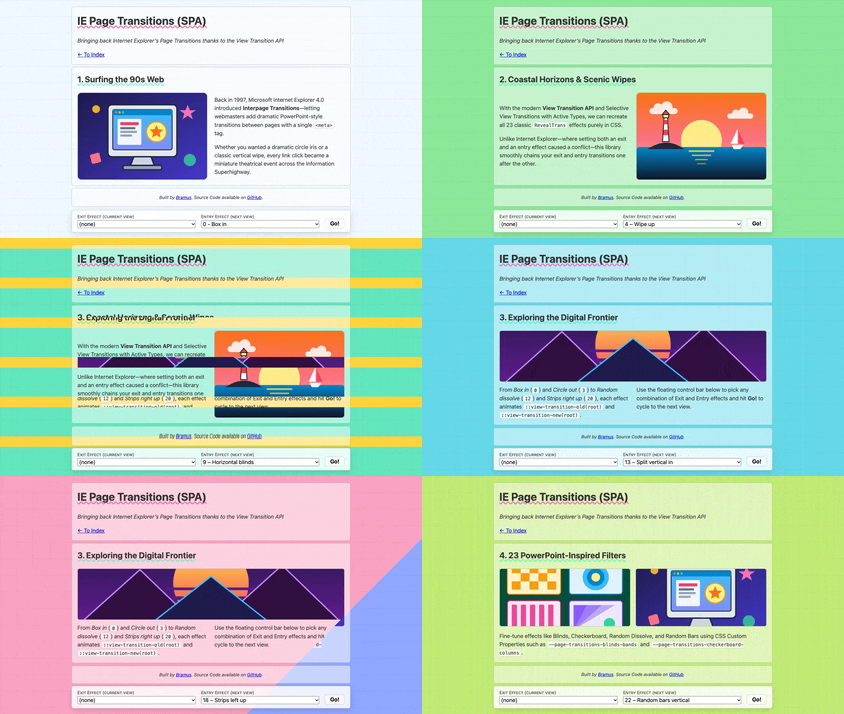
Back in late 2024, I started working on a fun end-of-year side project named ie-page-transitions. It”s a CSS + JS library that brings back Microsoft Internet Explorer’s proprietary “Interpage Transitions” to modern browsers, powered by the View Transition API. After sitting unfinished for a while, I finally got all 23 classic effects over the finish line and published the project on page-transitions.style.
Bringing Microsoft Internet Explorer’s proprietary “Interpage Transitions” back to Modern Browsers using the View Transition API
Back in late 2024, I started working on a fun end-of-year side project named ie-page-transitions. It”s a CSS + JS library that brings back Microsoft Internet Explorer’s proprietary “Interpage Transitions” to modern browsers, powered by the View Transition API. After sitting unfinished for a while, I finally got all 23 classic effects over the finish line and published the project on page-transitions.style.
page-transitions.style — Bringing back Internet Explorer’s Page Transitions
Bringing back Internet Explorer’s Page Transitions thanks to the View Transition API
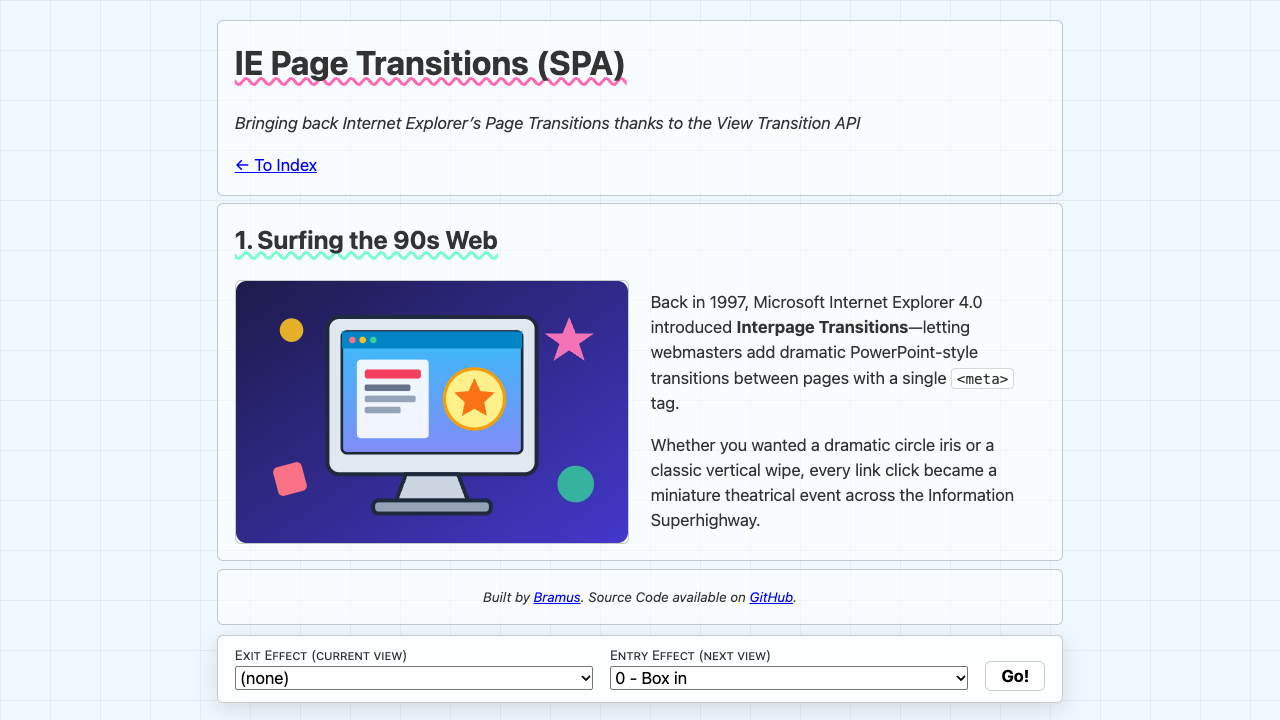
bramus/ie-page-transitions
Bringing back Internet Explorer’s Page Transitions thanks to the View Transition API
swup — Versatile and extensible page transition library for server-rendered websites
Versatile and extensible page transition library for server-rendered websites

View Transitions API | 12 Days of Web
Providing a native API for animated page and element transitions.

Native-Like Animations for Page Transitions on the Web | CSS-Tricks
Some of the most inspiring examples I’ve seen of front-end development have involved some sort of page transitions that look slick like they do in mobile

Cross-Document View Transitions: The Gotchas Nobody Mentions | CSS-Tricks
This is Part 1 of a two-part series about cross-document view transitions, going over all the gotchas, from ditching the deprecated way to opt into them to a little-known 4-second timeout.

18 Years of Internet Explorer Design History - 54 Images - Version Museum
A comprehensive visual history of Microsoft Internet Explorer from 1995 to 2013. See a gallery of the Microsoft Internet Explorer evolution from the beginning to 2013.

Animating and Compositing | Web Browser Engineering
Complex web applications use animations when transitioning between states. These animations help users understand the state change and they improve visual polish by replacing sudden jumps with gradual changes. But to execute these animations smoothly, the browser must minimize time in each animation frame, using GPU acceleration to speed up visual effects and compositing to minimize rendering work.
2022 CSS Updates | 12 Days of Web
Review (nearly) eleven exciting additions to CSS that became fully or nearly cross-browser in 2022!
Scroll-driven Animations: The Road to Baseline Newly Available (CSS)
This scrolled timeline traces the 12-year journey of Scroll-Driven Animations from the earliest proposal in September 2014 to becoming Baseline Newly Available in October 2026 with the release of Firefox 159.
Adding Visual Effects | Web Browser Engineering
Right now our browser can only draw colored rectangles and text—pretty boring! Real browsers support all kinds of visual effects that change how pixels and colors blend together. To implement those effects, and also make our browser faster, we’ll need control over surfaces, the key low-level feature behind fast scrolling, visual effects, animations, and many other browser capabilities. To get that control, we’ll also switch to using the Skia graphics library and even take a peek under its hood.
Chrome for Developers (@developer.chrome.com)
After 12 years, Scroll-Driven Animations are officially Baseline Newly Available 🎉 Pure CSS scroll-driven animations work across every major browser engine! Celebrate this milestone with our animated timeline tracing the feature's history since 2014 → goo.gle/3Urm9fT

【Modern Web 2015】JavaScript at 20 Years - Brendan Eich
Firefox's Major 'Nova' Redesign Officially Arrives in Nightly!