


Sanderson’s Second Law A few years back, I wrote an essay on creating magic systems that I titled Sanderson’s First Law. It had to do with the nature of foreshadowing as it relates to solving problems with magic. In that essay, I implied that I had other “laws” for magic systems that I’d someday talk about. Well, that
Sanderson's First Law
Sanderson’s First Law Introduction I like magic systems. That’s probably evident to those of you who have read my work. A solid, interesting and innovative system of magic in a book is something that really appeals to me. True, characters are what make a story narratively powerful—but magic is a large part of what make

Sanderson’s Third Law of Magic
Sanderson’s Third Law of Magic We’re celebrating the release of Steelheart, my new novel! It’s out this week. If you missed yesterday’s post, you can read up on the book here, listen to the first five chapters of the audiobook here, and watch the trailer here. Please consider going to your retailer of choice and lookin

Three Laws of Robotics
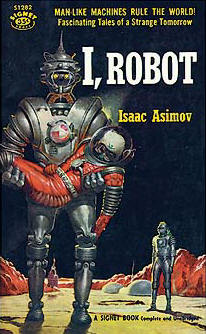
The Three Laws of Robotics are a set of rules devised by science fiction author Isaac Asimov, which were to be followed by robots in several of his stories. The rules were introduced in his 1942 short story "Runaround", although similar restrictions had been implied in earlier stories.
The Laws of Simplicity
John Maeda's book, The Laws of Simplicity, proposes ten laws for simplifying complex systems in business and life. Think of it as simplicity 101.

The Other Asimov | Los Angeles Review of Books
Isaac Asimov’s laws of robotics have influenced AI’s development, but to what end?

Law of thought
In logic and philosophy, "laws of thought" is a dated expression referring to three logical principles: the law of identity (LOI), the law of non-contradiction (LNC), and the law of excluded middle (LEM).[1]
Demystifying the second law of thermodynamics
Thermodynamics is really weird. Most people have probably encountered a bad explanation of the basics at some point in school, but probably don't remember more than
The Myth and Magic of Generating New Ideas
A mathematician on how to get the mind into motion.

Home | Laws of UX
Laws of UX is a collection of best practices that designers can consider when building user interfaces.

Chapter Eight—Technology and the Law: The Automobile · University of Wisconsin Law School Digital Repository · University of Wisconsin Law School Digital Repository
University of Wisconsin Law School Law Library 975 Bascom Mall Madison, WI 53706 608-262-3394
A Primer on Debates over Law and Ethics of Autonomous Weapon Systems
For Lawfare readers interested in law and regulation of autonomous weapon systems (AWS), we’re pleased to note our new essay, recently posted to SSRN, “Debating Autonomous
My Little Republic: Plato is Magic - Overthinking It
Socrates, first among Bronies.

MAGICevidence website
Trustworthy guidelines, evidence summaries and decision aids that we can all use and share

How Police Make Up The Law (ft. LegalEagle)
Directing large language models to follow the letter or spirit of the law
The distinction between the spirit and letter of the law is a central issue across research and everyday life, and a growing concern for building safe, intelligent machines. What is this distinction based on, and how can we develop machines that follow the intention behind a rule? We used targeted adaptation that made large language models prioritize the spirit or letter of the law. With minimal modifications, our method significantly changed LLM behavior across diverse measures, novel vignettes, real-world scenarios, and influential legal cases. An analysis of model internals revealed a low-dimensional space with three interpretable dimensions matching a formal pre-specified framework for the geometry of legal concepts. These findings show how legal thought in LLMs may be organized and directed.

Computational Law

RaC, rules as code, legislation as code, automated decision making, papers, resources, disasters, people

Legislation as Code | Version: 2

Governing Digital Legal Systems: Insights on Artificial Intelligence and Rules as Code · MIT Computational Law Report
Hamish Fraser