

How much regulation is happening under the Trump administration? This tracker helps you monitor a selection of delayed, repealed, and new rules, notable guidance and policy implementations, and important court battles covering energy, health, labor, and more.
Litigation Tracker: Legal Challenges to Trump Administration Actions
A public resource tracking the legal challenges to the Trump administration's executive orders and actions.

Where AI Regulation Stands Today
The White House has released a National Artificial Intelligence Legislative Framework and new executive orders aiming to establish a single, nationwide standard for AI regulation...

Trump Action Tracker | Keeping a tally of Trump's actions
Free and independent tracker documenting Trump-related actions using verified news sources. Statements & plans mapped to authoritarianism domains.
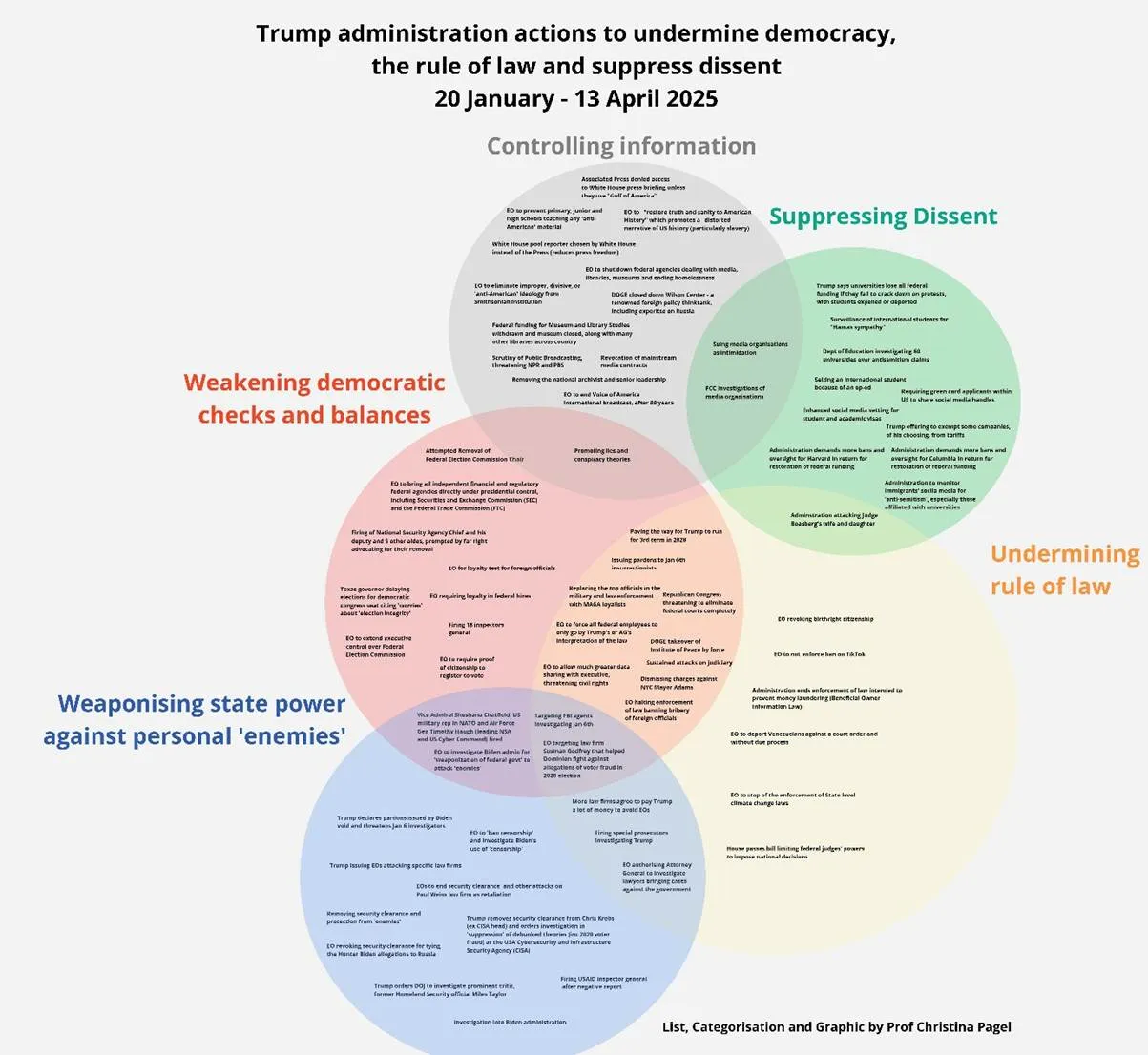
Trump Action Tracker | Keeping a tally of Trump's actions
Free and independent tracker documenting Trump-related actions using verified news sources. Statements & plans mapped to authoritarianism domains.
Litigation Tracker
Find legal challenges to executive orders and actions from the Trump administration.

US Domestic Policy Dashboard - Impact Counter | Impact Counter
Explore US domestic policies and their impact on public health across all branches of government.
What Can We Learn From the FDA Model for AI Regulation? - AI Now Institute
After holding a rapid deliberation late last year that convened deep experts on the FDA alongside key participants in the AI policy debate, we pulled together several immediate insights into a memo. Though it was clear the path forward isn’t to port over any single regulatory model wholesale, hosting a deep dive into the Food […]

The Anti-Corruption Tracker: Mapping the Erosion of Oversight and Accountability
This Anti-Corruption Tracker focuses on the erosion or dismantling of oversight and accountability systems within the United States Executive Branch

Collection: Just Security’s Coverage of Trump Administration Executive Actions
Ongoing coverage, including in concise “What Just Happened” expert explainers, legal and policy analysis, and other resources.

Regime Change: Inside the Imperial Presidency of Donald Trump
INSTANT #1 NEW YORK TIMES BESTSELLER “Regime Change is exceptional. It transcends its genre...the book is packed with news that will stay news...This is reporting of consequence.” —David Remnick, The New Yorker “A flabbergasting feat of political reporting.” —Tina Brown “Riveting and richly textured...What the authors add is the vivid detail that makes these events feel actual. They wrest reality itself back from the distorted world of entertainment, illusion, fantasy, and denial that Trump has generated around himself. It is this flood of provocation, atrocity, self-dealing, and fabrication that makes Haberman and Swan’s counternarrative so vital.” —Fintan O’Toole, The New York Times A riveting, intimate, and revelatory account of the most radical and consequential presidency of our time.From the two reporters who have covered him more closely than perhaps anyone else over the past decade comes this definitive portrait of Donald Trump in the White House. Regime Change covers the first year of Trump’s second presidency—a term liberated from every constraint that defined his first. The generals who once told him “no” are gone, and the lawyers who remain have learned to pick their battles. His administration has flouted court orders and he has claimed powers that Congress once checked. What remains is a President willing to take enormous risks that have upended global markets and toppled heads of state; an imperial President operating almost entirely on instinct alone. Based on hundreds of interviews and unprecedented reporting from deep within the administration’s most closely guarded rooms, Regime Change takes the reader inside the Situation Room and into the secret Oval Office deliberations that have launched a new war in the Middle East and seen Trump seal the border, surge National Guard troops into cities, and send immigration agents into deadly clashes with protestors. Maggie Haberman and Jonathan Swan bring us behind the scenes of a presidency that has transformed the culture, turned the Justice Department into an agent of retribution against the President’s enemies and the office itself into a brazen vehicle for profit. They reveal a second term propelled by a historical irony that Trump himself has come to understand: that the indictments, the convictions, the assassination attempts, and four years of exile made him not weaker but far more powerful, more vengeful, and more willing to gamble than any President in modern history. This is the story of how Trump has used that power, who has tried to stop him, and why nearly all of them have failed. It is also the story of something American journalists are more accustomed to chronicling in distant capitals than in their own: a President who has fundamentally altered the nature of the office he holds—and, with it, how the rest of the world understands American power. It is an account of Regime Change right here in America—a landmark real-time history of a modern presidency like no other.
Trump’s EPA Will Let Power Companies Unleash Unlimited Greenhouse Gas Pollution
Trump's EPA announced new changes that will eliminate federal limits on greenhouse gas emissions produced by power plants.

Trump drops restrictions on Anthropic's Mythos and Fable models | TechCrunch
The Trump administration's erratic approach to AI policymaking has left companies across the industry with little clarity about what will govern future model releases.

Explore Financial Disclosures From President Trump and 1,500 of His Appointees - ProPublica
Use this database to explore potential conflicts of interest for President Donald Trump and his team. The documents disclose positions officials have held outside government, their assets and their debts, among other things.
Trump’s DHS is using an obscure law to secretly snoop on journalists, non-profits and unions: ‘It’s outrageous’
Even after judges rejected the same ploy, the Trump administration is going directly to social media and telecommunications companies

Pacing the Frontier | Gillian K. Hadfield
The Pacing the Frontier letter calls on the US government to support an international effort to build the technical and governance tools needed to protect our option to pace AI development. I and others have been working on the problem of how to build such infrastructure for ten years, including participating in dialogues on AI safety with Chinese academic colleagues during the past three. Here are my suggestions: 1. Don’t rely on off-the-shelf models like FINRA and the FDA which were built for 20th Century single-domain government expertise. They’re not fit for purpose. 2. Don’t act like no-one’s thought about the AI governance problem before. We’ve spent two years refining a regulatory markets design into working legislative language, for example, and it’s now in AI governance bills in five states and in Congress. 3. Don’t try to write an exhaustive set of rules for AGI first. 4. Pick a domain that can achieve widespread global consensus to start. Mine would be recursive self-improvement: models should not build models. Build the technology that verifies that. 5. Focus relentlessly on building flexible verification infrastructure that is able to enforce whatever rules we can ultimately agree on. 6. Don’t assume we already know how to do this and governments can just write tests into law. Technology needs to be built and by the private sector. 7. Don’t wait for the infrastructure to emerge first. The components and people are there and the ecosystem can scale fast with the right incentives. 8. Incentivize large-scale investment in verification technology by building a governance structure and industry funding that creates a market for private verification organizations. 9. Use licensing and public oversight to ensure verifiers are independent of the frontier labs. 10. Protect sovereignty by enabling each government to license its own verifiers from a global market of verifiers recognized by other countries. 11. Leverage the incentive of global trade for models and model services by requiring verification for market access. 12. Just start. Sources in comments.
