

In our last post, we had some fun dunking on my poor, hapless TA. We asked and answered the question, “what is null”, and in answering that question, learned some important lessons about computer systems: 1. Everything is just data and context. When hardware and software components are interacting with
The Memory Walled Garden
The gap between first and third party memory systems
Your brain does not process information and it is not a computer | Aeon Essays
Your brain does not process information, retrieve knowledge or store memories. In short: your brain is not a computer

Anthropic's Opinionated Memory Bet
A deep dive into Claude's new memory tool—how it works, the architectural bets they're making, and whether it's the right fit for your application.
Basic Memory
AI conversations that actually remember. Never re-explain your project to your AI again. Join our Discord: https://discord.gg/tyvKNccgqN
ellen livia ᯅ on Twitter / X
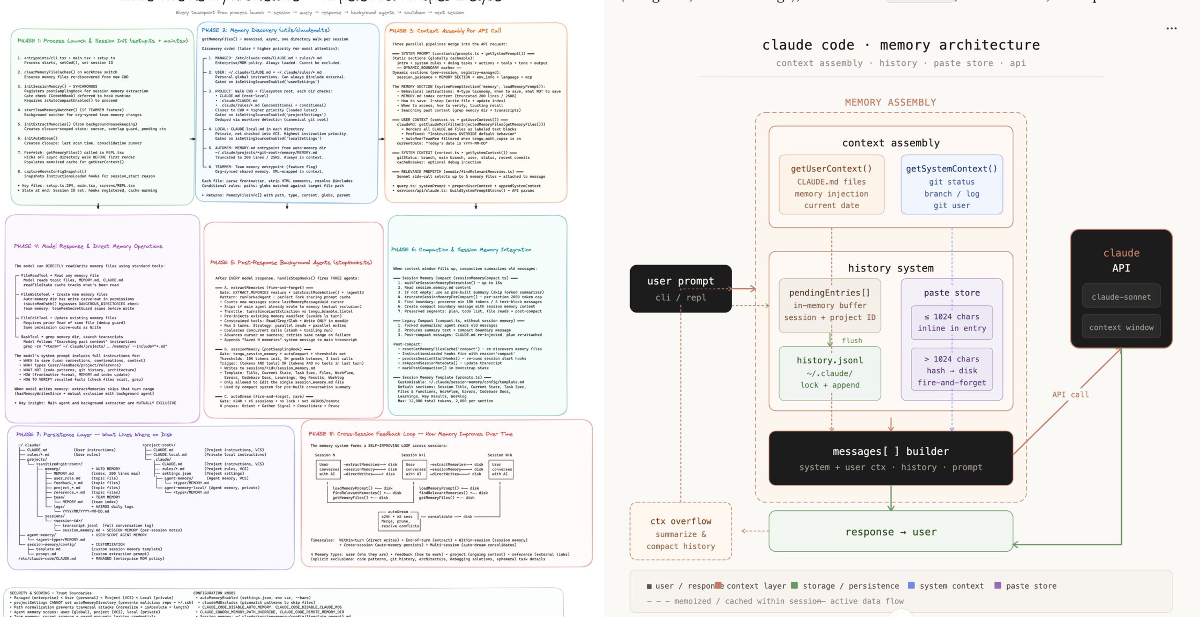
here's how Claude Code actually handles memory : all 8 phases 🧵Our team at @mem0ai use @claudeai a lot, we deeply care about memory. here is a summary of how it works 👇User Input -> Context Assembly -> History System -> API / Query -> Response -> SummaryPhase 1: session… pic.twitter.com/hcZbJzbUxB— ellen livia ᯅ (@ellen_in_sf) March 31, 2026
Memory system - Please Leave here your opinions (if you have any) · Issue #74 · code-yeongyu/oh-my-openagent
I heard many people wants that memory system- but it's really easy to be redundant from my experiences. Projects like claude-mem or many others have memory system. Want to hear your opinions re...
Ambient Associative Memory
Most agent memory waits to be queried. Ambient memory runs on every tool call — past lessons surface on their own, no rules list required.

The rebel alliance
This blog is co-authored with Zoe Weinberg and Matt Hawes at ex/ante, and is a follow-up to our first blog post on the topic, 'You don't own your memory.' We need an open architecture that puts us in control of our memories while making their exploitation technically impossible. But how will this shift happen? In order to discover possible implementations, we must understand how our data informs LLMs. The three predominant context engineering techniques are prompt design, retrieval-augmented ...

Agent Memory Patterns
A short HOW TO guide for agent memory systems. Especially the difference between blocks, files and skills.

nanomem: An Extremely Simple, Inference-Time Memory Module
nanomem is an extremely simple, user-owned memory module that casts memory management as LLM calls / agent loops on a markdown file tree. You interact with the tree with natural language commands like nanomem add <fact>, nanomem retrieve <query>, and nanomem import <chatgpt>. As such, nanomem is by design interpretable, partitionable, portable, and versioned.

AI Agent Memory: Complete Guide & Architecture
AI agent memory: what it is, how it works, architecture, memory types, and how to add persistent long-term context.


Pointers Are Complicated, or: What's in a Byte?
This summer, I am again working on Rust full-time, and again I will work (amongst other things) on a “memory model” for Rust/MIR. However, before I can talk about the ideas I have for this ...
Systems that defy detailed understanding
Last week, I wrote about the mindset that computer systems can be understood, and behaviors can be explained, if we’re willing to dig deep enough into the stack of abstractions our software is built atop. Some of the ensuing discussion on Twitter and elsewhere lead me to write this followup, in which I want to run through a few classes of systems where I’ve found pursuing in-detail understanding of the system wasn’t the right answer.