


Stay current on Cascadia Seaweed's latest milestones and innovations, and project updates from Cascadia Nature-based Solutions (CNbS).
Seaweed Kelp Recipes by BC Kelp
Easy, tasty, healthy, wild, edible kelp and seaweed recipes by BC Kelp BC Canada.
Could seaweed be the 'fastest and least expensive' tool to fight climate change?
A wave of startups say seaweed is a multi-pronged solution to climate change: It can absorb carbon, curb the effects of cattle's methane burps, and feed biofuels—not to mention the world.

Aquatic plants - Province of British Columbia
Find out more about requirements for the commercial harvest of seaweed. Aquatic plants include all species of plants found in B.C. waters.
Beyond sushi: 'Nature's Chef' shares tips, recipes for cooking with seaweed | CBC News
Personal chef Tom Kral shares his tips and recipes for cooking with seaweed.

Study raises concerns about contaminants in edible seaweeds
A new study just published by researchers at Western Washington University (WWU) reports concentrations of up to 162 chemical contaminants in three species of…

Food safety hazards in the European seaweed chain
Abstract Seaweed is a source of protein that can help overcome the anticipated challenges of a growing world population and the current challenges for finding alternatives for animal proteins in the Western diet. Thus far, data on the safety of seaweed for feed and food purposes in the Western world are scattered. This study aimed to review the available knowledge on the presence of food safety hazards in seaweed, including factors influencing their presence, and to prioritize the hazards that may pose a risk to human health. Given current knowledge from the literature, data from the Rapid Alert System for Food and Feed, and results from a stakeholder survey, 22 food safety hazards were ranked into major (4), moderate (5), and minor (13) hazards. Arsenic, cadmium, iodine, and Salmonella were identified as major hazards. Hazards, where data gaps exist, should be carefully assessed. These include pesticide residues, dioxins and polychlorinated biphenyls, brominated flame retardants, polycyclic aromatic hydrocarbons, pharmaceuticals, marine biotoxins, allergens, micro‐ and nanoplastics, other pathogenic bacteria, norovirus, and hepatitis E virus. It is recommended to collect more data on these hazards in future studies. Many factors can affect the presence of hazards including seaweed type, physiology, season, harvest and cultivation environment, geography including the location of cultivation, alongside further processing. Moreover, when seaweed is cultivated near industrialized or anthropogenic activities, these activities may negatively influence water quality, which can increase the likelihood of hazards in seaweed. Results of the ranking prioritized hazards can be used to prioritize monitoring programs and adjusted given future additional knowledge covering the data gaps.

Is it possible to make nori/seaweed sheets from scratch at home?
60 votes, 12 comments. Assuming I've bought the seaweed as opposed to cultivating it. I want to make and sell (hopefully) a nori based product that…
In Cell Studies, Seaweed Extract Outperforms Remdesivir in Blocking COVID-19 Virus | News
In a test of antiviral effectiveness against the virus that causes COVID-19, an extract from edible seaweeds substantially outperformed remdesivir, the current standard antiviral used to combat the disease.
Chemical contaminant levels in edible seaweeds of the Salish Sea and implications for their consumption
Despite growing interest in edible seaweeds, there is limited information on seaweed chemical contaminant levels in the Salish Sea. Without this knowledge, health-based consumption advisories can not be determined for consumers that include Tribes and First Nations, Asian and Pacific Islander community members, and recreational harvesters. We measured contaminant concentrations in edible seaweeds (Fucus distichus, F. spiralis, and Nereocystis luetkeana) from 43 locations in the Salish Sea. Metals were analyzed in all samples, and 94 persistent organic pollutants (POPs) (i.e. 40 PCBs, 15 PBDEs, 17 PCDD/Fs, and 22 organochlorine pesticides) and 51 PAHs were analyzed in Fucus spp. We compared concentrations of contaminants to human health-based screening levels calculated from the USEPA and to international limits. We then worked with six focal contaminants that either exceeded screening levels or international limits (Cd, total Hg, Pb, benzo[a]pyrene [BaP], and PCBs) or are of regional interest (total As). USEPA cancer-based screening levels were exceeded in 30 samples for the PCBs and two samples for BaP. Cadmium concentrations did not exceed the USEPA noncancer-based screening level but did exceed international limits at all sites. Lead exceeded international limits at three sites. Because there are no screening levels for total Hg and total As, and to be conservative, we made comparisons to methyl Hg and inorganic As screening levels. All samples were below the methyl Hg and above the inorganic As screening levels. Without knowledge of the As speciation, we cannot assess the health risk associated with the As. While seaweed was the focus, we did not consider contaminant exposure from consuming other foods. Other chemicals, such as contaminants of emerging concern (e.g., PFAS, pharmaceuticals and personal care products), should also be considered. Additionally, although we focused on toxicological aspects, there are cultural and health benefits of seaweed use that may affect consumer choice.
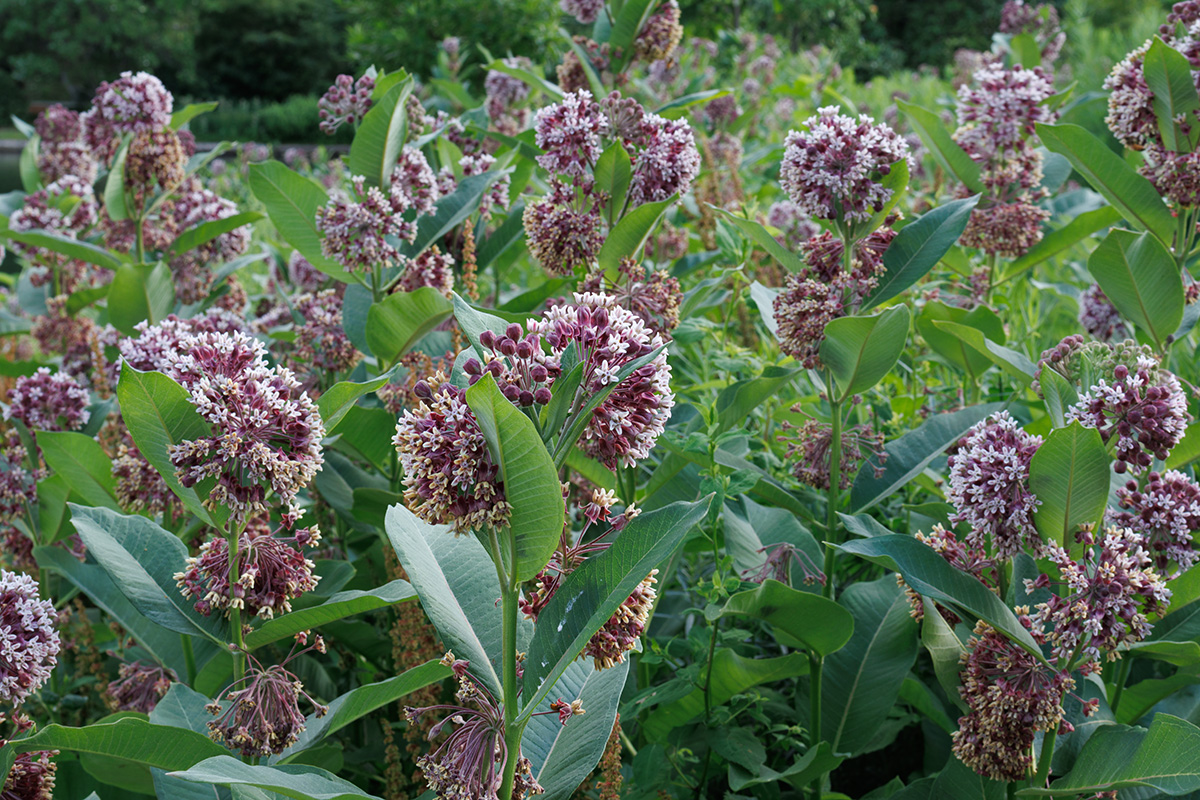
Milkweed Is a Monarch Butterfly Magnet—but Should You Plant It? Here's What to Know
Milkweed is an important plant for monarch butterfly populations, but certain species can also spread aggressively in a garden. We asked experts whether or not they think you should plant milkweed in your yard.

Common Milkweed: How to Grow This Native Perennial
Here's how and why to grow common milkweed, an important native perennial plant, with some expectation-management thrown in.
The invasive soft coral Xenia umbellata has been confirmed in Cuban waters
Octocoral colonies with unusual morphology were detected in September 2022 and October 2023 in two coastal areas east of Havana, Cuba, and tentatively identified as Unomia stolonifera. U. stolonifera is an invasive octocoral from the Indo-Pacific that was first reported in the Caribbean off Venezuela in the 2000s, where it has spread rapidly, smothering coral reefs and substantially altering benthic communities. After obtaining tissue samples from a Cuban octocoral colony, we re-examined the specimen using molecular barcoding of three mitochondrial regions (16S/ND2, mtMutS, COI) and the nuclear large ribosomal subunit (28S rRNA), and we unequivocally identified it as Xenia umbellata. X. umbellata, a native of the Red Sea, was first identified in southern Puerto Rico in October 2023 and has since been found in various marine ecosystems along the southern coast of the island. The presence of either invasive octocoral species in Cuba or elsewhere in the Caribbean would be of a serious environmental concern due to their documented tolerance, totipotentiality, propagation capacity and significant negative interactions with local benthic fauna. Attempts to eradicate the invasive soft coral colonies from Cuban waters have been initiated with apparent success, helping to control further expansion. The most likely introduction pathway is the accidental or intentional releases from the aquarium trade but transport via ballast water cannot be ruled out. We cannot discount the possibility of independent invasion events from different routes to Puerto Rico and Cuba occurring within a year of each other. Propagation from Cuba to Puerto Rico, or vice versa, which we consider highly improbable, would likely imply that soft coral populations may also have been established on Hispaniola but have remained undetected in the Dominican Republic and Haiti to date.

Kelp Forest Restoration in Australia
Kelp forests dominate the rocky coasts of temperate Australia and are the foundation of the Great Southern Reef. Much like terrestrial forests, these marine forests create complex habitat for diverse communities of flora and fauna. Kelp forests also support coastal food-webs and valuable fisheries and provide a suite of additional ecosystem services. In many regions of Australia and around the world, kelp forests are in decline due to ocean warming, overgrazing, and pollution. One potential tool in the conservation and management of these important ecosystems is habitat restoration, the science and practice of which is currently undergoing substantial expansion. We summarise the present state of Australian kelp forests and emphasise that consideration of the initial drivers of kelp decline is a critical first step in restoration. With a focus on Australian examples, we review methods, implementation and outcomes of kelp forest restoration, and discuss suitable measures of success and the estimated costs of restoration activities. We propose a workflow and decision system for kelp forest restoration that identifies alternative pathways for implementation and acknowledges that under some circumstances restoration at scale is not possible or feasible. As a case study, we then apply the Society of Ecological Restoration’s 5-star evaluation to Operation Crayweed, Australia’s primary example of kelp forest restoration. Overall, no single method of kelp forest restoration is suitable for all situations, but outcomes can be optimised by ameliorating the driver(s) of kelp decline and achieving ongoing natural recruitment of kelp. Whilst scalability of kelp forest restoration to the seascape-scale remains a considerable challenge, the present review should provide a platform for future restoration efforts. However, it is also crucial to emphasise that the challenges of restoration place a high value on preventative conservation and protection of existing kelp forest ecosystems – prevention is invariably better than cure.

A Model for Methylmercury Uptake and Trophic Transfer by Marine Plankton
Abstract. Methylmercury (MeHg) concentrations can increase by 100 000 times between seawater and marine phytoplankton, but levels vary across sites. To bet
We specialize in tropical, food bearing plants, that will grow and thrive in the Canadian environment.
Blanche Cybele Derby