


Restoration is the key to Canada’s efforts to reverse biodiversity loss — now a part of the country’s international obligations, after the COP15 UN biodiversity conference which was hosted in Montreal last December.
The Narwhal (@thenarwhal.ca)
Our pod of investigative journalists dives deep to tell stories about the natural world in Canada you can’t find anywhere else. Sign up for our newsletter: http://thenarwhal.ca/newsletter

Conservation Evidence - Site
This resource is designed to support anyone making decisions about how to maintain and restore biodiversity.

Metrics for biodiversity and health policy integration
Despite over a decade of progressive commitments from parties to the Convention on Biological Diversity (CBD), integrated biodiversity and health indicators and monitoring mechanisms remain limited, hampering achievement of the sustainable development goals and improvements in health and well-being. Adoption of the Kunming-Montreal Global Biodiversity Framework (2022) and the Global Action Plan on Biodiversity and Health (2024) provide a renewed entry point to shape the way governments approach health and wellbeing and address the environmental burden of disease. This is a critical opportunity that scholars at the health-environment nexus should not miss. This Perspective outlines building blocks to mobilize the field, starting with essential terminology and a scope of metrics needed by governments. We then evaluate elements to be considered in the construction of integrated metrics, including concepts, overarching challenges, a review of scientific hypotheses from an ecological perspective, as well as a set of principles and characteristics for indicators. To raise awareness across parallel communities of practice working at the health-environment nexus, we then briefly examine four approaches to integrated metrics developed by: conservationists, Indigenous scholars, One Health experts, and planetary health experts. We conclude with actionable steps to enhance governance, mobilize funding, and apply integrated indicators in national and global strategies. A broad science community is needed to support national governments to meet global commitments to address biodiversity loss and the environmental burden of disease concurrently. The overall aim of this paper is to contribute to addressing biodiversity loss by effectively linking policy and transdisciplinary practice at the health-environment nexus.

We specialize in tropical, food bearing plants, that will grow and thrive in the Canadian environment.
Biodiversity strategy to 2045: tackling the nature emergency - draft
This draft biodiversity strategy sets out our clear ambition for Scotland to be Nature Positive by 2030, and to have restored and regenerated biodiversity across the country by 2045.

IPBES Transformative Change Assessment: Summary for Policymakers
Summary for Policymakers of the Thematic Assessment Report on the Underlying Causes of Biodiversity Loss and the Determinants of Transformative Change and Options for Achieving the 2050 Vision for Biodiversity of the Intergovernmental Science-Policy Platform on Biodiversity and Ecosystem Services. The IPBES Transformative Change Assessment was initiated following a decision from the IPBES Plenary at its eigth session (IPBES-8, June 2021), and has been approved by the IPBES Plenary at its eleventh session (IPBES-11, Windhoek, 2024). It is composed of a Summary for Policymakers and five Chapters. IPBES is an independent intergovernmental body established by Governments in 2012, IPBES provides policymakers with objective scientific assessments about the state of knowledge regarding the planet’s biodiversity, ecosystems and the contributions they make to people, as well as options and actions to protect and sustainably use these vital natural assets.
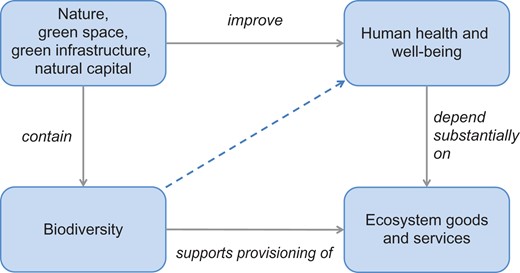
Biodiversity and human health: mechanisms and evidence of the positive health effects of diversity in nature and green spaces
AbstractIntroduction. Natural environments and green spaces provide ecosystem services that enhance human health and well-being. They improve mental health
IPBES Transformative Change Assessment : Full report
Thematic assessment of the underlying causes of biodiversity loss, determinants of transformative change and options for achieving the 2050 Vision for Biodiversity of the Intergovernmental Science-Policy Platform on Biodiversity and Ecosystem Services (IPBES) is composed of 1) a Summary for Policymakers (SPM), and 2) a set of five Chapters. All products of the assessment are available on Zenodo. Find all the links on the side bar "has part"
Tackling the Nature Emergency - strategic framework for biodiversity: consultation
A consultation on Scotland’s Strategic Framework for Biodiversity, including the first 5-year Delivery Plan for the Scottish Biodiversity Strategy, and elements of the proposed Natural Environment Bill.
Global assessment report on biodiversity and ecosystem services of the Intergovernmental Science-Policy Platform on Biodiversity and Ecosystem Services
IPBES is to perform regular and timely assessments of knowledge on biodiversity and ecosystem services and their interlinkages at the global level. Also addressing an invitation by the Conference of the Parties of the Convention on Biological Diversity (CBD) to prepare a global assessment of biodiversity and ecosystem services building, inter alia, on its own and other relevant regional, subregional and thematic assessments, as well as on national reports. The overall scope of the assessment is to assess the status and trends with regard to biodiversity and ecosystem services, the impact of biodiversity and ecosystem services on human well-being and the effectiveness of responses, including the Strategic Plan and its Aichi Biodiversity Targets. It is anticipated that this deliverable will contribute to the process for the evaluation and renewal of the Strategic Plan for Biodiversity and its Aichi Biodiversity Targets. The IPBES Global Assessment on Biodiversity and Ecosystem Services is composed of 1) a Summary for Policymakers (SPM), approved by the IPBES Plenary at its 7th session in May 2019 in Paris, France (IPBES-7); and 2) a set of six Chapters, accepted by the IPBES Plenary.
State of Conservation Technology | WILDLABS
Explore insights from the first community-sourced assessment of the State of Conservation Technology

Who owns nature ?
International policies for the protection of the Environment rest on a very specific conception of nature, which appeared in Europe during the Enlightenment. This conception is far from being shared by all the peoples of the earth, who value different cosmological principles. According to Philippe Descola, the preservation of biodiversity can only become fully effective if it takes into account this plurality in the understanding of nature. At the instigation of international (…)
UN Common Approach to Biodiversity | United Nations - CEB
In the spring of 2021, the UN System Chief Executives Board for Coordination endorsed the "Common approach to integrating biodiversity and nature-based...
Tories War on Science Hurts Us All
I was shocked by this week's news that the Harper Tories were closing Environment Canada's Experimental Lakes Area, cutting a smokestack emissions research group and a Department of Fisheries and Oceans contaminants program. Where are the real Tories willing to put the word "conserve" back into the Conservative Party of Canada?

Preparing for Climate Change: Canada’s National Adaptation Strategy (Discussion Paper - May 2022)
This page shows the ways that Canadians can engage in the development of Canada’s first National Adaptation Strategy in 2022. A National Adaptation Strategy will help Canada prepare and adapt to climate change impacts by uniting Canadians in a whole-of-society approach to climate change adaptation.
Scottish Biodiversity Strategy to 2045
This is the final updated version of our biodiversity strategy which sets out our clear ambition for Scotland to be Nature Positive by 2030, and to have restored and regenerated biodiversity across the country by 2045.