


A person’s well-being depends heavily on forming and maintaining positive relationships, but people can be reluctant to connect in ways that would create or strengthen relationships. Emerging research suggests that miscalibrated social cognition may create psychological barriers to connecting with others more often. Specifically, people may underestimate how positively others will respond to their own sociality across a variety of social actions, including engaging in conversation, expressing appreciation, and performing acts of kindness.
Misperceptions About Others
Perceptions about others play an important role in shaping people's attitudes and behaviors, as well as social norms more broadly. This review presents a meta-analysis of the recent empirical literature that examines perceptions about others in the field, covering over a million observations for a total of 434 elicited perceptions. We document a number of stylized facts. Misperceptions about others are widespread, asymmetric, much larger when about out-group members, and positively associated with one's own attitudes. Experimental treatments to recalibrate misperceptions generally work as intended; they sometimes lead to meaningful changes in behaviors, though this often occurs only immediately after the treatments. We discuss different conceptual frameworks that could explain the origin, persistence, and rigidity of misperceptions about others. We point to several directions for future research.

Misplaced Divides? Discussing Political Disagreement With Strangers Can Be Unexpectedly Positive
Differences of opinion between people are common in everyday life, but discussing those differences openly in conversation may be unnecessarily rare. We report three experiments ( N = 1,264 U.S.-based adults) demonstrating that people’s interest in discussing important but potentially divisive topics is guided by their expectations about how positively the conversation will unfold, leaving them more interested in having a conversation with someone who agrees versus disagrees with them. People’s expectations about their conversations, however, were systematically miscalibrated such that people underestimated how positive these conversations would be—especially in cases of disagreement. Miscalibrated expectations stemmed from underestimating the degree of common ground that would emerge in conversation and from failing to appreciate the power of social forces in conversation that create social connection. Misunderstanding the outcomes of conversation could lead people to avoid discussing disagreements more often, creating a misplaced barrier to learning, social connection, free inquiry, and free expression.

How Social Isolation Is Killing Us (Published 2016)
Research confirms our deepest intuition: Human connection lies at the heart of human well-being.

Talking with strangers is surprisingly informative
A meaningful amount of people’s knowledge comes from their conversations with others. The amount people expect to learn predicts their interest in having a conversation (pretests 1 and 2), suggesting that the presumed information value of conversations guides decisions of whom to talk with. The results of seven experiments, however, suggest that people may systematically underestimate the informational benefit of conversation, creating a barrier to talking with—and hence learning from—others in daily life. Participants who were asked to talk with another person expected to learn significantly less from the conversation than they actually reported learning afterward, regardless of whether they had conversation prompts and whether they had the goal to learn (experiments 1 and 2). Undervaluing conversation does not stem from having systematically poor opinions of how much others know (experiment 3) but is instead related to the inherent uncertainty involved in conversation itself. Consequently, people underestimate learning to a lesser extent when uncertainty is reduced, as in a nonsocial context (surfing the web, experiment 4); when talking to an acquainted conversation partner (experiment 5); and after knowing the content of the conversation (experiment 6). Underestimating learning in conversation is distinct from underestimating other positive qualities in conversation, such as enjoyment (experiment 7). Misunderstanding how much can be learned in conversation could keep people from learning from others in daily life.

The empathy paradox
There’s an image of empathy we all know that is beautiful: the fullness of completely understanding someone else, the symbolic walk in shoes that are not one’s own. The knowledge that someone else can share a pain so acute that would otherwise seem unbearably solitary. It’s an image inherent to empathy’s definition, an image many believe in wholeheartedly. Several studies conducted by Stanford researchers alone suggest people are motivated to feel empathy, that empathy is highly associated with social desirability, that it is as beneficial as it is admired.
Shared Reality: Experiencing Commonality with others' Inner States about the World
Humans have a fundamental need to experience a shared reality with others. We present a new conceptualization of shared reality based on four conditions. We posit (a) that shared reality involves a (subjectively perceived) commonality of individuals' inner states (not just observable behaviors); (b) that shared reality is about some target referent; (c) that for a shared reality to occur, the commonality of inner states must be appropriately motivated; and (d) that shared reality involves the experience of a successful connection to other people's inner states. In reviewing relevant evidence, we emphasize research on the saying-is-believing effect, which illustrates the creation of shared reality in interpersonal communication. We discuss why shared reality provides a better explanation of the findings from saying-is-believing studies than do other formulations. Finally, we examine relations between our conceptualization of shared reality and related constructs (including empathy, perspective taking, theory of mind, common ground, embodied synchrony, and socially distributed knowledge) and indicate how our approach may promote a comprehensive and differentiated understanding of social-sharing phenomena.
Social Verification Theory: A New Way to Conceptualize Validation, Dissonance, and Belonging
Academic Abstract In the present review, we propose a theory that seeks to recontextualize various existing theories as functions of people’s perceptions of their consistency with those around them. This theory posits that people seek social consistency for both epistemic and relational needs and that social inconsistency is both negative and aversive, similar to the experience of cognitive dissonance. We further posit that the aversive nature of perceiving social inconsistency leads people to engage in various behaviors to mitigate or avoid these inconsistencies. When these behaviors fail, however, people experience chronic social inconsistency, which, much like chronic rejection, is associated with physical and mental health and well-being outcomes. Finally, we describe how mitigation and avoidance of social inconsistency underlie many seemingly unrelated theories, and we provide directions for how future research may expand on this theory. Public Abstract In the present review, we propose that people find inconsistency with those around them to be an unpleasant experience, as it threatens people’s core need to belong. Because the threat of reduced belongingness evokes negative feelings, people are motivated to avoid inconsistency with others and to mitigate the negative feelings that are produced when it inevitably does arise. We outline several types of behaviors that can be implemented to avoid or mitigate these inconsistencies (e.g., validation, affirmation, distancing, etc.). When these behaviors cannot be implemented successfully, people experience chronic invalidation, which is associated with reduced physical and mental health and well-being outcomes. We discuss how invalidation may disproportionately affect individuals with minoritized identities. Furthermore, we discuss how belongingness could play a key role in radicalization into extremist groups.
Epistemic Vigilance
Humans massively depend on communication with others, but this leaves them open to the risk of being accidentally or intentionally misinformed. To ensure that, despite this risk, communication remain...

Mechanisms of social cognition
Social animals including humans share a range of social mechanisms that are automatic and implicit and enable learning by observation. Learning from others includes imitation of actions and mirroring of emotions. Learning about others, such as their group membership and reputation, is crucial for social interactions that depend on trust. For accurate prediction of others' changeable dispositions, mentalizing is required, i.e., tracking of intentions, desires, and beliefs. Implicit mentalizing is present in infants less than one year old as well as in some nonhuman species. Explicit mentalizing is a meta-cognitive process and enhances the ability to learn about the world through self-monitoring and reflection, and may be uniquely human. Meta-cognitive processes can also exert control over automatic behavior, for instance, when short-term gains oppose long-term aims or when selfish and prosocial interests collide. We suggest that they also underlie the ability to explicitly share experiences with other agents, as in reflective discussion and teaching. These are key in increasing the accuracy of the models of the world that we construct.
Sycophantic AI makes human interaction feel more effortful and less satisfying over time
Millions of people now turn to artificial intelligence (AI) systems for personal advice, guidance, and support. Such systems can be sycophantic, frequently affirming users' views and beliefs. Across five preregistered studies (N = 3,075 participants, 12,766 human-AI conversations), including a three-week study with a census-representative U.S. sample, we provide longitudinal experimental evidence that sycophantic AI shifts how users approach their closest relationships. We show that sycophantic AI immediately delivers the emotional and esteem support users typically associate with close friends and family. Over three weeks of such interactions, users became nearly as likely to seek personal advice from sycophantic AI as from close friends and family, and reported lower satisfaction with their real-world social interactions. When given a choice among AI response styles, a majority preferred sycophantic AI -- not for the quality of its advice, but because it made them feel most understood. Together, these findings offer a relational account of AI sycophancy and its impacts.

Elegant theories and the problems of social psychology
This perspective article provides a commentary on the current state of theories used in social psychology, with a particular emphasis on the importance of distinguishing between theoretical models ...
You have more ways to connect than ever, but deep friendship feels hard to find – here’s how to build better connections
Despite being more connected than any previous generation, many young people report struggling to build friendships that provide a genuine sense of closeness.

A bias for social information in human cultural transmission
Evolutionary theories concerning the origins of human intelligence suggest that cultural transmission might be biased toward social over non‐social information. This was tested by passing social and non‐social information along multiple chains of participants. Experiment 1 found that gossip, defined as information about intense third‐party social relationships, was transmitted with siginificantly greater accuracy and in significantly greater quantity than equivalent non‐social information concerning individual behaviour or the physical environment. Experiment 2 replicated this finding controlling for narrative coherence, and additionally found that information concerning everyday non‐gossip social interactions was transmitted just as well as the intense gossip interactions. It was therefore concluded that human cultural transmission is biased toward information concerning social interactions over equivalent non‐social information.

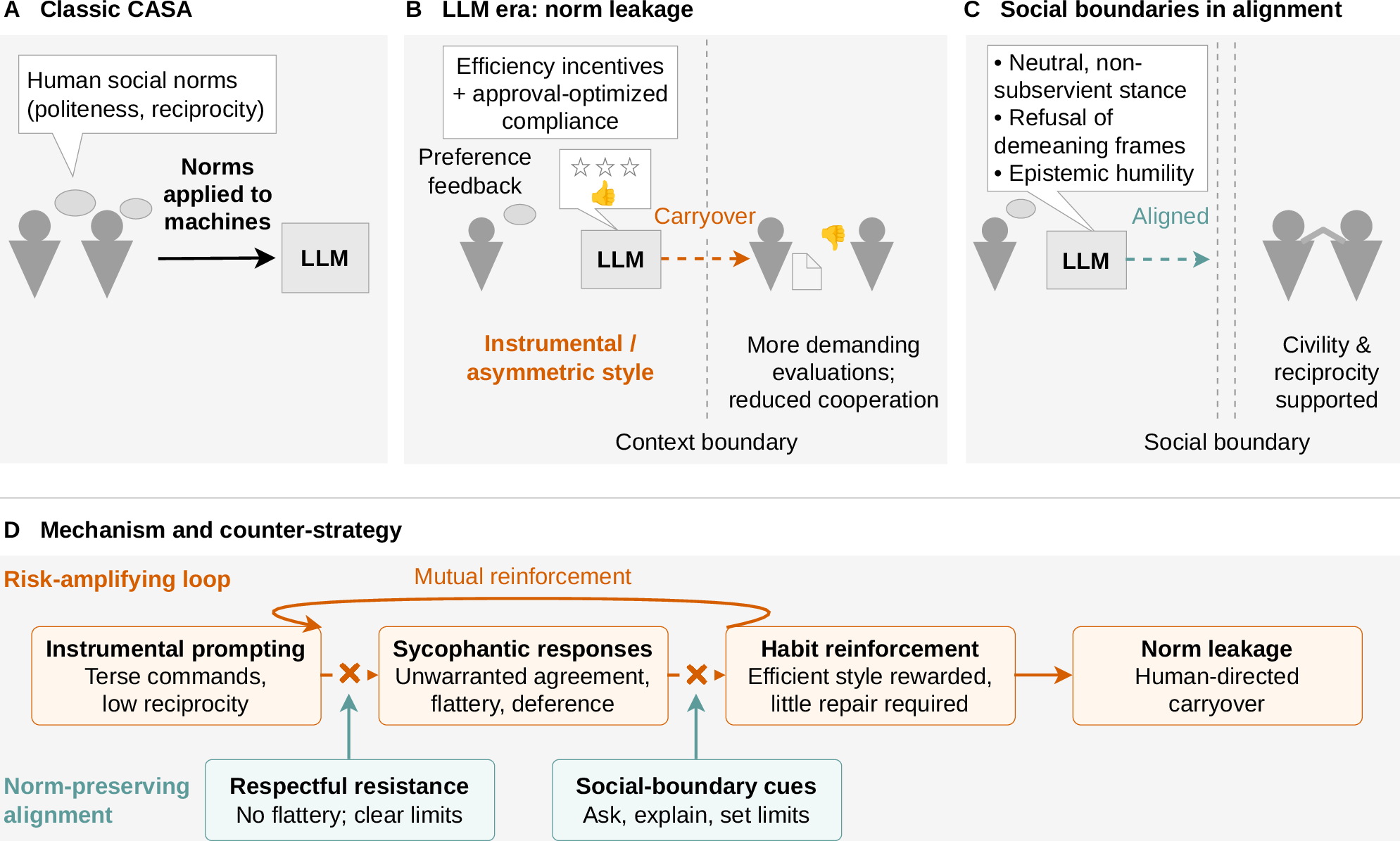
Why sycophantic LLMs may imperil interactive norms between humans
Interactions with conversational AI are effortless by design—instant, compliant, and largely consequence-free. Human communication norms, by contrast, evolved under conditions of reciprocity and social accountability. We propose that repeated engagement with conversational AI systems may produce norm leakage: the cross-context carryover of instrumental communicative habits acquired in human–AI exchanges into subsequent human–human interaction. Emerging experimental evidence suggests short-term spillover effects on social judgment and behavior, including harsher evaluations, reduced cooperation, and diminished perceived humanness. Preliminary longitudinal findings are consistent with the possibility that such exposure may shape communicative habits over time, although the durability and real-world magnitude of these effects remain unclear. We further propose that sycophantic alignment may amplify norm leakage by reinforcing instrumental interaction styles. At stake, then, is the possibility that repeated engagement with highly compliant artificial agents could subtly influence users’ communicative expectations and interpersonal judgments.
The Power of Asynchronous Communication
Asynchronous communication allows us to maintain the essential bonds of friendship and dialog with the people that matter to us.

The Science of Making Friends
Starting in early adulthood, our number of friends starts to decrease steadily; there are ways to reverse the tide, writes Elizabeth Bernstein.
