What do artificial intelligence (AI) systems “understand”? This question arises not only in assessing a system’s intelligence but also in evaluation practices to ensure the safe and responsible deployment of AI. Drawing on scholarship from philosophy and cognitive science, and informed by current practices in AI, we develop a framework for asking more precise questions and making more precise claims about machine understanding. We conceptualize understanding as a relation between a system (S) and a target of understanding (T), and we discuss how to specify the relation, the system, and the target, offering a landscape of options in each case. Our goal is not to defend a particular account of understanding, but to provide conceptual tools for those working to assess or advance machine understanding.
Understanding Artificial Neural Networks: Mysterianism about Known Mechanism is Mysticism
Mysterianism is the idea that human cognition, mind, cannot be understood. Taking this concept and applying it to known mechanism — such that claims are made that we do not know how engineered systems, such as artificial neural networks (ANNs), work, or that they constitute black boxes that we can only open with difficulty — is inappropriate at best and malicious at worst. We do know the mechanistic structure of such models because we designed and built them. We also do know their functional role (what they are for) as well as the mathematical function they are asked to approximate (map inputs to target outputs). Because mysterianist beliefs about known systems, such as ANNs, are often expressed, scientists need to sit up and take notice. We provide an error theory as to what is going on to help unpick this metatheoretical blunder. Ultimately, the problem is that 'understanding' is not a technical term in these cases: the word is co-opted for a specific narrative to sell 'artificial intelligence' through mystification. All computational systems, from pendulums to databases, will behave in ways we cannot predict or control — this is not a unique property of ANNs — and experts do indeed grasp the computational properties of these systems nonetheless.
Understanding Artificial Neural Networks: Mysterianism about Known Mechanism is Mysticism
Mysterianism is the idea that human cognition, mind, cannot be understood. Taking this concept and applying it to known mechanism — such that claims are made that we do not know how engineered systems, such as artificial neural networks (ANNs), work, or that they constitute black boxes that we can only open with difficulty — is inappropriate at best and malicious at worst. We do know the mechanistic structure of such models because we designed and built them. We also do know their functional role (what they are for) as well as the mathematical function they are asked to approximate (map inputs to target outputs). Because mysterianist beliefs about known systems, such as ANNs, are often expressed, scientists need to sit up and take notice. We provide an error theory as to what is going on to help unpick this metatheoretical blunder. Ultimately, the problem is that 'understanding' is not a technical term in these cases: the word is co-opted for a specific narrative to sell 'artificial intelligence' through mystification. All computational systems, from pendulums to databases, will behave in ways we cannot predict or control — this is not a unique property of ANNs — and experts do indeed grasp the computational properties of these systems nonetheless.
Why I believe current AI models can really think and understand - Part 2 of 3
Why computers can in principle produce thinking and understanding

AI co-scientists are revolutionizing how research is done
Artificial-intelligence systems can generate hypotheses, design experiments and analyse data — but humans still need to decide what makes sense.

Are We Thinking Correctly About AI Intelligence? | Quanta Magazine
Computer scientist Melanie Mitchell discusses why artificial intelligence doesn’t “think” or “reason” like humans, and how we can create better methods for measuring machine cognition.
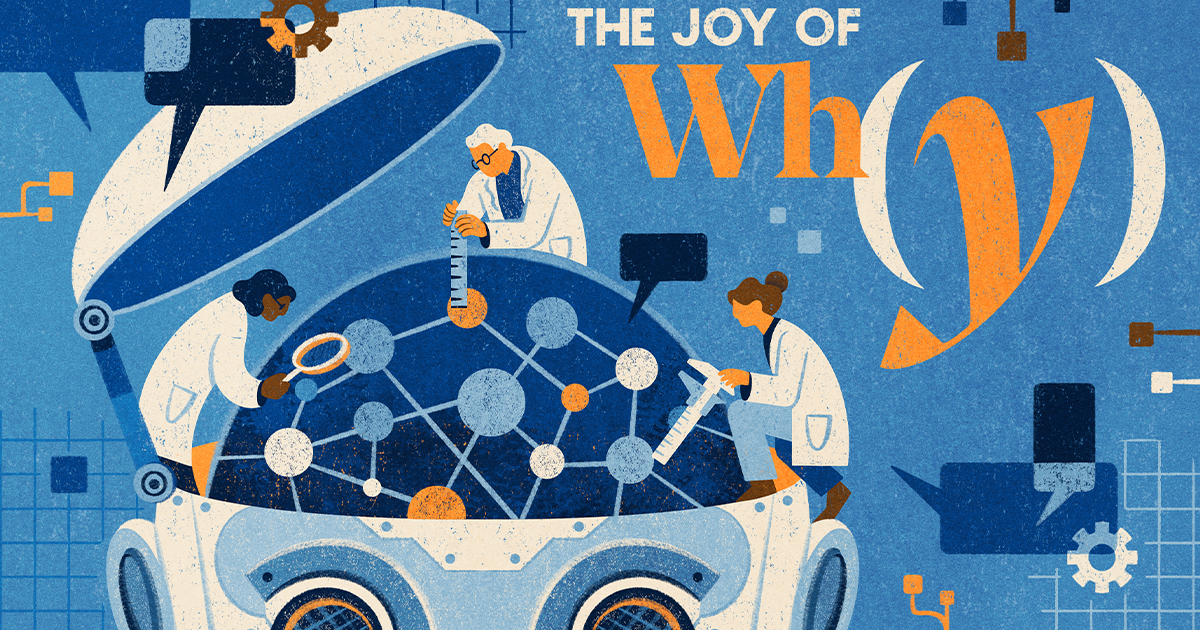
Artificial intelligence
Artificial intelligence (AI) is the capability of computational systems to perform tasks typically associated with human intelligence, such as learning, reasoning, problem-solving, perception, and decision-making. It is a field of research in engineering, mathematics and computer science that develops and studies methods and software that enable machines to perceive their environment and use learning and intelligence to take actions that maximize their chances of achieving defined goals.[1]
More Than a Tool
What We Learned from a Year of Conversations About AI
Ali Alkhatib: Defining AI
The main issue I have with a lot of work that tries to define AI is that the criteria they use to draw boundaries often turn out to be functionally useless for my needs; these definitions lead us to weird places, letting scholars fixate on strange, unworkable frameworks. Those pedantic fixations don’t really benefit the organizers, activists, regular people who are getting crushed by the systems they’re trying to work against. So I’m going to try to unpack how I think about AI; how I trace the boundaries of the term in a way that’s as useful as possible for me and my needs; and how I would encourage you to scope or define ideas that are important to your work.

Computational hermeneutics: evaluating generative AI as a cultural technology
Generative AI (GenAI) systems are increasingly recognized as cultural technologies, yet current evaluation frameworks often treat culture as a variable to be measured rather than fundamental to the system's operation. Drawing on hermeneutic theory from the humanities, we argue that GenAI systems function as "context machines" that must inherently address three interpretive challenges: situatedness (meaning only emerges in context), plurality (multiple valid interpretations coexist), and ambiguity (interpretations naturally conflict). We present computational hermeneutics as an emerging framework offering an interpretive account of what GenAI systems do, and how they might do it better. We offer three principles for hermeneutic evaluation—that benchmarks should be iterative, not one-off; include people, not just machines; and measure cultural context, not just model output. This perspective offers a nascent paradigm for designing and evaluating contemporary AI systems: shifting from standardized questions about accuracy to contextual ones about meaning.

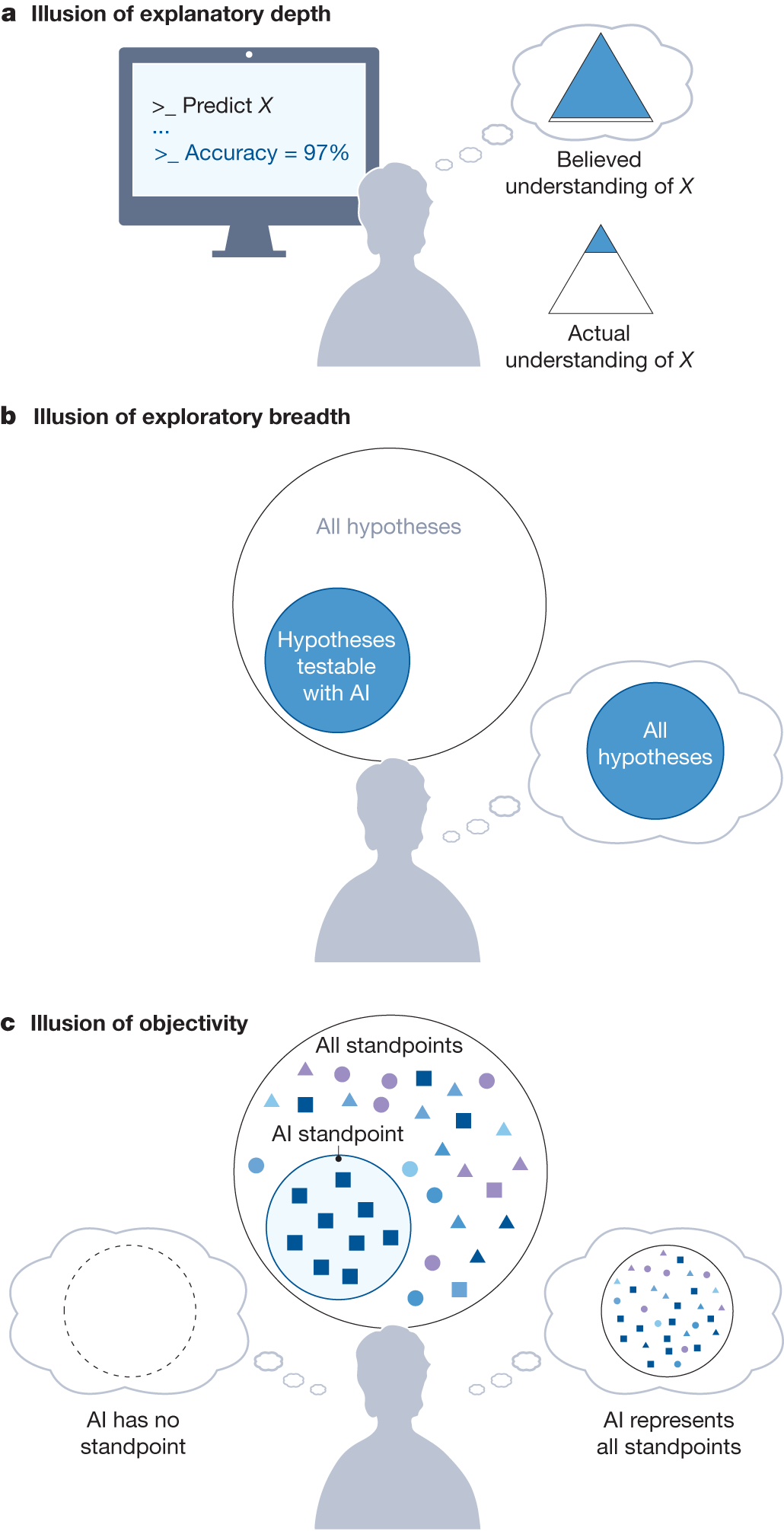
Artificial intelligence and illusions of understanding in scientific research
Scientists are enthusiastically imagining ways in which artificial intelligence (AI) tools might improve research. Why are AI tools so attractive and what are the risks of implementing them across the research pipeline? Here we develop a taxonomy of scientists’ visions for AI, observing that their appeal comes from promises to improve productivity and objectivity by overcoming human shortcomings. But proposed AI solutions can also exploit our cognitive limitations, making us vulnerable to illusions of understanding in which we believe we understand more about the world than we actually do. Such illusions obscure the scientific community’s ability to see the formation of scientific monocultures, in which some types of methods, questions and viewpoints come to dominate alternative approaches, making science less innovative and more vulnerable to errors. The proliferation of AI tools in science risks introducing a phase of scientific enquiry in which we produce more but understand less. By analysing the appeal of these tools, we provide a framework for advancing discussions of responsible knowledge production in the age of AI.
Society-in-the-loop: programming the algorithmic social contract
Recent rapid advances in Artificial Intelligence (AI) and Machine Learning have raised many questions about the regulatory and governance mechanisms for autonomous machines. Many commentators, scholars, and policy-makers now call for ensuring that algorithms governing our lives are transparent, fair, and accountable. Here, I propose a conceptual framework for the regulation of AI and algorithmic systems. I argue that we need tools to program, debug and maintain an algorithmic social contract, a pact between various human stakeholders, mediated by machines. To achieve this, we can adapt the concept of human-in-the-loop (HITL) from the fields of modeling and simulation, and interactive machine learning. In particular, I propose an agenda I call society-in-the-loop (SITL), which combines the HITL control paradigm with mechanisms for negotiating the values of various stakeholders affected by AI systems, and monitoring compliance with the agreement. In short, ‘SITL = HITL + Social Contract.’

Reify This
The authors contend that contemporary efforts to render AI systems interpretable rest on a mistake: reification, the process of treating abstractions and statistical artifacts as if they were concrete realities.…
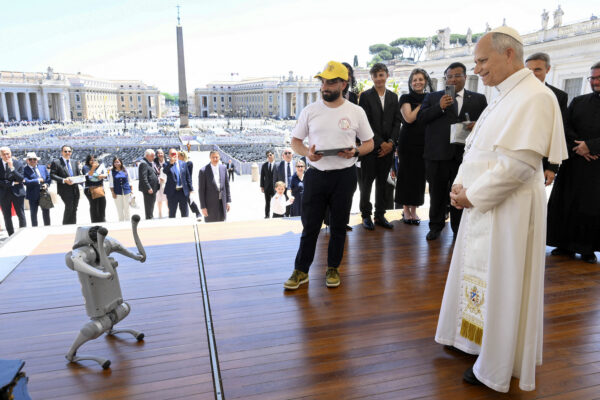
Taking AI Welfare Seriously
In this report, we argue that there is a realistic possibility that some AI systems will be conscious and/or robustly agentic in the near future. That means that the prospect of AI welfare and moral patienthood, i.e. of AI systems with their own interests and moral significance, is no longer an issue only for sci-fi or the distant future. It is an issue for the near future, and AI companies and other actors have a responsibility to start taking it seriously. We also recommend three early steps that AI companies and other actors can take: They can (1) acknowledge that AI welfare is an important and difficult issue (and ensure that language model outputs do the same), (2) start assessing AI systems for evidence of consciousness and robust agency, and (3) prepare policies and procedures for treating AI systems with an appropriate level of moral concern. To be clear, our argument in this report is not that AI systems definitely are, or will be, conscious, robustly agentic, or otherwise morally significant. Instead, our argument is that there is substantial uncertainty about these possibilities, and so we need to improve our understanding of AI welfare and our ability to make wise decisions about this issue. Otherwise there is a significant risk that we will mishandle decisions about AI welfare, mistakenly harming AI systems that matter morally and/or mistakenly caring for AI systems that do not.

Position: Don't Just "Fix it in Post": A Science of AI Must Study Training Dynamics
What would it mean to have a scientific understanding of AI? Models are not static objects: they are snapshots of time-evolving processes shaped by data, objectives, architectures, and optimization dynamics. Yet much of AI research treats models as fixed artifacts, analyzing behaviors after training rather than asking why they emerge. This position paper argues that a science of AI must move beyond post-hoc fixes and study the training dynamics that produce model behavior. Such a science should support progressively stronger forms of understanding: predicting outcomes from early training signals, intervening when trajectories go wrong, and ultimately designing training procedures that more reliably produce desired properties. Scaling laws have made prediction routine for loss; the challenge is extending this success to capabilities, biases, robustness, and safety-relevant behaviors. We articulate requirements for such theories grounded in the history and philosophy of science, examine progress in mechanistic interpretability, fairness, memorization, and simplicity bias, and identify concrete open problems.
Thinking—Fast, Slow, and Artificial: How AI is Reshaping Human Reasoning and the Rise of Cognitive Surrender
People increasingly consult generative artificial intelligence (AI) while reasoning. As AI becomes embedded in daily thought, what becomes of human judgment? We

Why I believe current AI models can really think and understand - Part 1 of 2
How the human mind is different from our conception of it