


Learn how Cerebras maps trillion-parameter frontier models across WSE-3T wafers to deliver scalable inference at 1,000–2,000+ tokens per second.
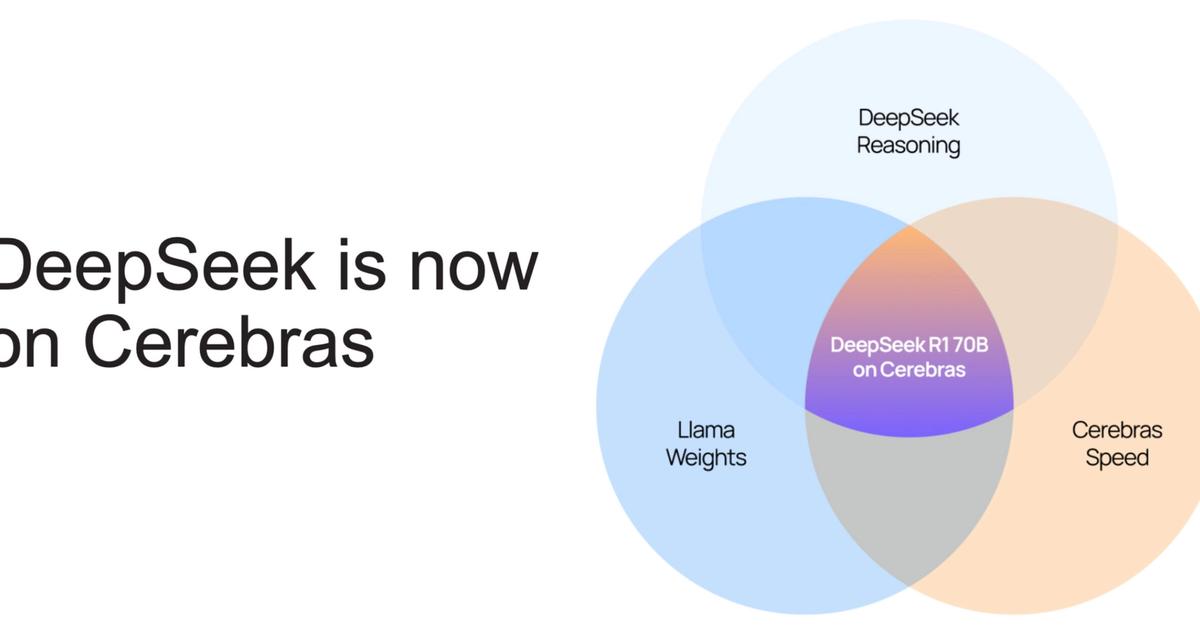
Cerebras Launches World Fastest DeepSeek R1 Llama-70B Inference - Cerebras
Cerebras launches fastest DeepSeek
Hyperfast AI: Rethinking Design for 1000 tokens/s
I recently spoke at AI Tinkerers Raleigh about hyperfast inference systems and how they’re fundamentally changing AI application design. If you haven’t heard of Cerebras (or however they pronounce it), you’re in for a treat—this is one of the most exciting areas of research in AI right now.
180B Parameters, 32GB of RAM: Pushing MoE Inference to the Limit with Transformers
We’re on a journey to advance and democratize artificial intelligence through open source and open science.

Wafer - Ship the fastest inference in the world
Autonomous AI agents that profile, diagnose, and optimize GPU inference across your entire stack — from kernels to models to production pipelines.

Cerebras
Cerebras is the go-to platform for fast and effortless AI training. Learn more at cerebras.ai.

Cerebras
Cerebras is the go-to platform for fast and effortless AI training. Learn more at cerebras.ai.
Cerebras
Cerebras is the go-to platform for fast and effortless AI training. Learn more at cerebras.ai.
Cerebras
Cerebras is the go-to platform for fast and effortless AI training. Learn more at cerebras.ai.
High Performance AI Lab
High Performance AI Lab builds open inference systems and publishes the conditions behind every number — device, model, quant, and rep count.
Training Compute-Optimal Large Language Models
We investigate the optimal model size and number of tokens for training a transformer language model under a given compute budget. We find that current large language models are significantly undertrained, a consequence of the recent focus on scaling language models whilst keeping the amount of training data constant. By training over 400 language models ranging from 70 million to over 16 billion parameters on 5 to 500 billion tokens, we find that for compute-optimal training, the model size and the number of training tokens should be scaled equally: for every doubling of model size the number of training tokens should also be doubled. We test this hypothesis by training a predicted compute-optimal model, Chinchilla, that uses the same compute budget as Gopher but with 70B parameters and 4$\times$ more more data. Chinchilla uniformly and significantly outperforms Gopher (280B), GPT-3 (175B), Jurassic-1 (178B), and Megatron-Turing NLG (530B) on a large range of downstream evaluation tasks. This also means that Chinchilla uses substantially less compute for fine-tuning and inference, greatly facilitating downstream usage. As a highlight, Chinchilla reaches a state-of-the-art average accuracy of 67.5% on the MMLU benchmark, greater than a 7% improvement over Gopher.

OpenAI partners with Cerebras
OpenAI partners with Cerebras to add 750MW of high-speed AI compute, reducing inference latency and making ChatGPT faster for real-time AI workloads.
deepseek-ai/DeepInfer
DeepInfer: High-performance, large-scale inference framework for DeepSeek models
DeepSeek-V3 Technical Report
We present DeepSeek-V3, a strong Mixture-of-Experts (MoE) language model with 671B total parameters with 37B activated for each token. To achieve efficient inference and cost-effective training, DeepSeek-V3 adopts Multi-head Latent Attention (MLA) and DeepSeekMoE architectures, which were thoroughly validated in DeepSeek-V2. Furthermore, DeepSeek-V3 pioneers an auxiliary-loss-free strategy for load balancing and sets a multi-token prediction training objective for stronger performance. We pre-train DeepSeek-V3 on 14.8 trillion diverse and high-quality tokens, followed by Supervised Fine-Tuning and Reinforcement Learning stages to fully harness its capabilities. Comprehensive evaluations reveal that DeepSeek-V3 outperforms other open-source models and achieves performance comparable to leading closed-source models. Despite its excellent performance, DeepSeek-V3 requires only 2.788M H800 GPU hours for its full training. In addition, its training process is remarkably stable. Throughout the entire training process, we did not experience any irrecoverable loss spikes or perform any rollbacks. The model checkpoints are available at https://github.com/deepseek-ai/DeepSeek-V3.
The energy and carbon costs of deploying AI models have largely been unknown.. until now! 🌏🚀 With @strubell and @YJernite, We tested 88 models on 30 datasets from 10 different tasks from different modalities and found some pretty cool stuff! A thread 🧵:
The energy and carbon costs of deploying AI models have largely been unknown.. until now! 🌏🚀With @strubell and @YJernite, We tested 88 models on 30 datasets from 10 different tasks from different modalities and found some pretty cool stuff! A thread 🧵: pic.twitter.com/0Ac7OsIcPg— Sasha Luccioni, PhD 🦋🌎✨🤗 (@SashaMTL) December 1, 2023

Gemma 4 Technical Report
We introduce Gemma 4, a new generation of open-weight, natively multimodal language models in the Gemma model family. Designed to advance compute efficiency and reasoning, the Gemma 4 model suite features dense and Mixture-of-Experts architectures, ranging from 2.3B to 31B parameters. Alongside improved vision and audio encoders for all model sizes, we propose a unified, encoder-free architecture for our 12B model, which ingests raw audio and image patches. Furthermore, we integrate a thinking mode, enabling Gemma models to generate reasoning traces prior to responding. We improve inference speed, memory, and compute efficiency, as well as long-context abilities through critical design choices. Gemma 4 establishes a leap in performance across STEM, multimodal, and long-context benchmarks, and rivals larger, frontier open models in human-rated tasks.