
Our roadmap outlines concrete steps that can be taken in 2024 to build a more democratic AI ecosystem that is adaptive, accountable, processes decentralized information, provides public goods, and safeguards human wellbeing. We describe what the ecosystem could build, research, advocate for, and fun
Building a Solidarity Ecosystem for AI (SSIR)
How cooperatives, public institutions, and social movements can come together to intentionally build a practical, community-owned alternative to extractive AI systems. <meta property=

AI and the knowledge commons
Democratizing AI Companies — The Collective Intelligence Project
As AI reshapes society, the companies behind these technologies face a critical challenge: how to build corporate governance structures that prioritize public benefit over profit maximization;.

What does it mean for AI to be democratic?
Some pushback on a specific fuzzy idea with some ominous implications

Checks and Balances to Empower Citizens in an Automated Society — Request for Proposals
A joint Request for Proposals from the Effective Institutions Project and the Collective Intelligence Project on AI, civil liberties, and the distribution of power.
AI Commons - One Project
What if we could redefine AI? What if we could shift its development from a capitalist model to a more disruptive, inclusive, and decentralized one?

Democratic Governance of AI Is the Real Solution
The potential for catastrophic effects from the AI boom demands robust deliberation and real democratic governance. Localized initiatives like data center moratoria won't get us there.

Democracy x AI Cohort | Mozilla Foundation
The Democracy x AI cohort is founded on the hypothesis that, if built differently, AI could strengthen democracy rather than erode it.
Open Call for Proposals - Humanity AI
Open Call for Proposals: Communities Leading on AI $10M Investment in U.S.-Based Community-Led AI Initiatives Humanity AI, an initiative spearheaded […]

Our Approach to Artificial Intelligence
We are experimenting with using AI tools to extend our work as a small nonprofit, so that we can focus our time on reinforcing human connections, conversations, and communities that have eroded.

How large language models can reshape collective intelligence
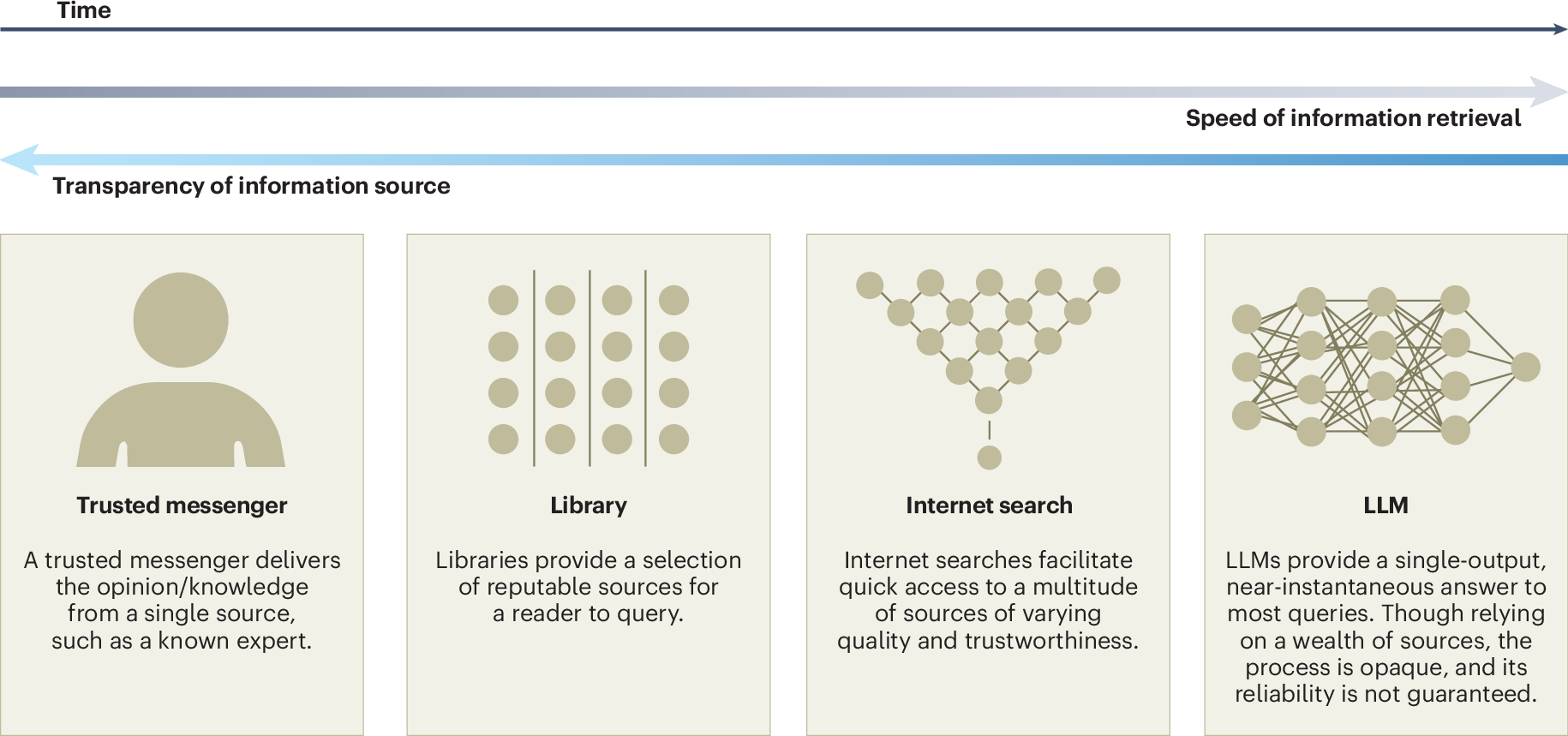
Collective intelligence underpins the success of groups, organizations, markets and societies. Through distributed cognition and coordination, collectives can achieve outcomes that exceed the capabilities of individuals—even experts—resulting in improved accuracy and novel capabilities. Often, collective intelligence is supported by information technology, such as online prediction markets that elicit the ‘wisdom of crowds’, online forums that structure collective deliberation or digital platforms that crowdsource knowledge from the public. Large language models, however, are transforming how information is aggregated, accessed and transmitted online. Here we focus on the unique opportunities and challenges this transformation poses for collective intelligence. We bring together interdisciplinary perspectives from industry and academia to identify potential benefits, risks, policy-relevant considerations and open research questions, culminating in a call for a closer examination of how large language models affect humans’ ability to collectively tackle complex problems.
How large language models can reshape collective intelligence
Collective intelligence underpins the success of groups, organizations, markets and societies. Through distributed cognition and coordination, collectives can achieve outcomes that exceed the capabilities of individuals—even experts—resulting in improved accuracy and novel capabilities. Often, collective intelligence is supported by information technology, such as online prediction markets that elicit the ‘wisdom of crowds’, online forums that structure collective deliberation or digital platforms that crowdsource knowledge from the public. Large language models, however, are transforming how information is aggregated, accessed and transmitted online. Here we focus on the unique opportunities and challenges this transformation poses for collective intelligence. We bring together interdisciplinary perspectives from industry and academia to identify potential benefits, risks, policy-relevant considerations and open research questions, culminating in a call for a closer examination of how large language models affect humans’ ability to collectively tackle complex problems.
The Collective Intelligence Project
We’ve launched an open, collaborative platform to build evaluations that test what matters to you. We empower a global community to create qualitative benchmarks for any domain—from medical chatbots to legal assistance. Just as Wikipedia democratized knowledge, Weval aims to democratize evaluation, ensuring that AI works for, and represents, everyone.
Harnessing Crowds: Mapping the Genome of Collective Intelligence
Over the past decade, the rise of the Internet has enabled the emergence of surprising new forms of collective intelligence. Examples include Google, Wikipedia,

AI Behavioral Science
We outline a foundation for a new field of ``AI Behavioral Science,'' covering three perspectives. First, as AI becomes ubiquitous and is increasingly proprietary and opaque, it becomes vital to develop techniques for assessing AI behavior. We outline how tools developed to assess people's behaviors by social scientists can be used to assess and infer AI's behaviors biases, tendencies, and heuristics. Second, we also discuss how AI can change the ways in which we learn about human behavior. Beyond its computational power, AI offers new techniques for simulating, inferring, and predicting human behaviors that we outline and discuss. Third, as humans and AI are interacting in increasingly complex and intertwined systems, we need to understand the implications for the resulting economic and political outcomes. We outline issues that are increasingly pressing concerning the future of human-AI interactions and potential changes and disruptions that can ensue.

Public Intelligence
Imagine 50 years from now a Public Intelligence that was a distributed, open-source, non-commercial artificial intelligence, operated like the internet, and available to the whole world. This public AI would be a federated system, not owned by any one entity, … Continue reading →