


ClaimReview is a tagging system for fact-checks, providing a new way to identify fact-check articles for search engines and apps.
eLife Claim Trees — eLife Claim Trees
Panel-level claim graphs for reproducibility — eLife Claim Trees
Most arguments scatter across papers, posts, and threads — and evaporate. A claim tree gives them a stable structure to gather against, the way a cathedral gathers centuries of work into a single, standing thing.
Scientific Web Claims: A survey of definitions, tasks, datasets and methods
Scientific web claims are seen as scientific claims as observed on the Web, across social media, online news, and other platforms. The growing prevalence of scientific discussions on the Web has intensified the need to process and assess this specific type of claims. Unlike claims from scientific publications, scientific web claims are expressed in lay terms, are often decontextualized, and typically lack proper citations, which poses unique challenges for their identification, verification, and communication. Nevertheless, the correct processing of scientific web claims is crucial to keeping online science discussions accurate and informed, for instance through fact-checking. This survey provides the first systematic overview dedicated specifically to scientific web claims. We review and compare existing definitions, task formulations, datasets, and methodological approaches across three major perspectives: (1) Scientific fact-checking on the Web, (2) Scientific citations on the Web, and (3) Science communication on the Web. Our interdisciplinary analysis integrates insights from natural language processing, information retrieval, artificial intelligence, social sciences, and science communication. We identify major methodological challenges, including the lack of unified definitions, domain-agnostic corpora, and foundational models tailored to science-related online discourse. We also discuss challenges related to the existing interplay between emotions and distortions of science online. By mapping current research efforts and highlighting open problems, this survey lays the groundwork for developing robust datasets, methods, and evaluation frameworks to advance the automated processing of scientific web claims, a necessary capability for strengthening the reliability of science-related online discourse at scale.
NLnet; Nanoarguments
Scientific knowledge is currently scattered across papers, repositories, and disconnected platforms, with no structured way to trace how claims connect to evidence or how arguments develop. Nanoarguments builds a framework and tools for creating, browsing, and contributing to a global, federated graph of scientific discourse and evidence. Researchers and their communities can collaboratively structure claims, evidence chains, and discussion as nanopublications, which are small, cryptographically signed Linked Data snippets with precise provenance and authorship, published to a decentralized peer-to-peer network. The project builds upon the Nanodash interface to help users browse, edit, and aggregate discourse and evidence graphs, and integrates with dokieli to enable in-context authoring of nanopublications as inline annotations while reading or writing a document. A bidirectional ActivityPub connector bridges the nanopublication network and the fediverse, allowing discourse threads to start as social exchanges and crystallize into persistent, machine-readable evidence records. The project will be piloted with early adopter research groups in discourse and evidence modeling. All components will be released as open-source modules that other systems can build upon.
Quarterly AI False Claim Monitor — January 2026
To download this NewsGuard report, please fill out your details below and you will be redirected to it. If you'd like to learn more about working with NewsGuard, email [email protected].

AI False Claims Monitor
As the domain experts in data reliability in the topic of news and information, NewsGuard provides the leading red-teaming analysis for information reliability. AI models continue to face significant challenges in ensuring their models provide safe, accurate responses to prompts instead of spreading false claims on the internet or refusing to respond to topics in the news.


Models of collaborative tagging
Collaborative tagging, also known as social tagging or folksonomy, allows users to apply public tags to online items, typically to make those items easier for themselves or others to find later. It has been argued that these tagging systems can provide navigational cues or "way-finders" for other users to explore information.[1][2] The notion is that given that social tags are labels users create to represent topics extracted from online documents, the interpretation of these tags should allow other users to predict the contents of different documents efficiently. Social tags are arguably more important in exploratory search, in which the users may engage in iterative cycles of goal refinement and exploration of new information (as opposed to simple fact-retrievals), and interpretation of information contents by others will provide useful cues for people to discover topics that are relevant.
TheoremGraph: Bridging Formal and Informal Mathematics
Mathematical knowledge is organized around statements and their dependencies, but this structure is exposed unevenly: informal papers cite mostly at the document level, while formal libraries record fine-grained dependencies over a much smaller body of mathematics. We introduce TheoremGraph, a unified statement-level dependency graph spanning both informal and formal mathematics. On the informal side, we parse 11.7M theorem-like environments from mathematics arXiv and recover 18.3M candidate directed dependencies, each labeled by the extractor that proposed it so downstream users can trade coverage for precision. On the formal side, we release LeanGraph, a Lean 4 elaborator-level extractor producing 388,105 declaration nodes and 11.3M typed edges across 25 Lean projects. We bridge the two graphs by embedding generated natural-language slogans into a shared semantic space, linking related statements across papers and across the informal/formal divide; an LLM judge affirms 47,952 such matches above a 0.8 cosine floor, with the judge-acceptance rate rising from 48% across the floor to 87% in the >=0.9 tier. On formal concept retrieval, our name-and-signature representation with graph expansion comes within 0.5pp of LeanSearch v2's reranked Recall@10 (0.775 vs. 0.780) without an LM reranker. We release the dataset, extractors, HTTP API, and MCP interface as infrastructure for mathematical search, attribution, and retrieval-augmented reasoning, available at theoremsearch.com and huggingface.co/datasets/uw-math-ai/theorem-matching.

Distinct representational properties of cues and contexts shape fear and reversal learning — eLife Claim Trees
Panel-level claim graphs for reproducibility — eLife Claim Trees
OpenStreetMap Taginfo
Reports show the tag data from different angles. They often bring together data from several sources in interesting ways. Some of the reports can help with finding specific errors.
biblio.livtet.olamaelcu.net is an experimental #appview that: - indexes information about books - allows for authors to claim books Experimental is the truth; it's still going under active review.
biblio.livtet.olamaelcu.net is an experimental #appview that: - indexes information about books - allows for authors to claim books Experimental is the truth; it's still going under active review.
dc: data provenance and source attribution

Part of the datacounterfactuals.org reading lists. Research on data provenance, dataset documentation, licensing and attribution audits, and technical source-attribution methods for understanding which data sources are available, permitted, or responsible for model behavior.
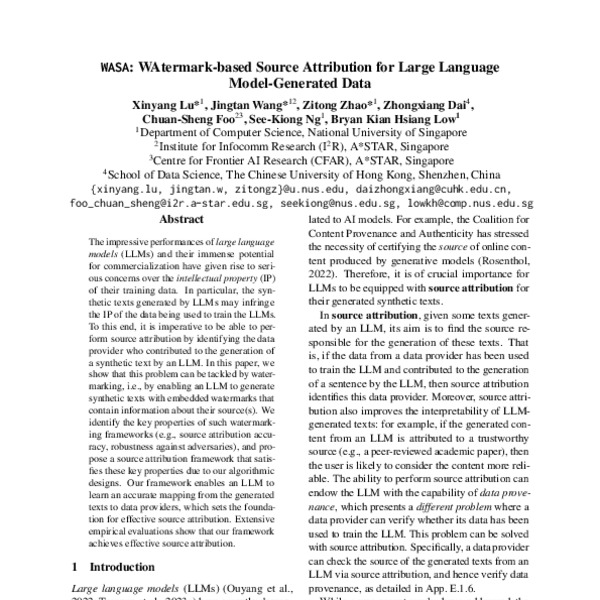
WASA: WAtermark-based Source Attribution for Large Language Model-Generated Data
SILO Language Models: Isolating Legal Risk In a Nonparametric Datastore
Datasheets for Datasets
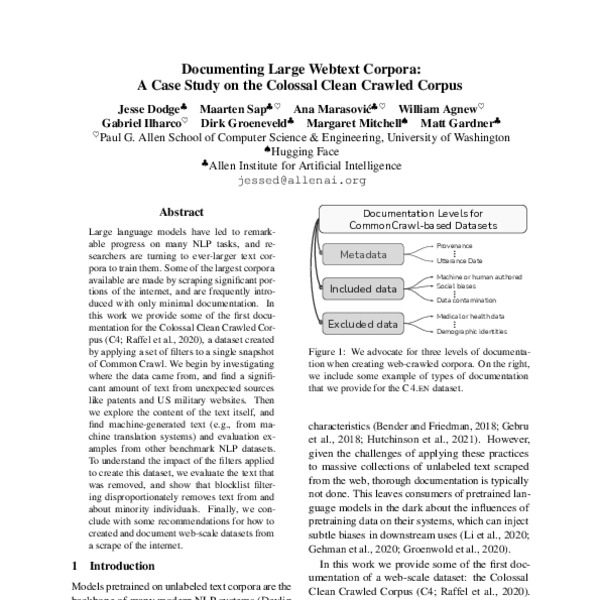
Documenting Large Webtext Corpora: A Case Study on the Colossal Clean Crawled Corpus

A large-scale audit of dataset licensing and attribution in AI
