

The revised rules for the Millennium Prize Problems were adopted by the Board of Directors of the Clay Mathematics Institute on 26 September, 2018. Please read this document carefully before contacting CMI about a proposed solution. In particular, please note that:
On the Navier–Stokes Millennium Prize Problem
We’re sharing an AI-generated solution to the Navier–Stokes Millennium Prize Problem, including a writeup and a formal proof in Lean.
Noam Brown on Twitter / X
And yes we did try other major problems without success. Sadly no Millennium Prize problems (yet).But also, we didn’t spend a lot on each problem. It’s possible to push test-time compute much further.— Noam Brown (@polynoamial) August 1, 2026
AI Has Solved One of Math’s $1 Million Millennium Prize Problems | Quanta Magazine
Mathematicians at OpenAI showed that the Navier-Stokes equations, which describe how fluids flow, can sometimes “blow up.” But the massive result is not without controversy.

Bartosz Naskręcki on Twitter / X
Congrats to @LechMazur for the solution and to Terence Tao for the digestion and storytelling. You see the trend. Mathematicians are still needed if we want to make any sense of the formal proofs. For now... Maybe the next gen LLMs will simply read allthe blogs of Terry and… https://t.co/yXiISCrNAF— Bartosz Naskręcki (@nasqret) August 13, 2026
The last IMO problem AI could not solve
98 out of 100. That's how many advanced maths problems current AI models managed to solve in an international benchmark in Leipzig. One of the two remaining problems? A simplified version of a… | Czech Technical University in Prague | 11 comments
98 out of 100. That's how many advanced maths problems current AI models managed to solve in an international benchmark in Leipzig. One of the two remaining problems? A simplified version of a combinatorics problem solved by researchers from the Faculty of Information Technology CTU in Prague. Alexander Clifton, Daniela Černá and Jan Volec, together with Bartołomiej Kielak from Universität Leipzig , found the solution to a simplified version of the long-standing open problem of breaking triples with permutations. The problem was later included among the 100 tasks used to test how today's AI models perform in advanced mathematics. While AI came remarkably close, this was one of the problems it couldn't solve on its own. A nice reminder that mathematical creativity and abstract reasoning still leave some room for humans. 🧠 🔗 Read the full story in the comments. | 11 comments on LinkedIn

Deedy on Twitter / X
The International Math Olympiad (IMO) 2026, the hardest math contest for high schoolers, just ended.I ran Fable (high), Sol (xhigh), K3 (max) and Axiom against it and all got a perfect score of 42/42 (repo below if you want to check their solutions):— Claude Fable 5 was the… pic.twitter.com/6oH7FiAjEP— Deedy (@deedydas) July 21, 2026

Edison Scientific Assembles Millennium Problems for Biology | Samuel G. Rodriques posted on the topic | LinkedIn
In light of the progress in mathematics, we at Edison Scientific and FutureHouse have assembled a set of Millennium Problems for Biology. They are chosen to be very hard to solve but very easy to validate in a simple laboratory environment. Any of these, if solved, would mark a major advance in biotechnology, and most of them would contribute materially towards curing disease. These are, in some sense, the “last reasonable eval” for AI in biology. This was work primarily by Michaela Hinks and myself, with contributions from many others. Short descriptions below. The full descriptions of the problems with acceptance criteria are at millenniumproblems.bio. Share more if you have ideas. If they meet our criteria, we’ll add them to our list (with attribution and permission). A few notes on exclusion/inclusion criteria: -We placed a major emphasis on ease of validation, so challenges like “solve aging” are omitted. These should all be validatable in a standard wet lab in a short period of time (days, maybe a week or two.) -We placed a major emphasis on ensuring grading would be as objective as possible, so many great basic science mysteries are also omitted, because it would be very challenging to tell when the mystery was “solved.” (E.g., “uncover the function of the Vault protein,” or “explain how the Oxytricha genome works.”) -We placed a major emphasis on ensuring the problems would be understandable to anyone with a basic biology background, so some highly technical but very important challenges were also omitted. Finally, we anticipate that some problems may require edits in response to community feedback. If you think we got them wrong, please send the feedback, and we will collate and update. Thanks to Adam Marblestone, Michael Baym, Erika DeBenedictis, and Tony Kulesa for reviews. | 52 comments on LinkedIn

Has an AI discovered new maths?
Michael Truell on Twitter / X
We believe Cursor discovered a novel solution to Problem Six of the First Proof challenge, a set of math research problems that approximate the work of Stanford, MIT, Berkeley academics. Cursor's solution yields stronger results than the official, human-written solution.…— Michael Truell (@mntruell) March 3, 2026
Ten advances in mathematics and theoretical computer science
OpenAI shares new results on long-standing open problems in mathematics and theoretical computer science, including advances in geometry, cryptography, and complexity.
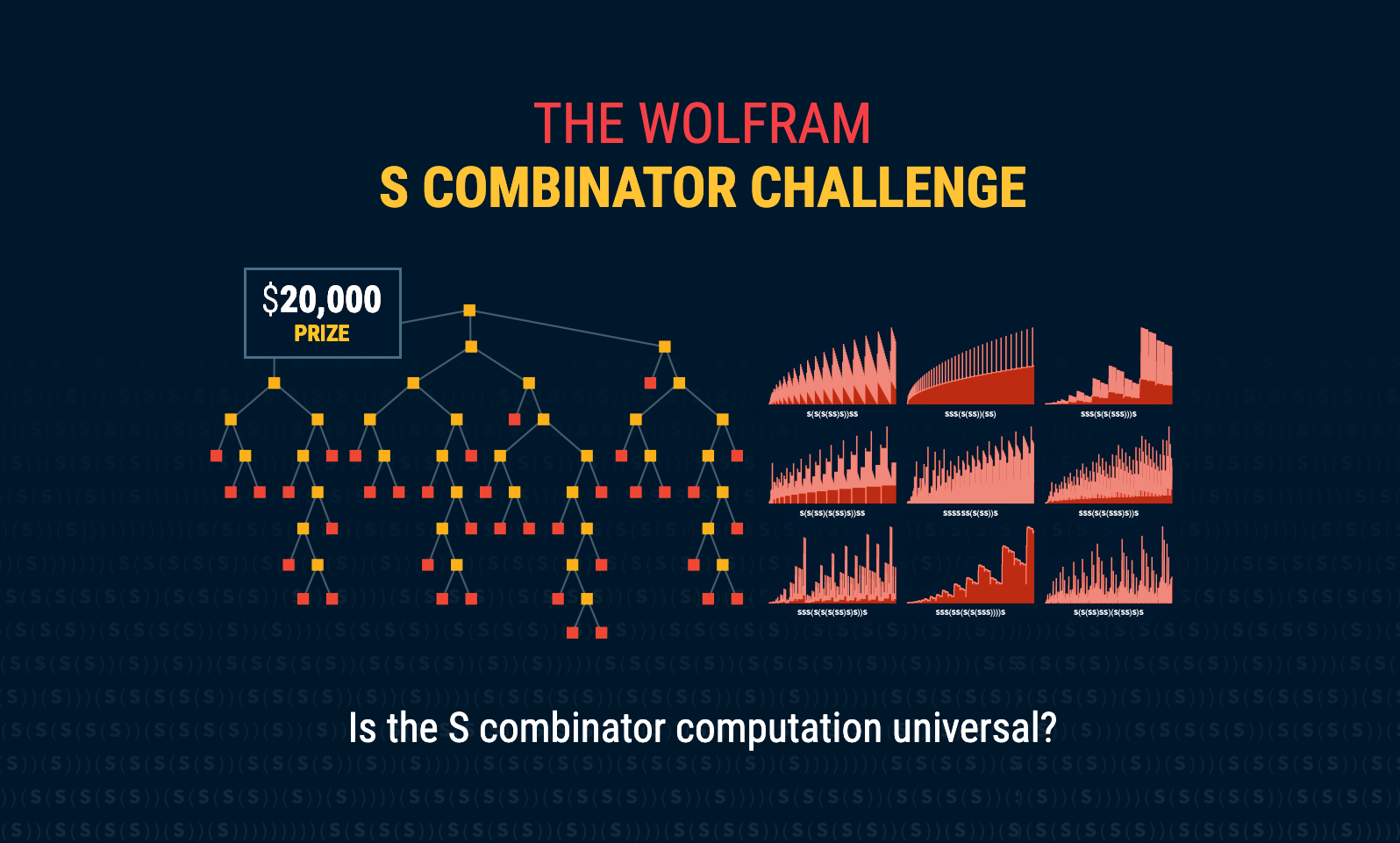
The Wolfram S Combinator Challenge
Wolfram is offering a total of $20,000 in prize money to determine if the S combinator is universal. Statement of problem to be solved, full guidelines, committee of judges and submission guidelines.
The last IMO problem AI could not solve
VibeMathed - Math Problems Solved by AI
A community-curated record of math problems no human had solved before, proved or disproved with AI in the loop - with checkable sources and verification labels.
Mathematics with large language models as provers and verifiers
During 2024 and 2025 the discussion about the theorem-proving capabilities of large language models started reporting interesting success stories, mostly to do with difficult exercises (such as problems from the International Mathematical Olympiad), but also with conjectures [Feldman & Karbasi, arXiv:2509.18383v1] formulated for the purpose of verifying whether the artificial intelligence could prove it. In this paper we report a theorem proving feat achieved by ChatGPT by using a protocol involving different prover and verifier instances of the gpt-5 model working collaboratively. To make sure that the produced proofs do not suffer from hallucinations, the final proof is formally verified by the lean proof assistant, and the conformance of premises and conclusion of the lean code is verified by a human. Our methodology is by no means complete or exact. It was nonetheless able to solve five out of six 2025 IMO problems, and close about a third of the sixty-six number theory conjectures in [Cohen, Journal of Integer Sequences, 2025].