

What divine authority can teach us about democratic principles.
Democracy and the Epistemic Commons
The Consilience Project is a publication of the Civilization Research Institute (CRI)

The Dispersion of Power: A Critical Realist Theory of Democracy
Abstract The Dispersion of Power is an urgent call to rethink centuries of conventional wisdom about what democracy is, why it matters, and how to make it better. Drawing from history, social science, psychology, and critical theory, it explains why elections do not and cannot realize the classic ideal of popular rule, and why prevailing strategies of democratic reform often make things worse. Instead, Bagg argues, we should see democracy as a way of protecting public power from capture—an alternative vision that is at once more realistic and more inspiring. Despite their many shortcomings, real-world elections do prevent the most extreme forms of tyranny, and are therefore indispensable. In dealing with the vast inequalities that remain, however, we cannot rely on standard solutions such as electoral reform, direct democracy, deliberation, and participatory governance. Instead, Bagg shows, protecting and enriching democracy requires addressing underlying inequalities of power directly. In part, this entails substantive policies attacking the advantages of wealthy elites. Even more crucially, deepening democracy requires the organization of oppositional, countervailing power among ordinary people. Neither task is easy, but historical precedents exist in both cases—and if democracy is to survive contemporary crises, leaders and citizens alike must find ways to revive and reinvent these essential democratic practices for the twenty-first century.

Liquid Democracy: True Democracy for the 21st Century
Liquid Democracy, a subset of Delegative Democracy, is a powerful voting model for collective decision making in large communities. Liquid…
We Need To Rethink Democracy
Five dimensions of scaling democratic deliberation: With and beyond AI
DemocracyNext's new paper on Five dimensions of scaling democratic deliberation: With and beyond AI
Hold the Line: A Guide to Defending Democracy
A practical guide for organizers, communities, and individuals defending democracy.

Scoping report: Future challenges to democracy | CoP CC on Participatory and Deliberative Democracy
The report from the European Commission identifies 10 key challenges and emerging trends impacting European democratic systems and suggests future policy options. These challenges are structured across three interconnected levels: citizens and societal dynamics, the information and knowledge environment, and institutions and the democratic system. This framework aims to provide a comprehensive and integrated view of democracy as a connected ecosystem, emphasising how challenges in one area can affect the entire system.
Democracy and the Epistemic Commons - The Consilience Project
We use cookies on our website, please read our Privacy Policy for more information Okay, thanks

Another Democratic Future | Substack
DemocracyNext brings you stories, research, and reflections on the global deliberative wave. Click to read Another Democratic Future, a Substack publication with thousands of subscribers.

Democracy Policy Network
Together, we can build the foundation for a deeper democracy.
Democracy Tracker | The Global State of Democracy
Each report describes an event that affects the state of democracy in a given country, with assessments made relative to that country's context, not as comparisons or rankings between countries.
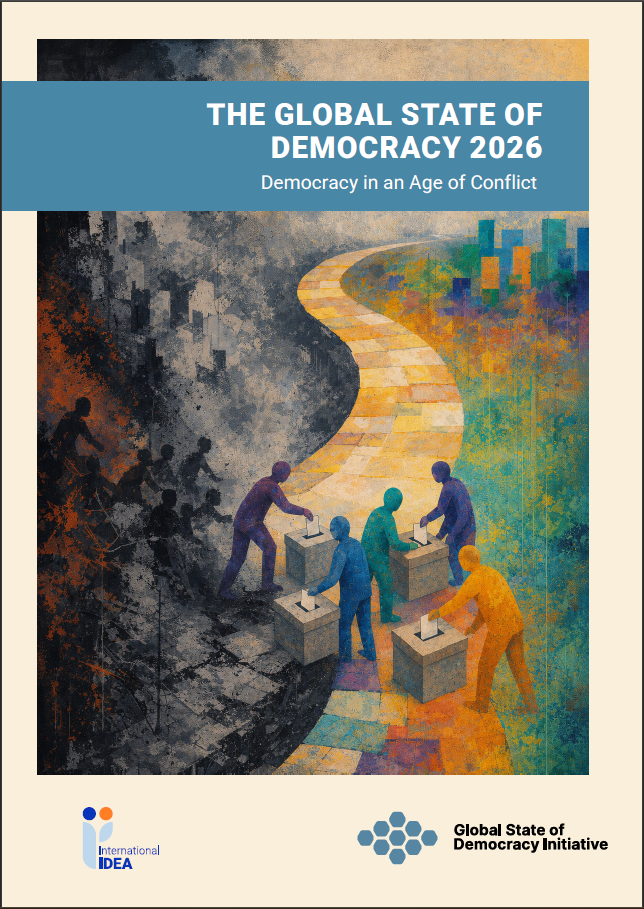
The Global State of Democracy 2026: Democracy in an Age of Conflict
In the face of increasing political and societal fragmentation, the Global State of Democracy 2026 explains the patterns that define the direction of democratization around the world. Drawing on the latest data from the Global State of Democracy Indices, the report documents both democratic stagnation and key declines in indicators that measure the credibility of elections, the effectiveness of legislatures, respect for freedoms of expression and the press, and access to justice. These phenomena affect countries across thespectrum of democratic performance.
The Global State of Democracy 2026: Democracy in an Age of Conflict
In the face of increasing political and societal fragmentation, the Global State of Democracy 2026 explains the patterns that define the direction of democratization around the world. Drawing on the latest data from the Global State of Democracy Indices, the report documents both democratic stagnation and key declines in indicators that measure the credibility of elections, the effectiveness of legislatures, respect for freedoms of expression and the press, and access to justice. These phenomena affect countries across thespectrum of democratic performance.
Designing a Constitution for a Community (Camille Canon) : Metagovernance Seminar
This is a talk exploring Apiary's work on the purpose/constitutional design of Radicle. We have been supporting the founders and community in drafting a...

Democracy is an epistemic discipline, it only works if truth can constrain power. Without a faster, more transparent architecture for shared reality, the arc of democracy bends away from substance, through simulation, and toward authoritarianism. Without major action, it's the inevitable end state.
