

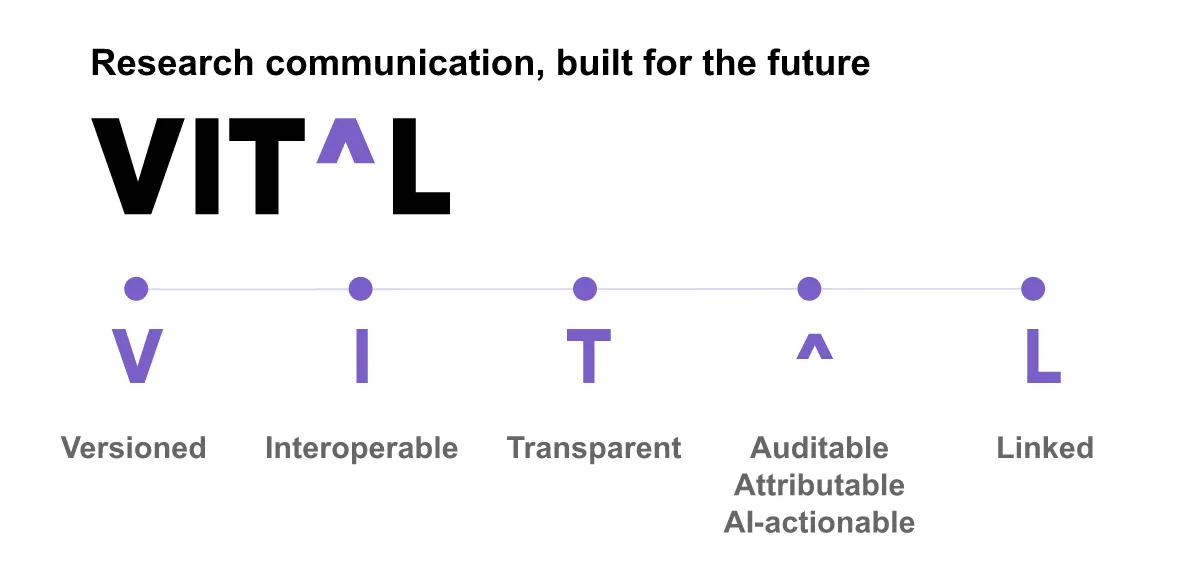
A National Academies action group proposes VIT^L, seven properties for sharing research that people and machines can check, reuse, and build on.
Check Research Outputs for Best Practices
A modular, extendable system for checking research outputs for best practices using text search, R code, and/or (optional) LLM queries.
MIRA · A new medium for research
Modular Interoperable Research Attribution. An open architecture that publishes research as a graph of questions, claims, evidence, and sources, with provenance and attribution on every record.
Metaudits
Audits of how completely research is described in DataCite, Crossref, ORCID, OpenAlex and repositories. In English, Spanish and German.
Science One Framework: A verifiable autonomous research framework via Chain-of-Evidence
Rui Meng, Research Scientist, and Tomas Pfister, Director, Google Cloud


Clear Skies – Your partner in research integrity
Perspective Chapter: Fit for Purpose? Creative Commons Licensing for Research Data in the Age of Artificial Intelligence
Licensing is an important component of the re-usability of research data, itself part of the FAIR principles: without clear, machine-readable licensing, datasets risk becoming technically...

Checking Reproducibility with the Open Research Knowledge Graph. Husein, Lorenz
Introducing COSIG: The Collection of Open Science Integrity Guides
Investigating the integrity of published scientific papers is key to the scientific process, but the necessary knowledge is in short supply. We present COSIG, an open collection of meta-scientific guides enabling anyone to perform forensic peer review.
A Data Utopia for Science-of-Science
Here I want to briefly sketch out a vision for how to solve a key set of problems facing science-of-science researchers, using the relatively new idea of a ‘data trust.’ In my ideal wor…

From Replication Rates to Replication Evidence: A Guest Editorial
Repeating original studies using existing data (reproducibility) or new data (replicability) is key to improving the credibility of scientific results. Here, we focus on replications, which can be…
GRN · German Reproducibility Network
Working together for trustworthy and useful research
The Research Nexus vision for a more connected scholarly community
Crossref envisions “a rich and reusable open network of relationships connecting research organizations, people, things, and actions; a scholarly record that the global community can build on forever, for the benefit of society”. This Research Nexus expands on the importance of research objects being persistently and uniquely identified. The scholarly community has an established practice of connecting things such as citations to others’ work and it is increasingly critical to identify relationships beyond citations, bringing together published work, unpublished work, institutions, individuals, and identifying the actions that they take e.g., funding, publishing, creating, modifying, citing, and sharing. The Research Nexus brings together metadata and relationships to build a joined-up picture of the scholarly ecosystem and helps everyone identify these relationships and how they change through time. This vision is possible if all parts of the scholarly ecosystem (and beyond) work together, including various scholarly infrastructure organizations.

MIRA — the structure layer for a shared research graph
Research ships as a sealed document. MIRAfying it makes a graph of signed, citable records anchored on the actual data artifacts — so analyses compound without flattening the nuance.
New study finds that when people help collect data or contribute to research it can build public trust by making scientists feel personally familiar and approachable, and that trust then spreads to how local and tangible the research feels. jcom.sissa.it/article/pubid/JCOM_2506_2026_…

How can citizen science reduce psychological distance to science? Insights from three projects in contested environmental contexts
jcom.sissa.itResearch tools 🔬

Interesting tools that assist with the research process.
Paperclip

Ronen Tamari (@ronentk.me)

Crossmark - Crossref
Crossmark - Crossref
Plaudit · Open endorsements from the academic community
Introducing the Elicit API - Elicit
