

By Deb Roy, Eugene Yi, Russell Stevens Published: March 1, 2018 The Internet and social media have transformed modern society in many positive ways by connecting us to the world’s information, enabling social connections that transcend space and time, and giving everyone a voice. Within this transformation, social media have become an essential part of
Impact of the COVID-19 pandemic on social media
Social media became an important platform for interaction during the COVID-19 pandemic, coinciding with the onset of social distancing. According to a study conducted by Facebook's analytics department, messaging rates rose by over 50% during this period. Individuals confined to their homes utilized social media not only to maintain social connections but also as a source of entertainment to alleviate boredom. Concerns arose regarding the overreliance on social media for primary social interactions, particularly given the constraints imposed by the pandemic.

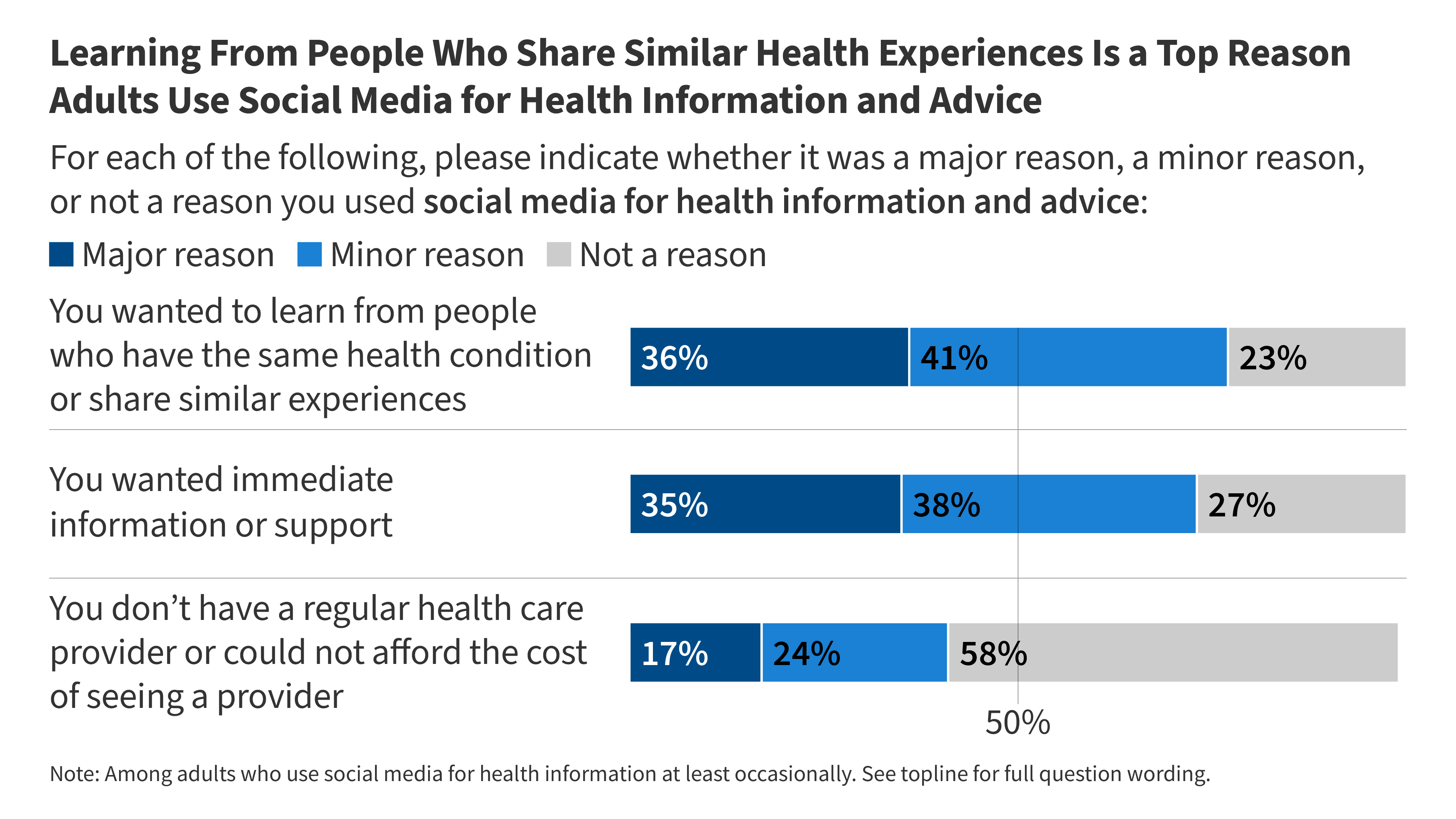
KFF Tracking Poll on Health Information and Trust: Use of Social Media and AI For Health Information and Advice | KFF
This poll finds that about 3 in 10 adults turn to social media for health information and advice at least monthly. Community connection and the need for immediate answers are the top reasons why people are turning to these tools. Slim majorities of those who use social media for health are confident they can tell what is true, and relatively few take steps to check the information they receive.
No Sense of Place: The Impact of Electronic Media on Social Behavior
Electronic media present us with a collage of experiences from everyplace. We eat dinner at home while watching starving children thousands of miles away reach out to us for food. From our easy chairs, we stare at blindfolded hostages, and coolly

Following news on social media boosts knowledge, belief accuracy and trust
Many worry that news on social media leaves people uninformed or even misinformed. Here we conducted a preregistered two-wave online field experiment in France and Germany (N = 3,395) to estimate the effect of following the news on Instagram and WhatsApp. Participants were asked to follow two accounts for 2 weeks and activate the notifications. In the treatment condition, the accounts were those of news organizations, while in the control condition they covered cooking, cinema or art. The treatment enhanced current affairs knowledge, participants’ ability to discern true from false news stories and awareness of true news stories, as well as trust in the news. The treatment had no significant effects on feelings of being informed, political efficacy, affective polarization and interest in news or politics. These results suggest that, while some forms of social media use are harmful, others are beneficial and can be leveraged to foster a well-informed society.

Shifts in U.S. Social Media Use, 2020–2024: Decline, Fragmentation, and Enduring Polarization
The social media ecosystem appears to be in flux. Twitter’s rebranding to X has come to symbolize a broader reorganization of online publics – political reshuffling, user attrition, and uncertainty over the role of legacy platforms. Simultaneously, the shift from text-based, networked feeds toward algorithmically curated, short-form video has accelerated, with TikTok setting the pace for the wider ecosystem [18, 14, 16]. At the same time, everyday communication increasingly migrates from large, open networks to semi-private spaces such as group chats and messaging apps. Commentators describe a digital public sphere in transition: smaller, more fragmented, less dominated by traditional social networking sites, and rise of more broadcast-oriented forms of media – with some even suggesting that we are seeing the beginning of the end of the social media era.
Social Media Is Now Parasocial Media
When practitioners used the term “social media” to describe the internet tools that emerged in the mid-aughts, they were giving a name to the kinds of platforms and protocols that allowed people to socialize with friends and communities of interest by using digital technologies. Twenty years later, users of social media are far more likely to scroll than post – and the content that they consume is often strategically produced and algorithmically curated. In this essay, I argue that the very essence of social media has changed. To more effectively interrogate what we are witnessing, we need to stop presuming that these tools are “social media” and begin recognizing that they are now “parasocial media.” Doing so raises new questions about digitally mediated sociality, not to mention the politics and governance of these platforms.

We’re in the middle of a perfect storm for rollback of the “open web” and burgeoning online surveillance
Looking at fallout of the KOSA hearings today — and subsequent commentary — I remain optimistic for the development of social technology & communication but I’m beginning to think the ope…

New_ Public | After the Feed
What happens after the social media feed? A presentation on the future of conversation, community, and social connection, and how AI will affect the everyday lives of billions.
Blue Skies Ahead: Social Media's Quiet User Revolution
In a digital landscape increasingly defined by user concerns over privacy and control, a quiet revolution is taking shape.

The limits of social media as a source of political information during routine and crisis times across 17 countries
Recent studies on political knowledge suggest people learn little about political events and societal issues from social media. Potentially, social media are a more effective source of information ...
Hard Questions: Is Spending Time on Social Media Bad for Us?
With people spending more time on social media, many rightly wonder whether that time is good for us. Do people connect in meaningful ways online? Or are they simply consuming trivial updates and polarizing memes at the expense of time with loved ones?

Computer-Mediated Communication, Social Media, and Mental Health: A Conceptual and Empirical Meta-Review
Computer-mediated communication (CMC), and specifically social media, may affect the mental health (MH) and well-being of its users, for better or worse. Research on this topic has accumulated rapidly, accompanied by controversial public debate and numerous systematic reviews and meta-analyses. Yet, a higher-level integration of the multiple disparate conceptual and operational approaches to CMC and MH and individual review findings is desperately needed. To this end, we first develop two organizing frameworks that systematize conceptual and operational approaches to CMC and MH. Based on these frameworks, we integrate the literature through a meta-review of 34 reviews and a content analysis of 594 publications. Meta-analytic evidence, overall, suggests a small negative association between social media use and MH. However, effects are complex and depend on the CMC and MH indicators investigated. Based on our conceptual review and the evidence synthesis, we devise an agenda for future research in this interdisciplinary field.
Shifts in U.S. Social Media Use, 2020-2024: Decline,...
Using nationally representative data from the 2020 and 2024 American National Election Studies (ANES), this paper traces how the U.S. social media landscape has shifted across platforms,...

Custodians of the Internet
A revealing and gripping investigation into how social media platforms police what we post online—and the large societal impact of these decisions Most use...
Brett Scott (@brettscott)
Marshall McLuhan is famous for his observation that the form of a communication technology can shape our mind and society The age of the printed book, for example, carried with it a particular way of being. Regardless of the differing content of different books, all books required a particular mindset in which a thread is followed from the beginning to the end through an arc I feel the age of social media is like the age of a ripped up book, as if we were surrounded by torn shards and shreds of paper floating like confetti around us. We grab for them, hoping for some tiny insight, but not having any way of knowing where it fits in the overarching narrative This note is one such shard. You can toss it away now

it's not lost on me how critical it is to be building community-driven social technology in this time, because there's a lot we need - more joy, more connection, more education, more agency, and more privacy. breaking out of the box of "social media" - what are the tools we need in these times?
