researching power and contestation in transnational media infrastructures
Eaten by the Internet
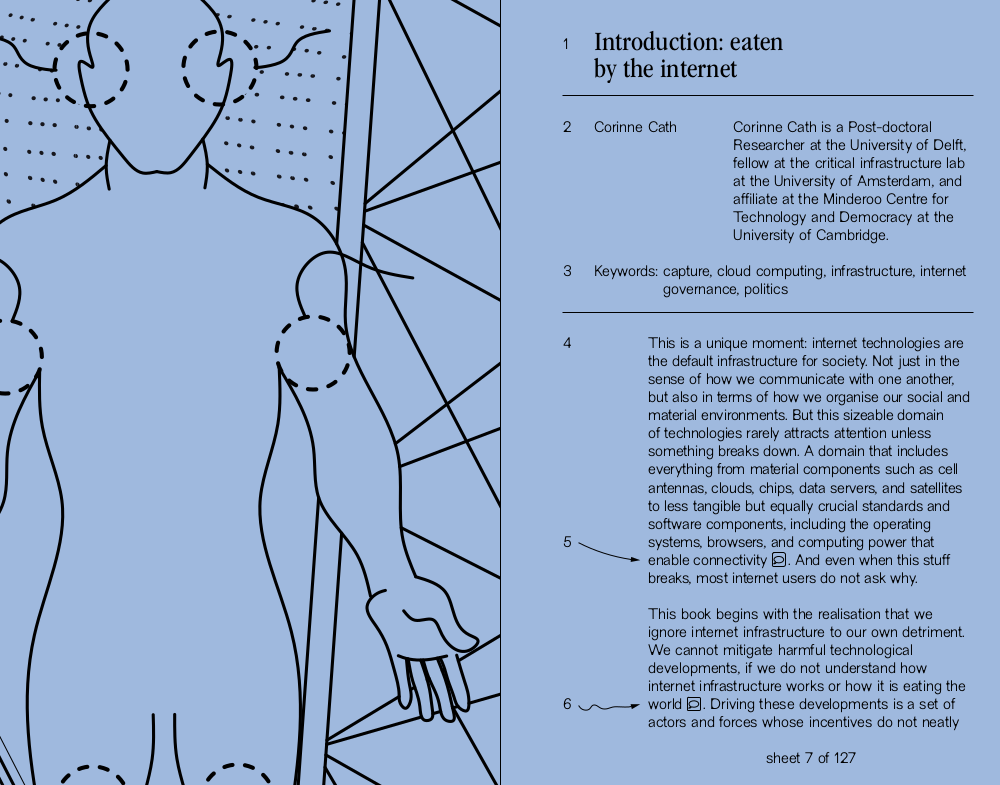
This book makes internet infrastructure visible as a force of political power, which is transforming the social world, from the bottom up—through fifteen chapters contributed by a global set of researchers, activists, and techies. We are living a unique moment: internet technologies are the default infrastructure for society, not just how we communicate but also how we organise our social life, politics, and economy, all the way down to our material environments, like cities. Our world is eaten by the internet. This means that those who control the internet control the bounds of public speech, economic production, social cohesion, and politics, making its infrastructure a core political terrain in the networked age. The book’s chapters cover a wide set of topics, spanning from the global politics of content moderation by internet infrastructure to the colonialism inherent in the race to plug the moon, from the harms wrought by blockchain companies in rural America to the particularities of online censorship across Asia. The chapters take on thorny topics, discussing power consolidation in the advertisement and cloud industry, the role of internet infrastructure in the war in Ukraine, and tech’s environmental impact—amongst others. In doing so, this book roots contemporary technology debates in the politics of internet infrastructure and urges us to ask how can we ensure our infrastructures sustain us, rather than consume us?
The Economics of Sovereign Media: A Roadmap for AT Protocol | ATmosphereConf VODs
The talk will focus on (1) the structural shifts reshaping the media landscape & creator economy and provide a roadmap / suggestions for how the AT Protocol ecosystem & community can be best positioning to serve the needs of creators of all kinds (emphasis / focus here on independent creators) through this evolutio, while preserving their rights to sovereignty & ownership. The talk ideally touches on both cultural, economic and technical / infrastructural topics. Will be speaking in my capacity both as an artist and as an investor / student of media markets.

W-Social: What does sovereignty mean for social media? – Open Future
The European Commission’s move to W-Social frames it as a European alternative to X, but its closed-source code and reliance on Bluesky’s infrastructure show that sovereign social media requires open infrastructure—not European ownership alone.
Independent Media has an Infrastructural Problem
We need to roll out infrastructures that foster public values and the common good over the market imperatives, writes Agustin Ferrari Braun.

W Social, public institutions and the theater of European digital sovereignty | Hacker News
And weirdly, there was never a peep about this in the press - while the W Social launch was on national news and a bunch of high-profile EU politicians immediately joined. What's going on here?
The Case for a Public Social Media Platform - JSTOR Daily
Artist and writer Joshua Citarella explores why corporate platforms corrode democracy—and what a postal-service-style digital commons could do differently.

De Facto Journalism Co-op
Non-profit investigative journalism that shines a light on systems of power and abuses of rights and authority

Fractured reality
The report examines the evolving impact of digital technologies on European democracy. In an era of a global struggle to control the information space, this report offers critical insights into the fracturing of perceived realities, the rise of the ‘fantasy-industrial complex’, and the systemic risks posed by the attention economy. It exposes how platforms algorithmically prioritise engagement over accuracy, reinforcing ideological echo chambers and amplifying mis- and disinformation that erode democratic resilience. The report highlights how structural incentives and foreign control of the most important players in the information space undermine information integrity, collective knowledge and civic discourse. In response, the report presents a number of recommendations from fostering alternative public spaces and crowd-sourced knowledge systems to reforming business models, restoring user agency, and advancing EU digital sovereignty through decentralised infrastructure
Interoperable Sovereignty: The Democratic Alternative to Digital Authoritarianism
A Democratic Architecture for the Digital Age Digital sovereignty has become a central concern for governments worldwide, yet its meaning remains contested. Too often it is framed as...

Transnational advocacy networks in international and regional politics
Click on the article title to read more.

Media Ownership Monitor
Mass media influences how facts are viewed and debated in a society, contributing to crafting its public opinion. Independence and pluralism...

Social Media Vs Democracy
Politics meets protocols in Berlin
What happens when you put politicians, media businesses and protocol engineers in the same room to discuss European sovereignty?

The Politics of Open Infrastructures: Power, Governance, and Justice in Digital Knowledge Practices
This volume examines how openness is designed, governed, contested and lived in contemporary digital knowledge infrastructures. From open source software and internet standards, to citizen science platforms, public sector data systems and alternative computing practices, the book shows that infrastructures are never neutral technical backbones.

Governable Stacks against Digital Colonialism
Critics have been converging around the logic of colonialism to describe the Internet economy. If we are serious about the laden language of the colonial, we should be ready to learn from struggles against pre-digital empires and colonial regimes. Although acts of insurrection may attract more attention, one thing leaders and theorists of anticolonial resistance have stressed persistently is the centrality of self-governance in everyday life as both a means and end of their movements. But the dominant platforms for online communities are not well-suited for durable self-governing. Resistance often relies on the same colonial firms it opposes. What would community-governed technologies look like? This paper introduces the concept of “governable stacks”, a framework for self-governing as resistance to digital colonialism.
New Paradigms in Trust and Safety: Navigating Defederation on Decentralized Social Media Platforms
Defederation on decentralized social media offers new possibilities for online governance. Experts consider how it can be used responsibly, in a way that balances speech and safety.