


The Crossmark button gives readers quick and easy access to the current status of an item of content, including any corrections, retractions, or updates to that record. Crossmark provides a cross-platform way for readers to quickly discover the status of a research output along with additional metadata related to the editorial process. Crucially, the Crossmark button can also be embedded in PDFs, which means that members have a way of alerting readers to changes months or even years after it’s been downloaded.
Crossmark - Crossref
The Crossmark button gives readers quick and easy access to the current status of an item of content, including any corrections, retractions, or updates to that record. Crossmark provides a cross-platform way for readers to quickly discover the status of a research output along with additional metadata related to the editorial process. Crucially, the Crossmark button can also be embedded in PDFs, which means that members have a way of alerting readers to changes months or even years after it’s been downloaded.
Crossref: The sustainable source of community-owned scholarly metadata
This paper describes the scholarly metadata collected and made available by Crossref, as well as its importance in the scholarly research ecosystem. Containing over 106 million records and expanding at an average rate of 11% a year, Crossref’s metadata has become one of the major sources of scholarly data for publishers, authors, librarians, funders, and researchers. The metadata set consists of 13 content types, including not only traditional types, such as journals and conference papers, but also data sets, reports, preprints, peer reviews, and grants. The metadata is not limited to basic publication metadata, but can also include abstracts and links to full text, funding and license information, citation links, and the information about corrections, updates, retractions, etc. This scale and breadth make Crossref a valuable source for research in scientometrics, including measuring the growth and impact of science and understanding new trends in scholarly communications. The metadata is available through a number of APIs, including REST API and OAI-PMH. In this paper, we describe the kind of metadata that Crossref provides and how it is collected and curated. We also look at Crossref’s role in the research ecosystem and trends in metadata curation over the years, including the evolution of its citation data provision. We summarize the research used in Crossref’s metadata and describe plans that will improve metadata quality and retrieval in the future.
You are Crossref - Crossref
Crossref runs open infrastructure to link research objects, entities, and actions—creating a lasting and reusable scholarly record that underpins open science. Together with our >25,000 members in 167 countries, we drive metadata exchange and support 2.1 billion monthly API queries, facilitating global research communication, for the benefit of society.

Manuscript submission systems and metadata completeness in Crossref: Patterns and associations
The importance of open research information, particularly publication metadata, is widely recognised. Crossref is one of the most important infrastructures for registering open metadata as part of DOI record registration. It is widely known, however, that the metadata of many publications is far from complete, with many publishers making certain metadata openly available, but failing to do so for other metadata elements. Publishers’ ability to register this metadata with Crossref depends on their capacity to capture and retain this data in their production workflows. Manuscript submission systems are an important, yet largely overlooked, factor in the extent to which publishers make metadata available through Crossref. In this paper, we present the results of an analysis investigating the relation between the level of metadata that publishers deposit with Crossref and the submission systems that they deploy for their journals. We have looked at the 153 publishers with the largest amounts of publications in Crossref and concentrate on the four most commonly used systems: Editorial Manager, ScholarOne, Open Journal Systems (OJS) and eJournalPress. We show that some submission systems appear better suited to capturing certain metadata elements. However, there are always cases where publishers using the same system differ widely in the level of metadata they register, suggesting that technology is not the only prohibiting factor and other considerations are at play.
Two billion citation links in Crossref help research travel further - Crossref
We’ve recently reached an important milestone for the research nexus: the works in our metadata corpus are now connected with over 2 billion citation links! This is a great opportunity to share a dedicated dataset and discuss why these are important for science.

Introducing Aris: The publishing platform for the Post-PDF Era - Aris
We're building the future of academic publishing: tools that make it easy to create, share, and preserve knowledge in formats designed for the web, not the printing press.
Skyreader update - Bookmark syncing to Semble/Margin and Standard Reader Collections support - Skyreader Dev Log
Sync your reading list across the Atmosphere. Read magazine-like collections.
Curvenote Scientific Content Management System
A web-first experience that brings science and data to the surface. Enhance comprehension and maximize impact and reach of your research using rich metadata and interactive figures.

Readwise Reader: The first read-it-later app built for power readers.
Save everything to one place to overcome content overload, search instantly, and highlight like a pro.

linkding
A self-hosted bookmarking service that is designed to be minimal, fast and easy to set up.
Standard Reader - Chrome Web Store
Save articles and follow publications on the standard.site network.

Lix | Version control system for every file format
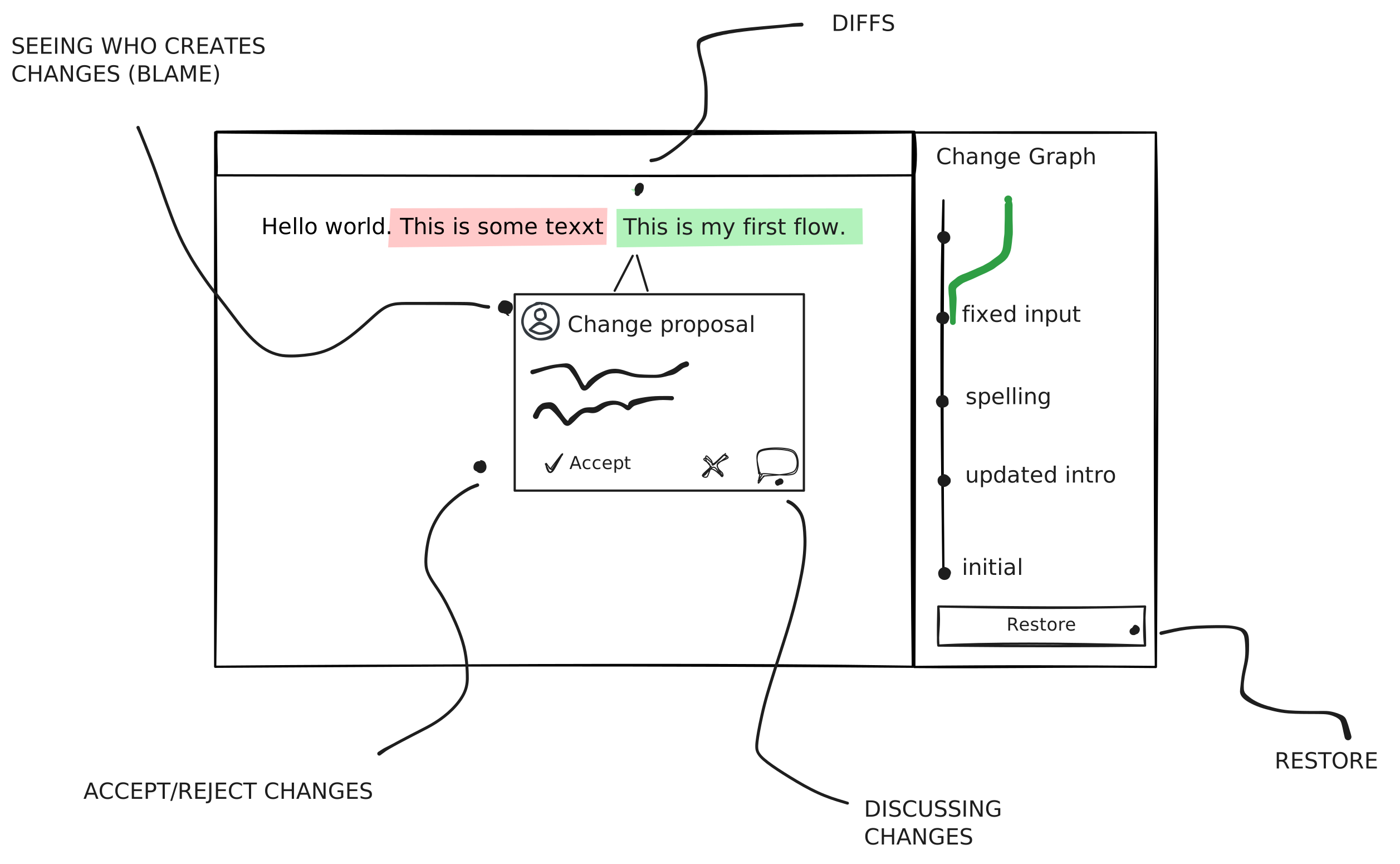
Lix tracks, reviews, branches, merges, and rolls back changes across Markdown, DOCX, XLSX, JSON, PDFs, and custom file formats.
I was just thinking this as I was scrolling arXiv recently, how cool it would be to have those papers published as at://records and to be able to see all the links between them.

Ronen Tamari
"The properties that make AT Protocol compelling for social networking are the same properties the research community has been asking for" Exciting vision for the future of science publishing on ATProto @row1.ca @opensci.dev @nokome.bsky.social #ATScience
Reminder that I maintain a periodically-updated reading list of papers at the intersection of E2EE and Trust & Safety; suggestions welcome: docs.google.com/spreadsheets/d/1aYaDogBF6JegB…

Encryption + Trust & Safety reading list (updated 2026-05-20)
docs.google.com
