

Transcription of the Bell Communications Research Colloquium Seminar 7 March 1986

Future Histories of Other Networks – Lori Emerson
“Are Protocols Elite?” in Rythms – Writings and rehearsals by Nathan Schneider
For a taste of what I’ve been working on this season, I have a new, tiny-little essay in the in-house journal of our Center for Media, Religion, and Culture, Rhythms: “Are Protocols Elite?” Based on a collab with Avery Edenfield. https://www.colorado.edu/cmrc/2025/11/06/rhythms-fall-2025-counter-media

A Mathematical Theory of Communication
"A Mathematical Theory of Communication" is an article by mathematician Claude Shannon published in Bell System Technical Journal in 1948. It was renamed The Mathematical Theory of Communication in the 1949 book of the same name, a small but significant title change after realizing the generality of this work. It has tens of thousands of citations, being one of the most influential and cited scientific papers of all time, as it gave rise to the field of information theory, with Scientific American referring to the paper as the "Magna Carta of the Information Age", while the electrical engineer Robert G. Gallager called the paper a "blueprint for the digital era". Historian James Gleick rated the paper as the most important development of 1948, placing the transistor second in the same time period, with Gleick emphasizing that the paper by Shannon was "even more profound and more fundamental" than the transistor.

AT Protocol, Part 2: Explanation For Non-Techies - Debbie's Blatherings - by Debbie Ridpath Ohi
Thanks to all who responded to my call for suggestions!
Mozilla Tech Speakers: A pilot for technical evangelism
The six-week pilot version of the Mozilla Tech Speakers program wrapped up at the end of May. We learned a lot, made new friends on several continents, and collected valuable ...
Sharing Notes about Collective Intelligence — Pop Junctions
Last week, my travels took me to San Antonio where I delivered one of the keynote addresses at the Educause Learning Initiative conference -- a gathering focused on the application of technology for learning at the college and university level. My presentation, "What Wikipedia Can Teach Us Ab

Decision to join W social network - a Freedom of Information request to Communication
https://bsky.app/profile/vonderleyen.ec.europa.eu/post/3moiosz24yk2j I wish to obtain any document that explains this decision, such as internal communication explaining the advantages of W, or contact with communications advisors who recommended this action. Yours faithfully, Alexander Fanta Follow the Money Rue Auguste Orts 2 1000 Bruxelles

Operation Voder: AT&T, Bell Labs, and the Labor of Techno-Utopia at the 1939 New York World’s Fair
This article explores the labor demands of the Voder, the electrical speech synthesis machine developed by Bell Labs for AT&T’s 1939 New York World’s Fair exhibit. The article situates the Voder within the historical context of the fair, with the United States emerging from the Great Depression and political tensions escalating across the globe. By examining the decision to incorporate the machine’s young female operators into the exhibit, the article argues that AT&T executives used Voder operators to normalize a new vision of technological utopia that relied heavily and conspicuously on the infrastructural labor of women. Moreover, the article highlights the previously unacknowledged engineering contributions of Voder operators in the years before the fair, writing women into the origin story of a machine that laid critical groundwork for speech recognition and voice encryption technology.
Operation Voder: AT&T, Bell Labs, and the Labor of Techno-Utopia at the 1939 New York World’s Fair
This article explores the labor demands of the Voder, the electrical speech synthesis machine developed by Bell Labs for AT&T’s 1939 New York World’s Fair exhibit. The article situates the Voder within the historical context of the fair, with the United States emerging from the Great Depression and political tensions escalating across the globe. By examining the decision to incorporate the machine’s young female operators into the exhibit, the article argues that AT&T executives used Voder operators to normalize a new vision of technological utopia that relied heavily and conspicuously on the infrastructural labor of women. Moreover, the article highlights the previously unacknowledged engineering contributions of Voder operators in the years before the fair, writing women into the origin story of a machine that laid critical groundwork for speech recognition and voice encryption technology.
From Space, to Time
This post is the text version of a talk I’ve been giving at several conferences (and I plan to give it a couple more times). I have spent many years observing and building things on the web and this is one of the main trends I’ve been…
The 37signals Guide to Internal Communication
The how, where, why, and when we communicate. Long form asynchronous? Real-time chat? In-person? Video? Verbal? Written? Via email? In Basecamp? How do we keep everyone in the loop without everyone getting tangled in everyone else’s business? It’s all in here.
mai ishikawa sutton
My work lies at the intersection of technology and the solidarity economy. I’m passionate about strengthening the digital commons, in which people control and steward communication technologies as collective goods.
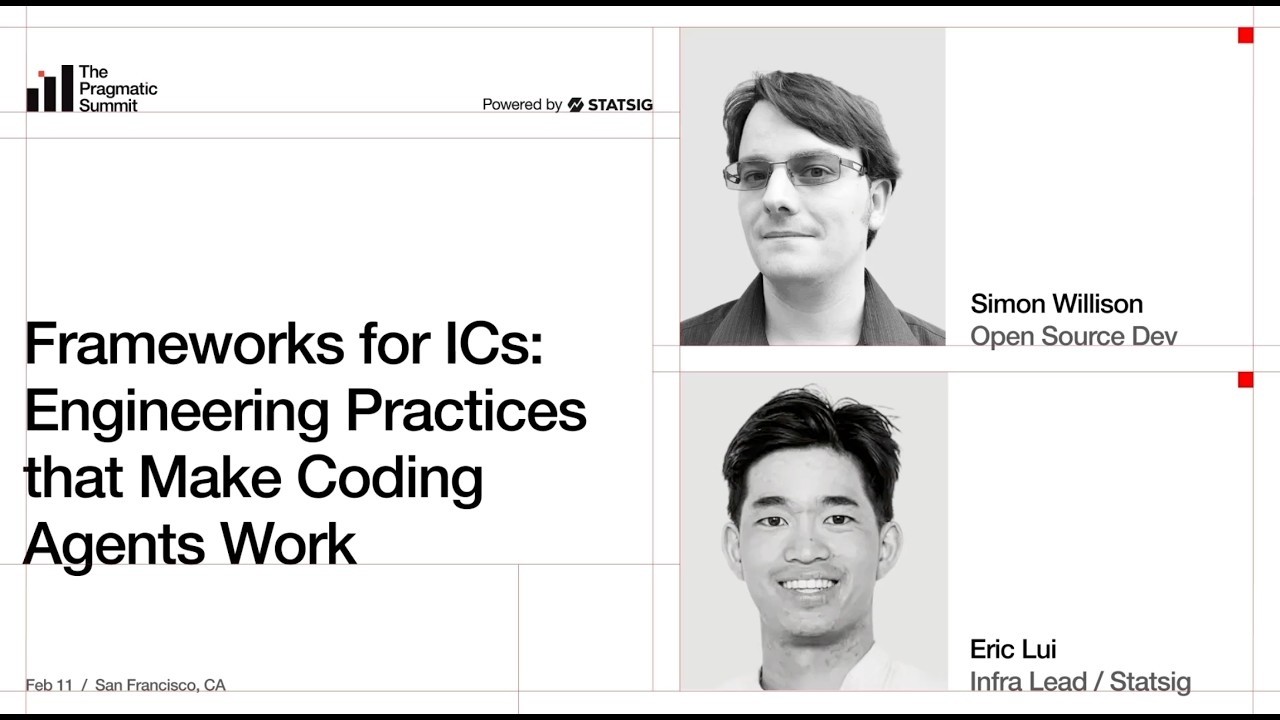
My fireside chat about agentic engineering at the Pragmatic Summit
I was a speaker last month at the Pragmatic Summit in San Francisco, where I participated in a fireside chat session about Agentic Engineering hosted by Eric Lui from Statsig. …
Okay... This looks very cool. 👏🏻👏🏻👏🏻 For researchers and reporters looking to find and collate material from across the web, imagine a search and bookmarking tool that's social. 📝📝📝 @semble.so let's you log in with your BlueSky account.

Semble
Wondering what Semble is all about and how to use it? Check out our video guides on our docs page to learn more! docs.cosmik.network/semble
“The inequities of our remote gathering tools” by Paula Te (2020) medium.com/@paulate/the-inequities-of-ou…

