


Text embeddings represent human language to computers, enabling tasks like semantic search. Here, we introduce sparse and dense vectors in a non-technical way.
Precise Zero-Shot Dense Retrieval without Relevance Labels
While dense retrieval has been shown effective and efficient across tasks and languages, it remains difficult to create effective fully zero-shot dense retrieval systems when no relevance label is available. In this paper, we recognize the difficulty of zero-shot learning and encoding relevance. Instead, we propose to pivot through Hypothetical Document Embeddings~(HyDE). Given a query, HyDE first zero-shot instructs an instruction-following language model (e.g. InstructGPT) to generate a hypothetical document. The document captures relevance patterns but is unreal and may contain false details. Then, an unsupervised contrastively learned encoder~(e.g. Contriever) encodes the document into an embedding vector. This vector identifies a neighborhood in the corpus embedding space, where similar real documents are retrieved based on vector similarity. This second step ground the generated document to the actual corpus, with the encoder's dense bottleneck filtering out the incorrect details. Our experiments show that HyDE significantly outperforms the state-of-the-art unsupervised dense retriever Contriever and shows strong performance comparable to fine-tuned retrievers, across various tasks (e.g. web search, QA, fact verification) and languages~(e.g. sw, ko, ja).

Word embedding
In natural language processing, a word embedding is a representation of a word. The embedding is used in text analysis. Typically, the representation is a real-valued vector that encodes the meaning of the word in such a way that the words that are closer in the vector space are expected to be similar in meaning. Word embeddings can be obtained using language modeling and feature learning techniques, where words or phrases from the vocabulary are mapped to vectors of real numbers.

EmbeddingGemma: Powerful and Lightweight Text Representations
We introduce EmbeddingGemma, a new lightweight, open text embedding model based on the Gemma 3 language model family. Our innovative training recipe strategically captures knowledge from larger models via encoder-decoder initialization and geometric embedding distillation. We improve model robustness and expressiveness with a spread-out regularizer, and ensure generalizability by merging checkpoints from varied, optimized mixtures. Evaluated on the Massive Text Embedding Benchmark (MTEB) across multilingual, English, and code domains, EmbeddingGemma (300M) achieves state-of-the-art results. Notably, it outperforms prior top models, both proprietary and open, with fewer than 500M parameters, and provides performance comparable to models double its size, offering an exceptional performance-to-cost ratio. Remarkably, this lead persists when quantizing model weights or truncating embedding outputs. This makes EmbeddingGemma particularly well-suited for low-latency and high-throughput use cases such as on-device applications. We provide ablation studies exploring our key design choices. We release EmbeddingGemma to the community to promote further research.

Sparse Autoencoders for Hypothesis Generation
We describe HypotheSAEs, a general method to hypothesize interpretable relationships between text data (e.g., headlines) and a target variable (e.g., clicks). HypotheSAEs has three steps: (1) train a sparse autoencoder on text embeddings to produce interpretable features describing the data distribution, (2) select features that predict the target variable, and (3) generate a natural language interpretation of each feature (e.g., "mentions being surprised or shocked") using an LLM. Each interpretation serves as a hypothesis about what predicts the target variable. Compared to baselines, our method better identifies reference hypotheses on synthetic datasets (at least +0.06 in F1) and produces more predictive hypotheses on real datasets (~twice as many significant findings), despite requiring 1-2 orders of magnitude less compute than recent LLM-based methods. HypotheSAEs also produces novel discoveries on two well-studied tasks: explaining partisan differences in Congressional speeches and identifying drivers of engagement with online headlines.
Lexicon Embed
How do we embed, display, and render different Lexicons across the ATmosphere?
Documenting Large Webtext Corpora: A Case Study on the Colossal Clean Crawled Corpus
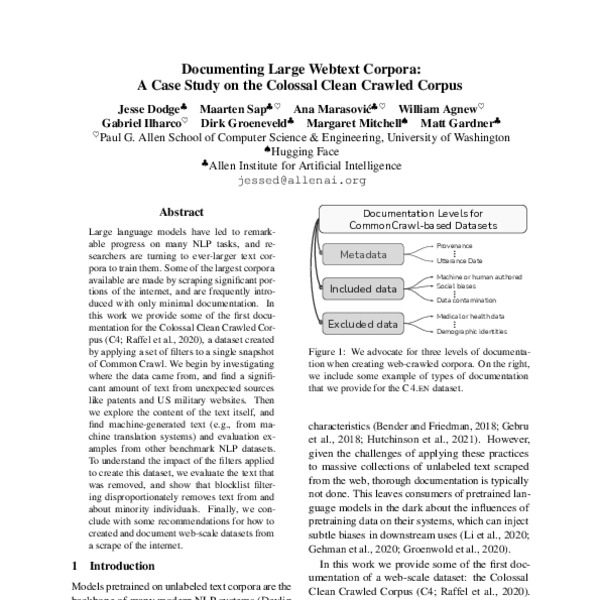
Large language models have led to remarkable progress on many NLP tasks, and researchers are turning to ever-larger text corpora to train them. Some of the largest corpora available are made by scraping significant portions of the internet, and are frequently introduced with only minimal documentation. In this work we provide some of the first documentation for the Colossal Clean Crawled Corpus (C4; Raffel et al., 2020), a dataset created by applying a set of filters to a single snapshot of Common Crawl. We begin by investigating where the data came from, and find a significant amount of text from unexpected sources like patents and US military websites. Then we explore the content of the text itself, and find machine-generated text (e.g., from machine translation systems) and evaluation examples from other benchmark NLP datasets. To understand the impact of the filters applied to create this dataset, we evaluate the text that was removed, and show that blocklist filtering disproportionately removes text from and about minority individuals. Finally, we conclude with some recommendations for how to created and document web-scale datasets from a scrape of the internet.
Exploring the Limits of Transfer Learning with a Unified Text-to-Text Transformer
Transfer learning, where a model is first pre-trained on a data-rich task before being fine-tuned on a downstream task, has emerged as a powerful technique in natural language processing (NLP). The effectiveness of transfer learning has given rise to a diversity of approaches, methodology, and practice. In this paper, we explore the landscape of transfer learning techniques for NLP by introducing a unified framework that converts all text-based language problems into a text-to-text format. Our systematic study compares pre-training objectives, architectures, unlabeled data sets, transfer approaches, and other factors on dozens of language understanding tasks. By combining the insights from our exploration with scale and our new “Colossal Clean Crawled Corpus”, we achieve state-of-the-art results on many benchmarks covering summarization, question answering, text classification, and more. To facilitate future work on transfer learning for NLP, we release our data set, pre-trained models, and code.
Google for Developers Blog - News about Web, Mobile, AI and Cloud
Discover EmbeddingGemma, Google's new on-device embedding model designed for efficient on-device AI, enabling features like RAG and semantic search.
Jekyll • Simple, blog-aware, static sites
Transform your plain text into static websites and blogs

Top2Vec: Distributed Representations of Topics
Topic modeling is used for discovering latent semantic structure, usually referred to as topics, in a large collection of documents. The most widely used methods are Latent Dirichlet Allocation and Probabilistic Latent…

Inducing Sustained Creativity and Diversity in Large Language Models
We address a not-widely-recognized subset of exploratory search, where a user sets out on a typically long "search quest" for the perfect wedding dress, overlooked research topic, killer company idea, etc. The first few outputs of current large language models (LLMs) may be helpful but only as a start, since the quest requires learning the search space and evaluating many diverse and creative alternatives along the way. Although LLMs encode an impressive fraction of the world's knowledge, common decoding methods are narrowly optimized for prompts with correct answers and thus return mostly homogeneous and conventional results. Other approaches, including those designed to increase diversity across a small set of answers, start to repeat themselves long before search quest users learn enough to make final choices, or offer a uniform type of "creativity" to every user asking similar questions. We develop a novel, easy-to-implement decoding scheme that induces sustained creativity and diversity in LLMs, producing as many conceptually unique results as desired, even without access to the inner workings of an LLM's vector space. The algorithm unlocks an LLM's vast knowledge, both orthodox and heterodox, well beyond modal decoding paths. With this approach, search quest users can more quickly explore the search space and find satisfying answers.
Nick's Blog
Lexicon Garden can help you explore and interact with lexicons both in the browser and with the help of your favorite agent.
Overcoming Vocabulary Constraints with Pixel-level Fallback
Subword tokenization requires balancing computational efficiency and vocabulary coverage, which often leads to suboptimal performance on languages and scripts not prioritized during training. We propose to augment pretrained language models with a vocabulary-free encoder that generates input embeddings from text rendered as pixels. Through experiments on English-centric language models, we demonstrate that our approach substantially improves machine translation performance and facilitates effective cross-lingual transfer, outperforming tokenizer-based methods. Furthermore, we find that pixel-based representations outperform byte-level approaches and standard vocabulary expansion. Our approach enhances the multilingual capabilities of monolingual language models without extensive retraining and reduces decoding latency via input compression.
Technical Report on the Pangram AI-Generated Text Classifier
We present Pangram Text, a transformer-based neural network trained to distinguish text written by large language models from text written by humans. Pangram Text outperforms zero-shot methods such as DetectGPT as well as leading commercial AI detection tools with over 38 times lower error rates on a comprehensive benchmark comprised of 10 text domains (student writing, creative writing, scientific writing, books, encyclopedias, news, email, scientific papers, short-form Q&A) and 8 open- and closed-source large language models. We propose a training algorithm, hard negative mining with synthetic mirrors, that enables our classifier to achieve orders of magnitude lower false positive rates on high-data domains such as reviews. Finally, we show that Pangram Text is not biased against nonnative English speakers and generalizes to domains and models unseen during training.