Illiberal and antidemocratic political forces, for example, in the form of far-right populism, are on the rise. Such politics, commonly referred to as ‘unreasonable’ in political philosophy, is widely seen as a threat to democracy. Many argue that an adequate response must involve listening to , that is, understanding and seriously considering the perspective of the unreasonable. I disagree. I argue that as democratic citizens, we should not listen to the unreasonable; we should, in a sense, ignore them, that is, refuse to understand and seriously consider their perspective, although continue to monitor their activities. Listening to the unreasonable is not instrumentally required for countering unreasonable politics. In addition, the unreasonable likely have no moral claim to be listened to. Finally, listening to them is disrespectful to reasonable citizens whose voice is ignored for the sake of paying attention to the unreasonable. For these reasons, we should ignore the unreasonable.
How to Think About Politics Without Wanting to Kill Yourself
There are Enemies, and then there are Cowards.

The Dispersion of Power: A Critical Realist Theory of Democracy
Abstract The Dispersion of Power is an urgent call to rethink centuries of conventional wisdom about what democracy is, why it matters, and how to make it better. Drawing from history, social science, psychology, and critical theory, it explains why elections do not and cannot realize the classic ideal of popular rule, and why prevailing strategies of democratic reform often make things worse. Instead, Bagg argues, we should see democracy as a way of protecting public power from capture—an alternative vision that is at once more realistic and more inspiring. Despite their many shortcomings, real-world elections do prevent the most extreme forms of tyranny, and are therefore indispensable. In dealing with the vast inequalities that remain, however, we cannot rely on standard solutions such as electoral reform, direct democracy, deliberation, and participatory governance. Instead, Bagg shows, protecting and enriching democracy requires addressing underlying inequalities of power directly. In part, this entails substantive policies attacking the advantages of wealthy elites. Even more crucially, deepening democracy requires the organization of oppositional, countervailing power among ordinary people. Neither task is easy, but historical precedents exist in both cases—and if democracy is to survive contemporary crises, leaders and citizens alike must find ways to revive and reinvent these essential democratic practices for the twenty-first century.

Public support for the <i>cordon sanitaire</i> : Descriptive evidence from Spain
Reactions to the rise of far-right parties that advocate democratic backsliding, and the dilution of socially liberal democratic norms present a dilemma for existing political parties. How should existing political parties respond to this challenge? A commonly adopted strategy is to apply a cordon sanitaire which excludes radical right-wing challengers from the government-forming process. Do voters support this policy? Leveraging data from Spain – where the mainstream right has accommodated the radical right-wing party, VOX, via numerous governing coalitions – I rely on individual citizens’ views on how parties should respond to rise of the far-right party, to answer this question. Empirically, the results show very low-level support for the cordon sanitaire in Spain. Indeed, the modal position of the electorate, regardless of their ideological position, is to treat the party just like any other. These results are not conditioned by the propensity of individuals to identify VOX as indeed being a “radical right” party. These descriptive findings suggest that whilst radical right-wing parties may present an inimical threat to democratic norms, citizens do not necessarily view the means of squashing this threat to be one of strategic exclusion. This likely explains why the mainstream right has been able to institutionalise VOX as a political ally: where strategic exclusion is not expected, the mainstream right need not fear violating an expectation that does not exist.

Public support for the <i>cordon sanitaire</i> : Descriptive evidence from Spain
Reactions to the rise of far-right parties that advocate democratic backsliding, and the dilution of socially liberal democratic norms present a dilemma for existing political parties. How should existing political parties respond to this challenge? A commonly adopted strategy is to apply a cordon sanitaire which excludes radical right-wing challengers from the government-forming process. Do voters support this policy? Leveraging data from Spain – where the mainstream right has accommodated the radical right-wing party, VOX, via numerous governing coalitions – I rely on individual citizens’ views on how parties should respond to rise of the far-right party, to answer this question. Empirically, the results show very low-level support for the cordon sanitaire in Spain. Indeed, the modal position of the electorate, regardless of their ideological position, is to treat the party just like any other. These results are not conditioned by the propensity of individuals to identify VOX as indeed being a “radical right” party. These descriptive findings suggest that whilst radical right-wing parties may present an inimical threat to democratic norms, citizens do not necessarily view the means of squashing this threat to be one of strategic exclusion. This likely explains why the mainstream right has been able to institutionalise VOX as a political ally: where strategic exclusion is not expected, the mainstream right need not fear violating an expectation that does not exist.
I Don't Know How To Explain To You That You Should Care About Other People
Our disagreement is not merely political, but a fundamental divide on what it means to live in a society.

Facts and Myths about Misperceptions
Misperceptions threaten to warp mass opinion and public policy on controversial issues in politics, science, and health. What explains the prevalence and persistence of these false and unsupported beliefs, which seem to be genuinely held by many people? Though limits on cognitive resources and attention play an important role, many of the most destructive misperceptions arise in domains where individuals have weak incentives to hold accurate beliefs and strong directional motivations to endorse beliefs that are consistent with a group identity such as partisanship. These tendencies are often exploited by elites who frequently create and amplify misperceptions to influence elections and public policy. Though evidence is lacking for claims of a “post-truth” era, changes in the speed with which false information travels and the extent to which it can find receptive audiences require new approaches to counter misinformation. Reducing the propagation and influence of false claims will require further efforts to inoculate people in advance of exposure (for example, media literacy), debunk false claims that are already salient or widespread (for example, fact-checking), reduce the prevalence of low-quality information (for example, changing social media algorithms), and discourage elites from promoting false information (for example, strengthening reputational sanctions).
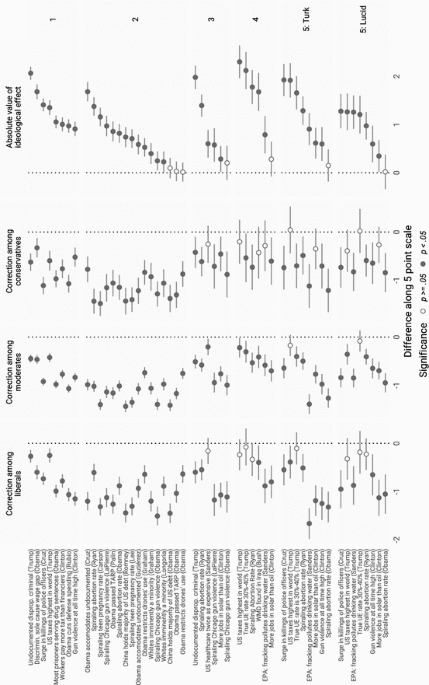
The Elusive Backfire Effect: Mass Attitudes’ Steadfast Factual Adherence
Can citizens heed factual information, even when such information challenges their partisan and ideological attachments? The “backfire effect,” described by Nyhan and Reifler (Polit Behav 32(2):303–330. https://doi.org/10.1007/s11109-010-9112-2, 2010), says no: rather than simply ignoring factual information, presenting respondents with facts can compound their ignorance. In their study, conservatives presented with factual information about the absence of Weapons of Mass Destruction in Iraq became more convinced that such weapons had been found. The present paper presents results from five experiments in which we enrolled more than 10,100 subjects and tested 52 issues of potential backfire. Across all experiments, we found no corrections capable of triggering backfire, despite testing precisely the kinds of polarized issues where backfire should be expected. Evidence of factual backfire is far more tenuous than prior research suggests. By and large, citizens heed factual information, even when such information challenges their ideological commitments.
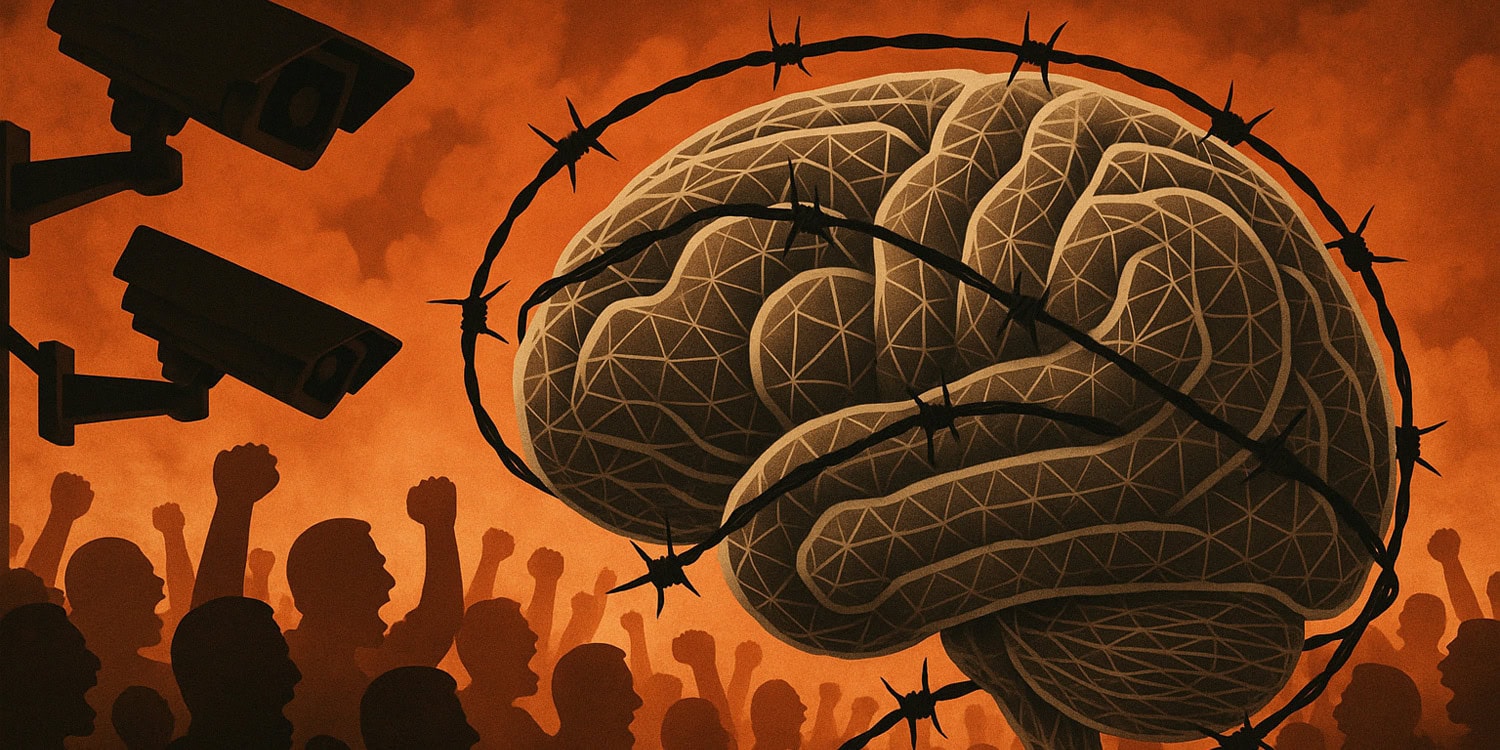
Anti-democratic attitudes are highly contagious, new psychology study finds
The rise of anti-democratic sentiments might be driven by social contagion. Researchers have discovered that citizens often adapt their personal support for authoritarian rule to align with the political views of those around them.
It’s Not Polarization; It’s the Radicalization of the Political Right
Polarization has become the master concept for diagnosing contemporary democratic crises. The notion denotes three features: symmetry between parties, politics as an opinion space where positions diverge, and mutual repulsion between opposing camps. Yet none of these capture current realities. Across democracies, the central dynamic is not two poles drifting apart but the transformation of the political right into authoritarianism, norm breaking, and openness to political violence. Social democratic and center-right parties tend to respond in the opposite way from what “polarization” implies: by accommodating rightward. Attempts to salvage the polarization frame with modifiers (“asymmetric,” “affective,” “sectarian,” “pernicious”) concede these realities but risk hollowing out the concept’s definitional core. These limitations reveal a deeper misdiagnosis: when one party turns antidemocratic and illiberal, incivility and conflict are inevitable—but they are symptoms, not the root problem. Misdiagnosing them as the central issue leads to viewing civility and compromise as remedies, thereby risking the legitimation of authoritarian actors. This article proposes an alternative lens: the radicalization of the political right. Developed in the study of extremism, the radicalization framework better captures asymmetric change, identity-driven politics, and the mainstreaming of illiberalism. It foregrounds identity fusion, threat narratives, elite entrepreneurship, and escalation. Concepts are never politically innocent and persisting with “polarization” risks both misdiagnosing and normalizing authoritarian threats.
It’s Not Polarization; It’s the Radicalization of the Political Right
Polarization has become the master concept for diagnosing contemporary democratic crises. The notion denotes three features: symmetry between parties, politics as an opinion space where positions diverge, and mutual repulsion between opposing camps. Yet none of these capture current realities. Across democracies, the central dynamic is not two poles drifting apart but the transformation of the political right into authoritarianism, norm breaking, and openness to political violence. Social democratic and center-right parties tend to respond in the opposite way from what “polarization” implies: by accommodating rightward. Attempts to salvage the polarization frame with modifiers (“asymmetric,” “affective,” “sectarian,” “pernicious”) concede these realities but risk hollowing out the concept’s definitional core. These limitations reveal a deeper misdiagnosis: when one party turns antidemocratic and illiberal, incivility and conflict are inevitable—but they are symptoms, not the root problem. Misdiagnosing them as the central issue leads to viewing civility and compromise as remedies, thereby risking the legitimation of authoritarian actors. This article proposes an alternative lens: the radicalization of the political right. Developed in the study of extremism, the radicalization framework better captures asymmetric change, identity-driven politics, and the mainstreaming of illiberalism. It foregrounds identity fusion, threat narratives, elite entrepreneurship, and escalation. Concepts are never politically innocent and persisting with “polarization” risks both misdiagnosing and normalizing authoritarian threats.
Why Science Can't Settle Political Disputes
Attempts to scientifically “rationalize” policy, based on the belief that science is purified of politics, may be damaging democracy

Political Neutrality in AI Is Impossible- But Here Is How to Approximate It
AI systems often exhibit political bias, influencing users' opinions and decisions. While political neutrality-defined as the absence of bias-is often seen as an ideal solution for fairness and safety, this position paper argues that true political neutrality is neither feasible nor universally desirable due to its subjective nature and the biases inherent in AI training data, algorithms, and user interactions. However, inspired by Joseph Raz's philosophical insight that "neutrality [...] can be a matter of degree" (Raz, 1986), we argue that striving for some neutrality remains essential for promoting balanced AI interactions and mitigating user manipulation. Therefore, we use the term "approximation" of political neutrality to shift the focus from unattainable absolutes to achievable, practical proxies. We propose eight techniques for approximating neutrality across three levels of conceptualizing AI, examining their trade-offs and implementation strategies. In addition, we explore two concrete applications of these approximations to illustrate their practicality. Finally, we assess our framework on current large language models (LLMs) at the output level, providing a demonstration of how it can be evaluated. This work seeks to advance nuanced discussions of political neutrality in AI and promote the development of responsible, aligned language models.

Political Neutrality in AI Is Impossible- But Here Is How to Approximate It
AI systems often exhibit political bias, influencing users' opinions and decisions. While political neutrality-defined as the absence of bias-is often seen as an ideal solution for fairness and safety, this position paper argues that true political neutrality is neither feasible nor universally desirable due to its subjective nature and the biases inherent in AI training data, algorithms, and user interactions. However, inspired by Joseph Raz's philosophical insight that "neutrality [...] can be a matter of degree" (Raz, 1986), we argue that striving for some neutrality remains essential for promoting balanced AI interactions and mitigating user manipulation. Therefore, we use the term "approximation" of political neutrality to shift the focus from unattainable absolutes to achievable, practical proxies. We propose eight techniques for approximating neutrality across three levels of conceptualizing AI, examining their trade-offs and implementation strategies. In addition, we explore two concrete applications of these approximations to illustrate their practicality. Finally, we assess our framework on current large language models (LLMs) at the output level, providing a demonstration of how it can be evaluated. This work seeks to advance nuanced discussions of political neutrality in AI and promote the development of responsible, aligned language models.
How to break populist parties’ appeal? An experimental evaluation of communication counter-strategies
Right-wing populist parties have become a major challenge to liberal democracies worldwide. How can mainstream parties effectively counter their appeal? While prior research has focused on the drivers of populist support, much less is known about how to counter right-wing populist rhetoric. We test four communication counter-strategies that target core elements of right-wing populist appeals: (i) undermining populists’ claims to democratic credibility, (ii) promoting inclusive in-group identity to counter exclusionary narratives, (iii) highlighting their performance legitimacy, and (iv) emphasizing the procedural legitimacy of mainstream parties. Drawing on real-world party communications from social media, manifestos, and press releases, we created 170 experimental treatments (posters and social media posts varying in format and complexity) to simulate how voters encounter political messages in everyday life. In a large-scale survey experiment with over 24,000 respondents in Germany, messages undermining right-wing populists’ democratic credibility prove most effective, particularly among citizens with high initial support for such parties.
Editor's Notes: Can We Defy Courts While Believing In Rule of Law?
Do our tactics throw out democracy and rule of law while purportedly aiming at saving them?