

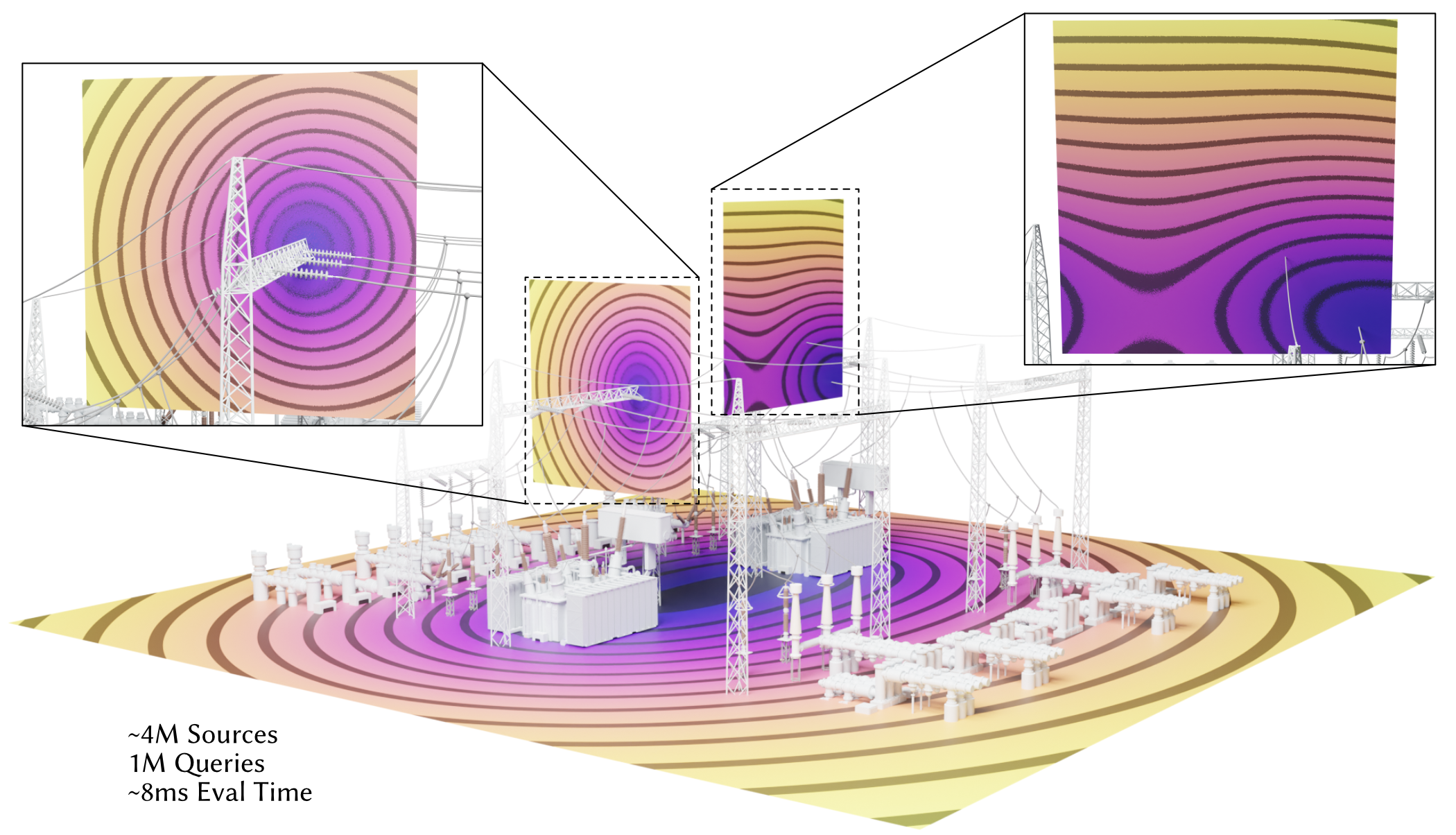
We present a novel stochastic version of the Barnes-Hut approximation. Regarding the level-of-detail (LOD) family of approximations as control variates, we construct an unbiased estimator of the kernel sum being approximated. Through several examples in graphics applications such as winding number computation and smooth distance evaluation, we demonstrate that our method is well-suited for GPU computation, capable of outperforming a GPU-optimized implementation of the deterministic Barnes-Hut approximation by achieving equal median error in up to 9.4x less time.
Modern GPU Programming For MLSys — Modern GPU Programming For MLSys
Machine learning systems sit at the heart of modern AI workloads. In these systems, performance often comes down to the quality of a small number of GPU kernels. Attention kernels, LLM prefill and decode kernels, low-precision block-scaled GEMMs, fused MoE layers, and other large fused kernels all directly shape end-to-end speed in both training and serving.
Modern GPU Programming For MLSys — Modern GPU Programming For MLSys
Machine learning systems sit at the heart of modern AI workloads. In these systems, performance often comes down to the quality of a small number of GPU kernels. Attention kernels, LLM prefill and decode kernels, low-precision block-scaled GEMMs, fused MoE layers, and other large fused kernels all directly shape end-to-end speed in both training and serving.
Random Forest ML on GPU
In my recent post on Rastair , we looked at some performance best-practices and optimizations for Rastair , a bioinformatics tool that I’m currently working on. One of the slowest parts of the tool is …
Hash Functions for GPU Rendering – Nathan Reed’s coding blog
Pixels and polygons and shaders, oh my!
Rendering Particles with Compute Shaders
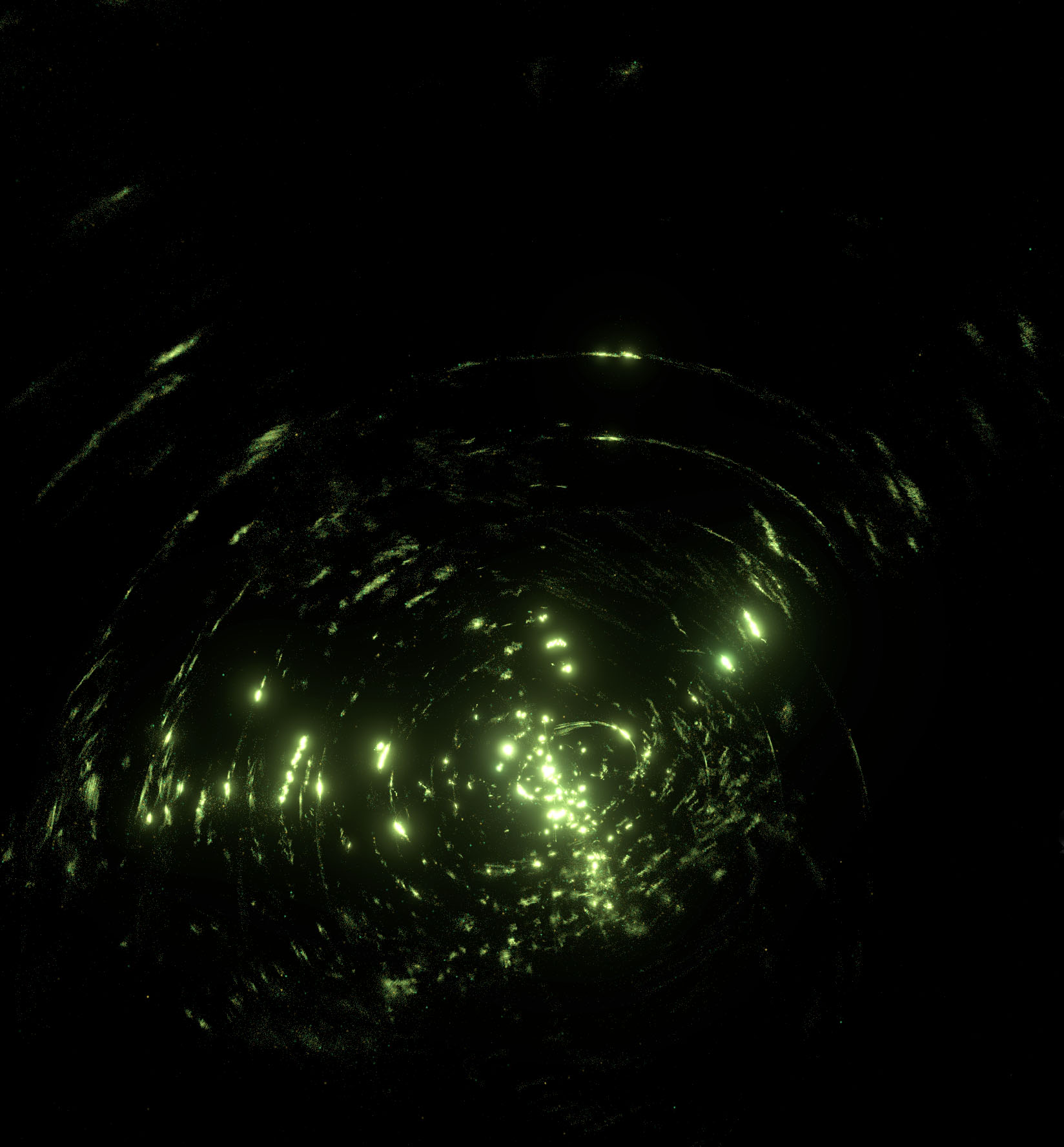
Overview I developed a technique to render single-pixel particles (using additive blending) with compute shaders rather than the usual fixed-function rasterization with vertex and fragment shaders. My approach runs 31–350% faster than rasterization on the cases I tested and is particularly faster for some “pathological” cases (which for my application are not actually that uncommon). I observed these speedups on both NVIDIA and AMD GPUs. Using this technique allowed me to ship an app that runs on minimum-spec hardware without sacrificing visual fidelity.
vik on Twitter / X
Photon, our inference engine, isn't fast just because of GPU kernels. A lot of the speedup comes from engine-level work: request scheduling, prefix caching, image processing, all tuned to keep the GPU saturated. https://t.co/3M7eFcFKo5— vik (@vikhyatk) May 2, 2026
RightNow AI - YC-Backed GPU Research Lab
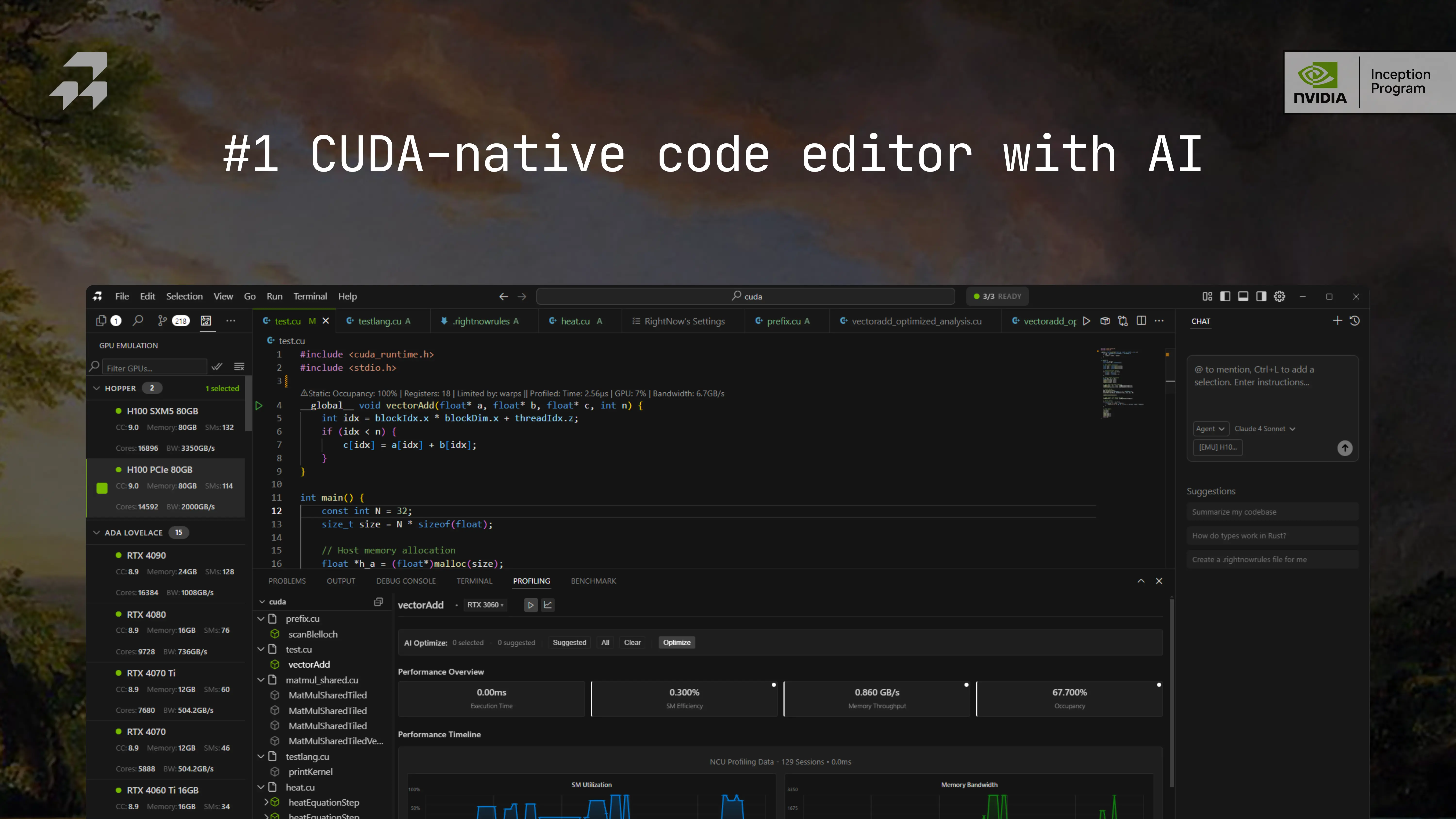
YC-backed GPU research lab building the RightNow CUDA editor, RunInfra inference infra, Forge kernels, and publishing AutoMegaKernel and related papers on arXiv.
Introducing CUDA Rust: Two Tracks for Writing GPU Kernels | NVIDIA Technical Blog
In September 2026, NVIDIA announced it is leaning into native GPU programming in Rust. CUDA C++ and CUDA Python are mature, enterprise-grade toolchains, and NVIDIA will be growing and maturing CUDA…

Minions: A Dynamic and Distributed Virtual GPU Cloud Built on Idle Apple Silicon Devices
The increasing demand for GPU-accelerated machine learning inference has exposed limitations in centralized GPU infrastructures, including…

Open Source AI Inference Benchmark | InferenceX
Compare AI inference performance across GPUs and frameworks. Real benchmarks on NVIDIA GB200, B200, AMD MI355X, and more. Free, open-source, continuously updated.
GPU Pricing — Live Platform Rates | Vast.ai
Live GPU pricing on Vast.ai. Prices set by supply and demand across 40+ data centers. On-demand, interruptible, or reserved — find the right GPU at the right price.
TPUs vs. GPUs and why Google is positioned to win AI race in the long term | Hacker News
To quote The Next Platform: "An Ironwood cluster linked with Google’s absolutely unique optical circuit switch interconnect can bring to bear 9,216 Ironwood TPUs with a combined 1.77 PB of HBM memory... This makes a rackscale Nvidia system based on 144 “Blackwell” GPU chiplets with an aggregate of 20.7 TB of HBM memory look like a joke."
Spiral on Twitter / X
4/ Spiral is our database built on Vortex: • Direct S3 → GPU data loading (skip the CPU bottleneck) • One API for 10KB embeddings AND 4GB videos • Time-bounded, audited permissions (no more credentials passed to AI agents) • Actually saturates your GPUs— Spiral (@SpiralDB) September 11, 2025