


Job-seeking graduates with disabilities began a hunger strike unto death on Saturday, marking the 21st consecutive day of their protest demanding immediate government action on their five-point charter of demands. The strike, organized by the Chakri Pratyashi Protibondhi...
Bangladesh: Garment workers protest demanding TK30,000 minimum wage increase - Business and Human Rights Centre
Check out this page via the Business and Human Rights Centre
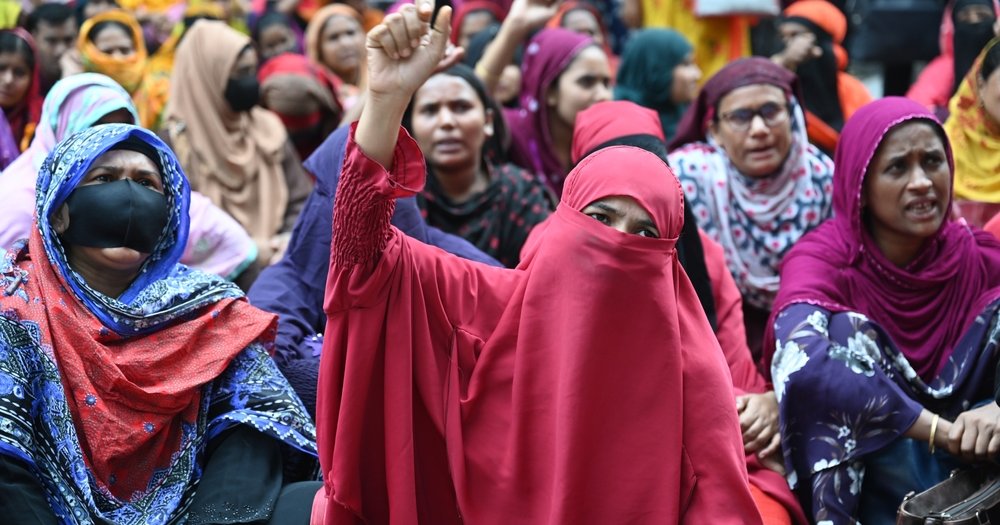
Bangladesh garment workers protest over low pay; govt announces formation of wage board
Dhaka, Nov 1 (PTI) Garment workers in Bangladesh on Sunday staged protests in Gazipur and Dhaka over their longstanding demand for higher pay, prompting the government to announce the formation of a wage board, according to local media reports. Garment workers chanting slogans blocked the Dhaka-Tangail highway in Gazipur, demanding a minimum monthly wage of […]

Egypt, The New Republic: Hunger strikes on the rigs, digital sweatshops & factories cleared for capital
Labor dispatch!


2026 Bangladesh garment workers protests
The 2026 Bangladesh garment workers protests are a series of labour demonstrations by workers in the ready-made garment industry of Bangladesh, demanding an increase in the sector's minimum monthly wage from ৳12,500 to ৳30,000.[1] Protests began in August 2026[2] and escalated in late October and early November 2026 in the industrial areas of Ashulia and Gazipur and in the capital, Dhaka.[3][4] On 1 November 2026, the government announced the formation of a six-member Minimum Wage Board including factory owners, though protests continued after the announcement due to not meeting demands.[1]
2026 Bangladesh garment sector minimum wage protests
The 2026 Bangladesh garment sector minimum wage protests are a series of labour demonstrations by workers in the ready-made garment industry of Bangladesh, demanding an increase in the sector's minimum monthly wage from ৳12,500 to ৳30,000.[1] Protests began in August 2026[2] and escalated in late October and early November 2026 in the industrial areas of Ashulia and Gazipur and in the capital, Dhaka.[3][4] On 1 November 2026, the government announced the formation of a six-member Minimum Wage Board including factory owners, though protests continued after the announcement due to not meeting demands. [1]
Wage protests spread as workers take to streets, often ‘without unions’
Wage protests spread as workers take to streets, often ‘without unions’

Resist as a Worker Self-Directed Nonprofit Part Two: The Work of Connection
By Kendra Hicks

Workers' power – Victorian Socialists
Everyone deserves well paid, secure work. We’re fighting for the right to strike, a $35 minimum wage on government-funded work, and an end to wage theft.
Find Protests Near You - Updated Daily | find a protest
Find protests and solidarity events near you — updated daily. Discover local rallies, vigils, teach-ins and justice actions happening this week and weekend.
Bangladesh garment workers stage fourth day of wage protests
Garment workers in Bangladesh staged a fourth day of wage protests on Tuesday, with police firing tear gas to disperse demonstrators as unrest disrupted factory operations and transport links in the country's vital export sector.

How France protests could ignite a wider European revolution
The engagement of the organised working classes, already growing, may lead to large-scale strike action across the continent

RMG workers’ protests shut factories, choke roads
Readymade garment (RMG) workers blocked major roads and highways in the capital’s Mirpur, Savar’s Ashulia, and Gazipur’s Kaliakoir yesterday demanding a minimum monthly wage of Tk 30,000,

Crip Technoscience Manifesto
As disabled people engaged in disability community, activism, and scholarship, our collective experiences and histories have taught us that we are effective agents of world building and dismantling toward more socially just relations.The grounds for social justice and world remaking, however, are frictioned;technologies, architectures, and infrastructures are often designed and implemented without committing to disability as a difference that matters. This manifesto calls attention to the powerful, messy, non-innocent, contradictory, and nevertheless crucial work of what we name as “crip technoscience,” practices of critique, alteration, and reinvention of our material-discursive world. Disabled people are experts and designers of everyday life. But we also harness technoscience for political action, refusing to comply with demands to cure, fix, or eliminate disability. Attentive to the intersectional workings of power and privilege, we agitate against independence and productivity as requirements for existence. Instead, we center technoscientific activism and critical design practices that foster disability justice.
In 1977, Disabled activists occupied the Federal Building in San Francisco to demand the passage of Section 504— legislation to protect against disability discrimination.When the building was cordoned off, in an effort to starve activists out, The Black Panthers *Broke In* to deliver them hot meals.
The 504 Protests and the Black Panther Party – Disability Social History Project
disabilityhistory.org