

How Zen Buddhism helps me with depression.
To experience Zen-like awakening, try going the headless way | Psyche Ideas
Try to point to your true self as you’d point to a brick wall, and other experiments in Zen-like awakening

Is everything you think you know about depression wrong?
In this extract from his new book, Johann Hari, who took antidepressants for 14 years, calls for a new approach

How to take things less personally and avoid mind reading | Psyche Guides
Always blaming yourself or assuming others think ill of you? A CBT therapist shares ways to break these self-critical habits

Let me tell you about my journey through 35 years of Zen practice | Aeon Essays
Growing up in countercultural California, ‘enlightenment’ had real glamour. But decades of practice have changed my mind

The neuroimaging correlates of depression established across six large-scale population datasets
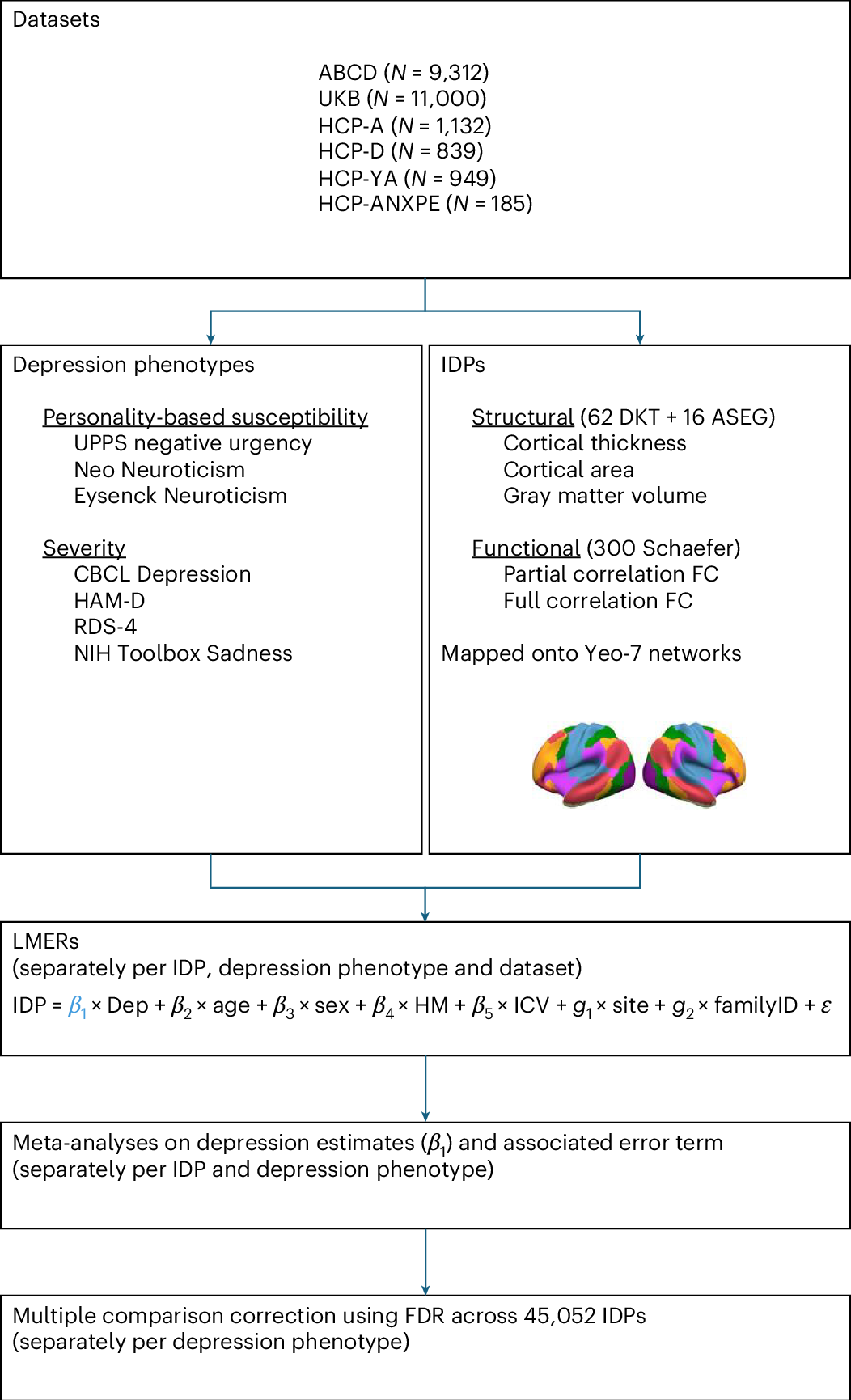
Depression has been linked to reduced size of subcortical regions and abnormal functional connectivity in frontal and default mode networks. However, recent meta-analyses have failed to identify significant converging correlates of depression across the literature such that a conclusive mapping of the neuroimaging correlates of depression remains elusive. We leveraged 23,417 participants across 6 population datasets to comprehensively establish the neuroimaging correlates of depression. We found reductions in gray matter volume/cortical surface area associated with depression in the frontal cortex, anterior cingulate and insula, confirming previous studies showing the importance of prefrontal and default mode regions in depression. Our findings demonstrate multiple surprising results, including a lack of depression correlates in subcortical brain regions and significant depression correlates in somatomotor and visual regions. Overall, these results shed new light on key brain regions involved in the pathophysiology of depression, updating our understanding of the neuroimaging correlates of depression symptoms.
The neuroimaging correlates of depression established across six large-scale population datasets
Depression has been linked to reduced size of subcortical regions and abnormal functional connectivity in frontal and default mode networks. However, recent meta-analyses have failed to identify significant converging correlates of depression across the literature such that a conclusive mapping of the neuroimaging correlates of depression remains elusive. We leveraged 23,417 participants across 6 population datasets to comprehensively establish the neuroimaging correlates of depression. We found reductions in gray matter volume/cortical surface area associated with depression in the frontal cortex, anterior cingulate and insula, confirming previous studies showing the importance of prefrontal and default mode regions in depression. Our findings demonstrate multiple surprising results, including a lack of depression correlates in subcortical brain regions and significant depression correlates in somatomotor and visual regions. Overall, these results shed new light on key brain regions involved in the pathophysiology of depression, updating our understanding of the neuroimaging correlates of depression symptoms.
Depression doesn't shrink the brain like we thought it did | New Scientist
For the past decade, depression has been linked to a shrunken hippocampus, which has a vital role in memory. But a large study using up-to-date scanning techniques suggests this may not be the case

the depression thing
the depression thing: a neat story about depression and mental health. By Zach Holman.

Managing intrusive thoughts | Lifeline
Dealing with overwhelming and distressing thoughts can be difficult, but knowing how to handle them can make a big difference to how you feel. Learn why you might be experiencing intrusive thoughts and strategies that can help you manage them.

How Bad Are Things?
One “advantage” of working in psychiatry is getting a window into an otherwise invisible world of really miserable people. I work in a wealthy, mostly-white college town consistently ra…


How to Think for Yourself
OpenAI shares data on ChatGPT users with suicidal thoughts, psychosis
The figure could mean potentially hundreds of thousands of users show signs of mental health distress weekly.

How to think like a Hegelian | Psyche Guides
For Hegel, your thoughts aren’t trapped in a cerebral box: they act on the world, making meaning and expressing your freedom

Mental health


Dysthymia
Autistic Burnout vs. Depression | Neurodivergent Insights

Defining autistic burnout through experts by lived experience: Grounded Delphi method investigating #AutisticBurnout - Julianne M Higgins, Samuel RC Arnold, Janelle Weise, Elizabeth Pellicano, Julian N Trollor, 2021
What Is Autistic Burnout? A Thematic Analysis of Posts on Two Online Platforms - Jane Mantzalas, Amanda L. Richdale, Achini Adikari, Jennifer Lowe, Cheryl Dissanayake, 2022
“Having All of Your Internal Resources Exhausted Beyond Measure and Being Left with No Clean-Up Crew”: Defining Autistic Burnout - Dora M. Raymaker, Alan R. Teo, Nicole A. Steckler, Brandy Lentz, Mirah Scharer, Austin Delos Santos, Steven K. Kapp, Morrigan Hunter, Andee Joyce, Christina Nicolaidis, 2020
“Shutdowns Are Like You’re Stuck on the Blue Screen of Death”: A Metaphor Analysis of Autistic Shutdowns - Katie Paris, Alexandru “Zeph” Lodestone, Melissa Houser, Laura Foran Lewis, 2025