

Elicitation is the process of extracting expert knowledge about some unknown quantity or quantities, and formulating that information as a probability distribution. Elicitation is important in situations, such as modelling the safety of nuclear installations or assessing the risk of terrorist attacks, where expert knowledge is essentially the only source of good information. It also plays a major role in other contexts by augmenting scarce observational data, through the use of Bayesian statistical methods. However, elicitation is not a simple task, and practitioners need to be aware of a wide range of research findings in order to elicit expert judgements accurately and reliably. Uncertain Judgements introduces the area, before guiding the reader through the study of appropriate elicitation methods, illustrated by a variety of multi-disciplinary examples. This is achieved by: Presenting a methodological framework for the elicitation of expert knowledge incorporating findings from both statistical and psychological research. Detailing techniques for the elicitation of a wide range of standard distributions, appropriate to the most common types of quantities. Providing a comprehensive review of the available literature and pointing to the best practice methods and future research needs. Using examples from many disciplines, including statistics, psychology, engineering and health sciences. Including an extensive glossary of statistical and psychological terms. An ideal source and guide for statisticians and psychologists with interests in expert judgement or practical applications of Bayesian analysis, Uncertain Judgements will also benefit decision-makers, risk analysts, engineers and researchers in the medical and social sciences.
Expert Knowledge Elicitation: Subjective but Scientific
Expert opinion and judgment enter into the practice of statistical inference and decision-making in numerous ways. Indeed, there is essentially no aspect of scientific investigation in which judgme...
The Assessment of Prior Distributions in Bayesian Analysis
In the Bayesian framework, quantified judgments about uncertainty are an indispensable input to methods of statistical inference and decision. Ultimately, all components of the formal mathematica...
Eliciting Beliefs with Random Generation Tasks
Elicitation methods, such as asking people to produce the deciles of a distribution, are standard practices in policy or applied statistics. Similarly, much of cognitive science and psychology focuses on determining people's people's beliefs or latent traits through questionnaires or judgment tasks. However, these approaches often only capture a rough outline of what people know and are usually limited to point estimates of people's beliefs. Here, we present a novel experimental paradigm that allows us to access people's beliefs and how variable these beliefs are. Our task is based on an established random generation paradigm in which participants produce quantities from a particular domain as randomly as possible. We hypothesize that due to the minds' general-purpose mechanisms for probabilistic inferences, these random sequences represent the participants' underlying prior beliefs. We show that our method can infer participants' beliefs for a wide range of numeric quantities at comparable accuracy as an established elicitation method. Moreover, these inferred beliefs are consistent with individual participants' generalization and inference patterns in a subsequent conditional prediction task. We then extend our approach to non-numeric belief elicitation, highlighting how our method can go beyond numeric elicitation and provide insight into complex beliefs that are challenging to assess experimentally. Empirically, our results highlight that people know the rough shapes of environmental distributions, and these beliefs guide inference and generalization. Moreover, using our novel approach, we also show that people know the fine details of environmental distributions. Finally, our experimental results show that random generation paradigms can be a useful tool for cognitive scientists, psychologists, and applied statisticians.
Prior Modeling
In Bayesian inference the prior model provides a valuable opportunity to incorporate domain expertise into our inferences. Unfortunately this opportunity often becomes a contentious issue in many fields, and this potential value is lost in the debate. In this case study I will discuss the challenges of building prior models that capture meaningful domain expertise and some practical strategies for ameliorating those challenges as much as possible.
A Bayesian Truth Serum for Subjective Data
Subjective judgments, an essential information source for science and policy, are problematic because there are no public criteria for assessing judgmental truthfulness. I present a scoring method for eliciting truthful subjective data in situations ...

WRKSHP.tools | Uncertainty Matrix
The Uncertainty Matrix helps you find threats and opportunities that are uncertain but can have a big impact on your business
Reasoning Under Uncertainty: Exploring Probabilistic Reasoning Capabilities of LLMs
Despite widespread success in language understanding and generation, large language models (LLMs) exhibit unclear and often inconsistent behavior when faced with tasks that require probabilistic reasoning. In this work, we present the first comprehensive study of the reasoning capabilities of LLMs over explicit discrete probability distributions. Given observations from a probability distribution, we evaluate models on three carefully designed tasks, mode identification, maximum likelihood estimation, and sample generation, by prompting them to provide responses to queries about either the joint distribution or its conditionals. These tasks thus probe a range of probabilistic skills, including frequency analysis, marginalization, and generative behavior. Through comprehensive empirical evaluations, we demonstrate that there exists a clear performance gap between smaller and larger models, with the latter demonstrating stronger inference and surprising capabilities in sample generation. Furthermore, our investigations reveal notable limitations, including sensitivity to variations in the notation utilized to represent probabilistic outcomes and performance degradation of over 60% as context length increases. Together, our results provide a detailed understanding of the probabilistic reasoning abilities of LLMs and identify key directions for future improvement.

Reasoning Under Uncertainty: Exploring Probabilistic Reasoning Capabilities of LLMs
Despite widespread success in language understanding and generation, large language models (LLMs) exhibit unclear and often inconsistent behavior when faced with tasks that require probabilistic reasoning. In this work, we present the first comprehensive study of the reasoning capabilities of LLMs over explicit discrete probability distributions. Given observations from a probability distribution, we evaluate models on three carefully designed tasks, mode identification, maximum likelihood estimation, and sample generation, by prompting them to provide responses to queries about either the joint distribution or its conditionals. These tasks thus probe a range of probabilistic skills, including frequency analysis, marginalization, and generative behavior. Through comprehensive empirical evaluations, we demonstrate that there exists a clear performance gap between smaller and larger models, with the latter demonstrating stronger inference and surprising capabilities in sample generation. Furthermore, our investigations reveal notable limitations, including sensitivity to variations in the notation utilized to represent probabilistic outcomes and performance degradation of over 60% as context length increases. Together, our results provide a detailed understanding of the probabilistic reasoning abilities of LLMs and identify key directions for future improvement.
Bayesian Thinking in Everyday Life
More than 200 years ago, Thomas Bayes came up with a brilliant idea that has helped shape the world today, called Bayes Theorem. This…

People Reject Algorithms in Uncertain Decision Domains Because They Have Diminishing Sensitivity to Forecasting Error
Will people use self-driving cars, virtual doctors, and other algorithmic decision-makers if they outperform humans? The answer depends on the uncertainty inherent in the decision domain. We propose that people have diminishing sensitivity to forecasting error and that this preference results in people favoring riskier (and often worse-performing) decision-making methods, such as human judgment, in inherently uncertain domains. In nine studies ( N = 4,820), we found that (a) people have diminishing sensitivity to each marginal unit of error that a forecast produces, (b) people are less likely to use the best possible algorithm in decision domains that are more unpredictable, (c) people choose between decision-making methods on the basis of the perceived likelihood of those methods producing a near-perfect answer, and (d) people prefer methods that exhibit higher variance in performance (all else being equal). To the extent that investing, medical decision-making, and other domains are inherently uncertain, people may be unwilling to use even the best possible algorithm in those domains.

The Wisdom of Individuals: Exploring People's Knowledge About Everyday Events Using Iterated Learning
Abstract Determining the knowledge that guides human judgments is fundamental to understanding how people reason, make decisions, and form predictions. We use an experimental procedure called ‘‘iterated learning,’’ in which the responses that people give on one trial are used to generate the data they see on the next, to pinpoint the knowledge that informs people's predictions about everyday events (e.g., predicting the total box office gross of a movie from its current take). In particular, we use this method to discriminate between two models of human judgments: a simple Bayesian model ( Griffiths & Tenenbaum, 2006 ) and a recently proposed alternative model that assumes people store only a few instances of each type of event in memory (Min K ; Mozer, Pashler, & Homaei, 2008 ). Although testing these models using standard experimental procedures is difficult due to differences in the number of free parameters and the need to make assumptions about the knowledge of individual learners, we show that the two models make very different predictions about the outcome of iterated learning. The results of an experiment using this methodology provide a rich picture of how much people know about the distributions of everyday quantities, and they are inconsistent with the predictions of the Min K model. The results suggest that accurate predictions about everyday events reflect relatively sophisticated knowledge on the part of individuals.

Prompting Science Report 4: Playing Pretend: Expert Personas Don't Improve Factual Accuracy
<span> <p><span>This is the fourth in a series of short reports that help business, education, and policy leaders understand the technical details of working with AI through rigorous testing. Here, we ask whether assigning personas to models improves performance on difficult objective multiple-choice questions. We study both domain-specific expert personas and low-knowledge personas, evaluating six models on GPQA Diamond (Rein et al. 2024) and MMLU-Pro (Wang et al. 2024), graduate-level questions spanning science, engineering, and law. </span></p> <p><span>We tested three approaches:</span></p> <p><span>• In-Domain Experts: Assigning the model an expert persona (“you are a physics expert”) matched to the problem type (physics problems) had no significant impact on performance (with the exception of the Gemini 2.0 Flash model).</span></p> <p><span> • Off-Domain Experts (Domain-Mismatched): Assigning the model an expert persona (“you are a physics expert”) not matched to the problem type (law problems) resulted in marginal differences.</span></p> <p><span> • Low-Knowledge Personas: We assigned the model negative capability personas (layperson, young child, toddler), which were generally harmful to benchmark accuracy. </span></p> <p><span>Across both benchmarks, persona prompts generally did not improve accuracy relative to a no-persona baseline. Expert personas showed no consistent benefit across models, with few exceptions. Domain-mismatched expert personas sometimes degraded performance. Low-knowledge personas often reduced accuracy. These results are about the accuracy of answers only; personas may serve other purposes (such as altering the tone of outputs), beyond improving factual performance.</span></p></span>

Trust and reliance on AI — An experimental study on the extent and costs of overreliance on AI
Decision-making is undergoing rapid changes due to the introduction of artificial intelligence (AI), as AI recommender systems can help mitigate human flaws and increase decision accuracy and efficiency. However, AI can also commit errors or suffer from algorithmic bias. Hence, blind trust in technologies carries risks, as users may follow detrimental advice resulting in undesired consequences. Building upon research on algorithm appreciation and trust in AI, the current study investigates whether users who receive AI advice in an uncertain situation overrely on this advice — to their own detriment and that of other parties. In a domain-independent, incentivized, and interactive behavioral experiment, we find that the mere knowledge of advice being generated by an AI causes people to overrely on it, that is, to follow AI advice even when it contradicts available contextual information as well as their own assessment. Frequently, this overreliance leads not only to inefficient outcomes for the advisee, but also to undesired effects regarding third parties. The results call into question how AI is being used in assisted decision making, emphasizing the importance of AI literacy and effective trust calibration for productive deployment of such systems.
Valerio Capraro on Twitter / X
Our new paper shows that AI destroys the wisdom of uncertainty.The willingness to say “I don’t know” collapses from 44% to 3%.This happens even when the AI’s advice is wrong. Consequently, correct answers fall from 27% to 9%.Yes: some people who would otherwise answer… pic.twitter.com/l0YZ75IFHn— Valerio Capraro (@ValerioCapraro) August 10, 2026
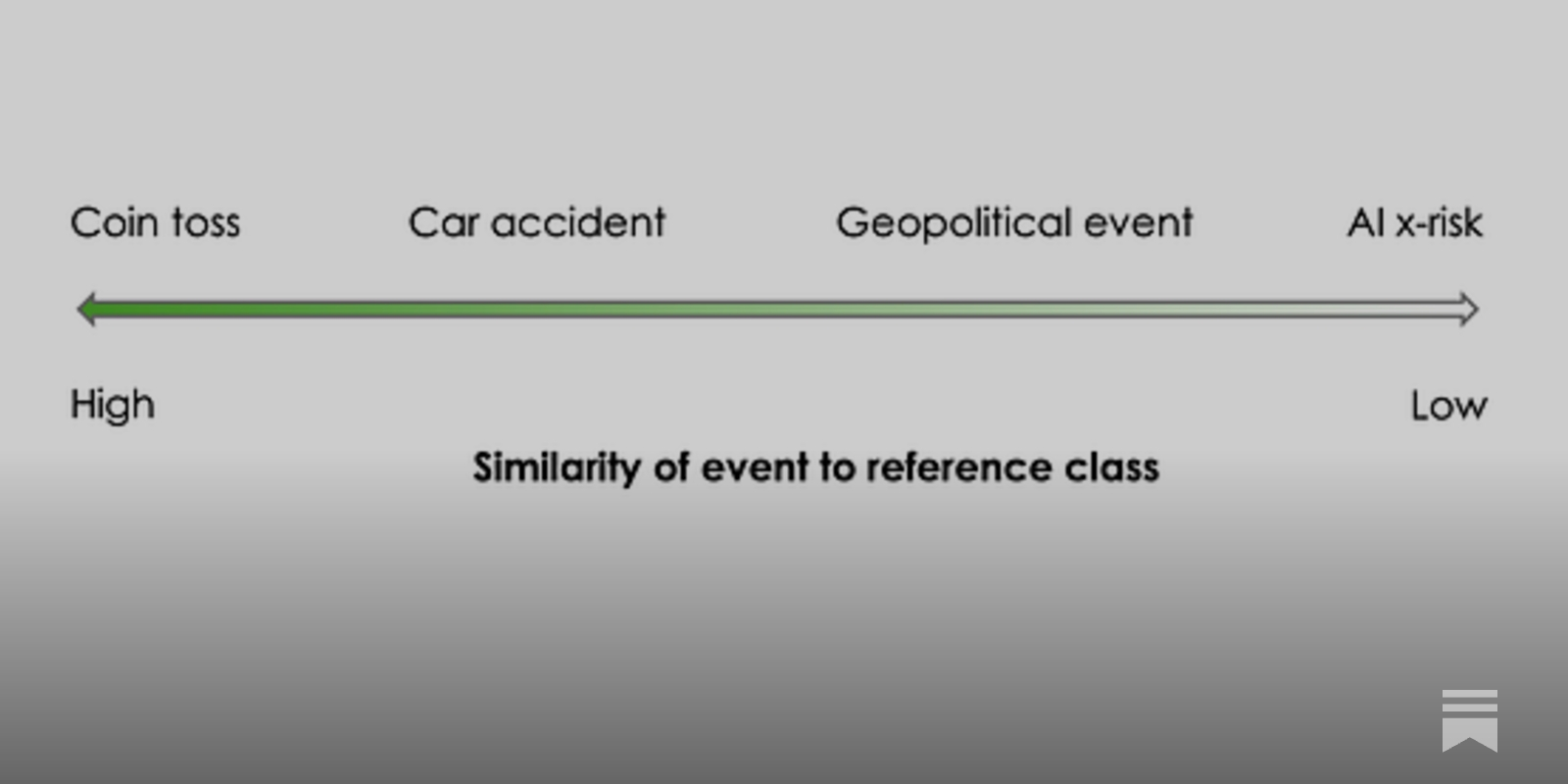
AI existential risk probabilities are too unreliable to inform policy
How speculation gets laundered through pseudo-quantification
Safety Co-Option and Compromised National Security: The Self-Fulfilling Prophecy of Weakened AI Risk Thresholds
Risk thresholds provide a measure of the level of risk exposure that a society or individual is willing to withstand, ultimately shaping how we determine the safety of technological systems. Against the backdrop of the Cold War, the first risk analyses, such as those devised for nuclear systems, cemented societally accepted risk thresholds against which safety-critical and defense systems are now evaluated. But today, the appropriate risk tolerances for AI systems have yet to be agreed on by global governing efforts, despite the need for democratic deliberation regarding the acceptable levels of harm to human life. Absent such AI risk thresholds, AI technologists-primarily industry labs, as well as "AI safety" focused organizations-have instead advocated for risk tolerances skewed by a purported AI arms race and speculative "existential" risks, taking over the arbitration of risk determinations with life-or-death consequences, subverting democratic processes. In this paper, we demonstrate how such approaches have allowed AI technologists to engage in "safety revisionism," substituting traditional safety methods and terminology with ill-defined alternatives that vie for the accelerated adoption of military AI uses at the cost of lowered safety and security thresholds. We explore how the current trajectory for AI risk determination and evaluation for foundation model use within national security is poised for a race to the bottom, to the detriment of the US's national security interests. Safety-critical and defense systems must comply with assurance frameworks that are aligned with established risk thresholds, and foundation models are no exception. As such, development of evaluation frameworks for AI-based military systems must preserve the safety and security of US critical and defense infrastructure, and remain in alignment with international humanitarian law.