


In the Bayesian framework, quantified judgments about uncertainty are an indispensable input to methods of statistical inference and decision. Ultimately, all components of the formal mathematica...
Prior Modeling
In Bayesian inference the prior model provides a valuable opportunity to incorporate domain expertise into our inferences. Unfortunately this opportunity often becomes a contentious issue in many fields, and this potential value is lost in the debate. In this case study I will discuss the challenges of building prior models that capture meaningful domain expertise and some practical strategies for ameliorating those challenges as much as possible.
Uncertain Judgements: Eliciting Experts' Probabilities
Elicitation is the process of extracting expert knowledge about some unknown quantity or quantities, and formulating that information as a probability distribution. Elicitation is important in situations, such as modelling the safety of nuclear installations or assessing the risk of terrorist attacks, where expert knowledge is essentially the only source of good information. It also plays a major role in other contexts by augmenting scarce observational data, through the use of Bayesian statistical methods. However, elicitation is not a simple task, and practitioners need to be aware of a wide range of research findings in order to elicit expert judgements accurately and reliably. Uncertain Judgements introduces the area, before guiding the reader through the study of appropriate elicitation methods, illustrated by a variety of multi-disciplinary examples. This is achieved by: Presenting a methodological framework for the elicitation of expert knowledge incorporating findings from both statistical and psychological research. Detailing techniques for the elicitation of a wide range of standard distributions, appropriate to the most common types of quantities. Providing a comprehensive review of the available literature and pointing to the best practice methods and future research needs. Using examples from many disciplines, including statistics, psychology, engineering and health sciences. Including an extensive glossary of statistical and psychological terms. An ideal source and guide for statisticians and psychologists with interests in expert judgement or practical applications of Bayesian analysis, Uncertain Judgements will also benefit decision-makers, risk analysts, engineers and researchers in the medical and social sciences.
Choosing informative priors in Bayesian regression models: a simulation study and tutorial using Stan and R
BackgroundBayesian regression models provide a robust framework for complex data analysis, which is particularly advantageous in scenarios with small sample sizes, common in psychology or medical research. However, specifying appropriate prior distributions that incorporate existing knowledge to regularize model parameters remains a challenge for many researchers. This can lead to unstable or implausible estimates. This study aims to demonstrate the impact of different prior distributions on regression models and to provide a practical guide for choosing and justifying informative priors to produce more stable and credible results.MethodsThe study involved two parts. First, a simulation study was conducted to systematically assess the sensitivity of Bayesian linear regression models to prior specification. We systematically varied the sample size, prior location, and prior scale to observe their impact on posterior estimates for a known true effect size. Second, a case–control study using real-world patient data (N = 526) demonstrated the practical application of choosing informative priors. Bayesian logistic regression models were used to analyze the relationship between severe dementia and fall incidence, comparing results from priors based on existing literature (“believer”), conservative priors (“agnostic”), and priors assuming an opposite effect (“skeptical”).ResultsThe simulation study showed that strongly informative priors had a substantial influence on posterior estimates, particularly for smaller sample sizes. As the sample size increased, the influence of the data increased, and the estimates converged toward the true effect. In the case–control study, a standard frequentist logistic regression produced an odds ratio of 8.87 with a very wide and unstable confidence interval (1.66–165.19), likely due to data sparsity. In contrast, a Bayesian model using a moderately informative “believer” prior derived from existing research yielded a more stable and plausible odds ratio of 4.01 with a substantially narrower credible interval (1.99–8.78).ConclusionCareful and transparent specification of informative priors is a critical tool in Bayesian analysis, especially when data are sparse. By incorporating justified evidence-based assumptions, researchers can regularize models to prevent implausible outcomes and produce more stable, interpretable, and credible results. This approach enhances the robustness of statistical inference in fields where small sample sizes are a frequent challenge.

Bayesian Thinking in Everyday Life
More than 200 years ago, Thomas Bayes came up with a brilliant idea that has helped shape the world today, called Bayes Theorem. This…

A Bayesian Truth Serum for Subjective Data
Subjective judgments, an essential information source for science and policy, are problematic because there are no public criteria for assessing judgmental truthfulness. I present a scoring method for eliciting truthful subjective data in situations ...


WRKSHP.tools | Uncertainty Matrix
The Uncertainty Matrix helps you find threats and opportunities that are uncertain but can have a big impact on your business
An Intuitive Explanation of Bayes’ Theorem
Bayes’ Theoremfor the curious and bewildered;an excruciatingly gentle introduction.
The Consistent Histories Approach to Quantum Mechanics
The consistent histories, also known as decoherent histories, approachto quantum interpretation is broadly compatible with standard quantummechanics as found in textbooks. However, the concept ofmeasurement by which probabilities are introduced in standardquantum theory no longer plays a fundamental role. Instead,all quantum time dependence is probabilistic (stochastic),with probabilities given by the Born rule or its extensions. Byrequiring that the description of a quantum system be carried outusing a well-defined probabilistic sample space (called a“framework”) this approach resolves many well-knownquantum paradoxes of quantum foundations. In particular, quantummechanics is local and consistent with special relativity. Classicalmechanics emerges as a useful approximation to the more fundamentalquantum mechanics under suitable conditions. The price to be paid forthis is a set of rules for reasoning resembling, but very much simplerthan, those of quantum logic. An important philosophical implicationis the absence of a single universally-true state of affairs at eachinstant of time. However, there is a correspondence limit in which thenew quantum logic becomes standard logic in the macroscopic world ofeveryday experience, and the laws of classical mechanics emerge as agood approximation to an underlying, and in principle more exact,quantum description.
AI existential risk probabilities are (still) too unreliable to inform policy
How speculation gets laundered through pseudo-quantification
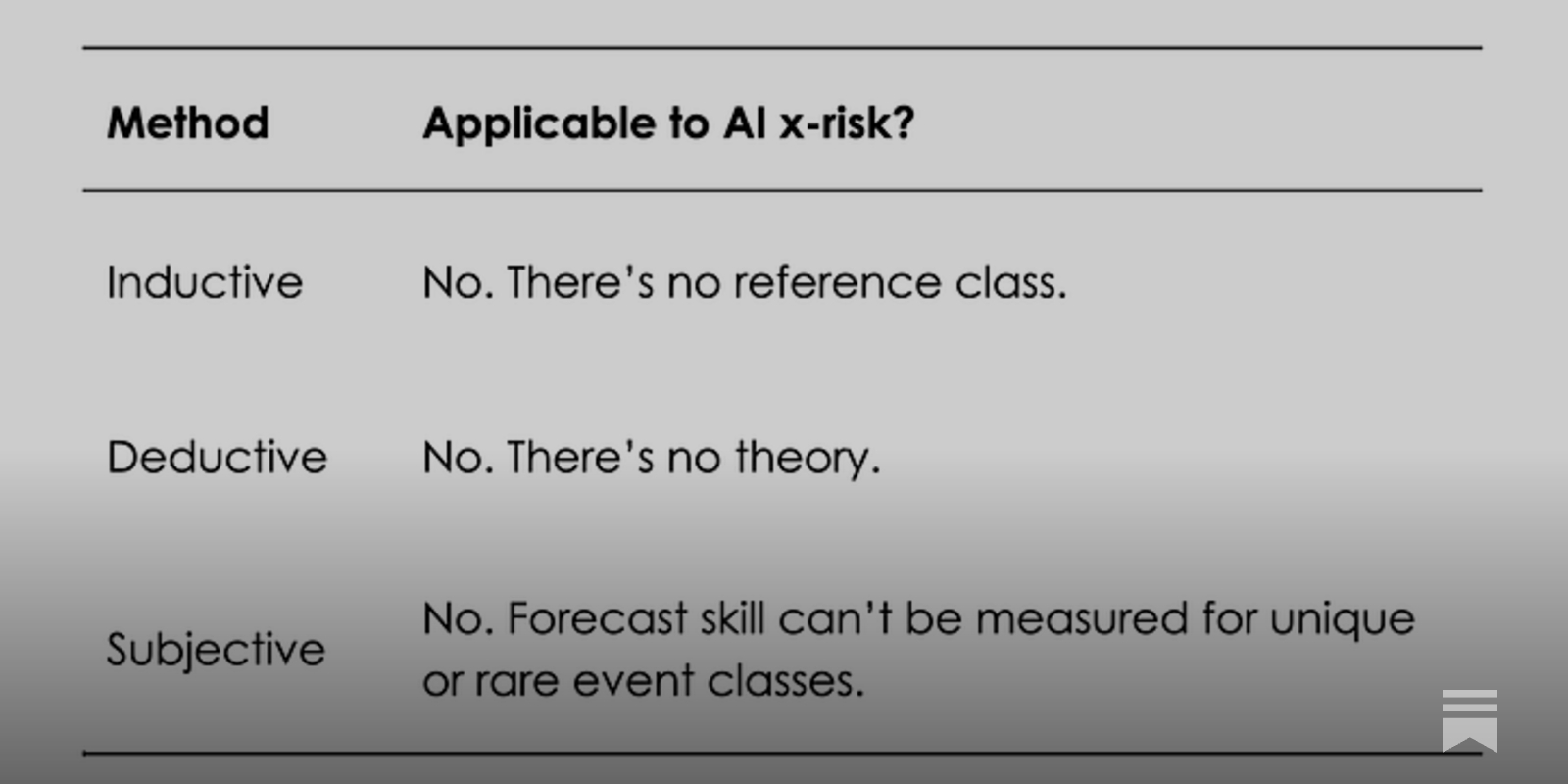
People Reject Algorithms in Uncertain Decision Domains Because They Have Diminishing Sensitivity to Forecasting Error
Will people use self-driving cars, virtual doctors, and other algorithmic decision-makers if they outperform humans? The answer depends on the uncertainty inherent in the decision domain. We propose that people have diminishing sensitivity to forecasting error and that this preference results in people favoring riskier (and often worse-performing) decision-making methods, such as human judgment, in inherently uncertain domains. In nine studies ( N = 4,820), we found that (a) people have diminishing sensitivity to each marginal unit of error that a forecast produces, (b) people are less likely to use the best possible algorithm in decision domains that are more unpredictable, (c) people choose between decision-making methods on the basis of the perceived likelihood of those methods producing a near-perfect answer, and (d) people prefer methods that exhibit higher variance in performance (all else being equal). To the extent that investing, medical decision-making, and other domains are inherently uncertain, people may be unwilling to use even the best possible algorithm in those domains.

AI existential risk probabilities are too unreliable to inform policy
How speculation gets laundered through pseudo-quantification
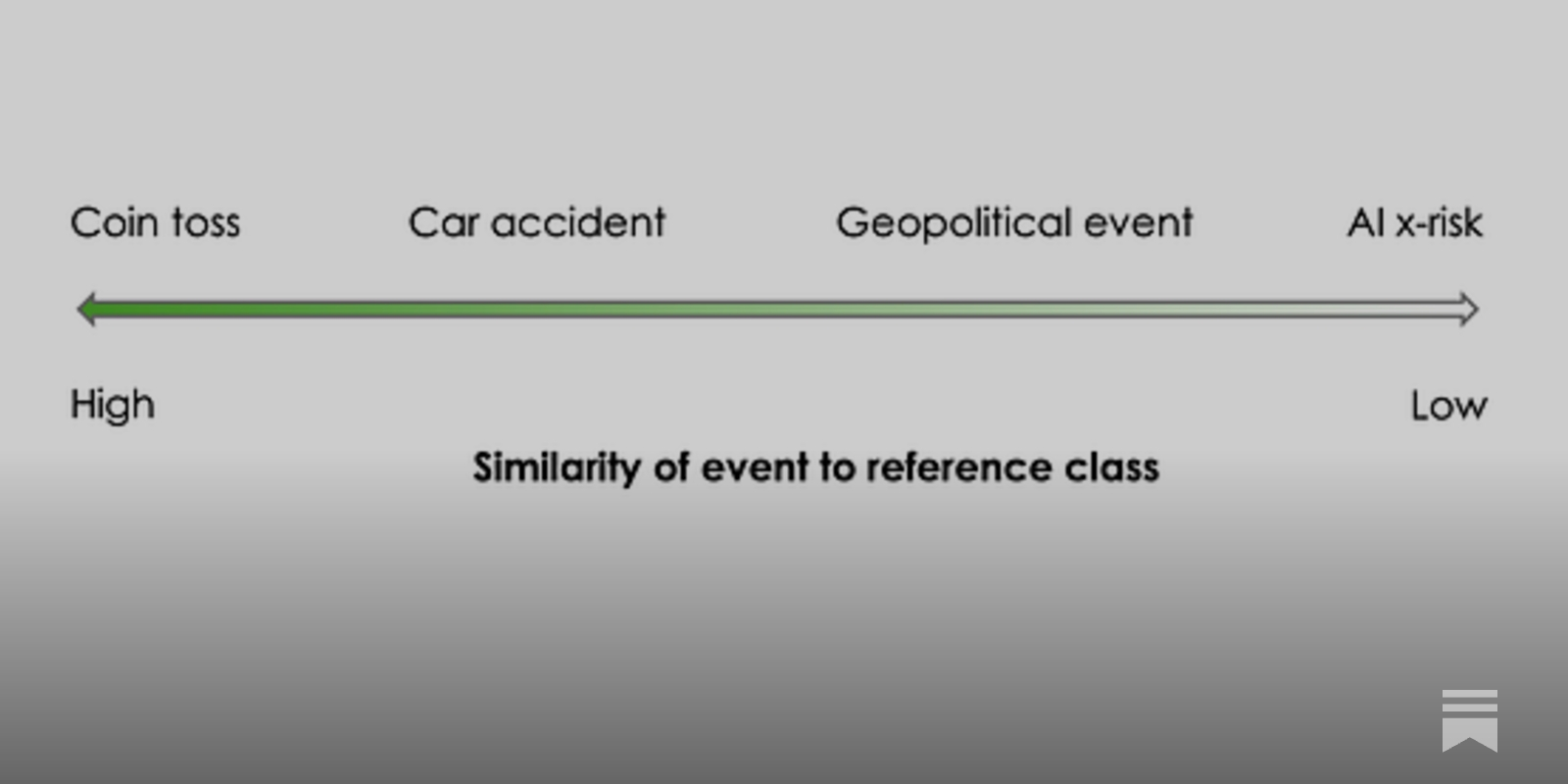

Expert Knowledge Elicitation: Subjective but Scientific
Expert opinion and judgment enter into the practice of statistical inference and decision-making in numerous ways. Indeed, there is essentially no aspect of scientific investigation in which judgme...

Eliciting Beliefs with Random Generation Tasks
Elicitation methods, such as asking people to produce the deciles of a distribution, are standard practices in policy or applied statistics. Similarly, much of cognitive science and psychology focuses on determining people's people's beliefs or latent traits through questionnaires or judgment tasks. However, these approaches often only capture a rough outline of what people know and are usually limited to point estimates of people's beliefs. Here, we present a novel experimental paradigm that allows us to access people's beliefs and how variable these beliefs are. Our task is based on an established random generation paradigm in which participants produce quantities from a particular domain as randomly as possible. We hypothesize that due to the minds' general-purpose mechanisms for probabilistic inferences, these random sequences represent the participants' underlying prior beliefs. We show that our method can infer participants' beliefs for a wide range of numeric quantities at comparable accuracy as an established elicitation method. Moreover, these inferred beliefs are consistent with individual participants' generalization and inference patterns in a subsequent conditional prediction task. We then extend our approach to non-numeric belief elicitation, highlighting how our method can go beyond numeric elicitation and provide insight into complex beliefs that are challenging to assess experimentally. Empirically, our results highlight that people know the rough shapes of environmental distributions, and these beliefs guide inference and generalization. Moreover, using our novel approach, we also show that people know the fine details of environmental distributions. Finally, our experimental results show that random generation paradigms can be a useful tool for cognitive scientists, psychologists, and applied statisticians.
Reasoning Under Uncertainty: Exploring Probabilistic Reasoning Capabilities of LLMs
Despite widespread success in language understanding and generation, large language models (LLMs) exhibit unclear and often inconsistent behavior when faced with tasks that require probabilistic reasoning. In this work, we present the first comprehensive study of the reasoning capabilities of LLMs over explicit discrete probability distributions. Given observations from a probability distribution, we evaluate models on three carefully designed tasks, mode identification, maximum likelihood estimation, and sample generation, by prompting them to provide responses to queries about either the joint distribution or its conditionals. These tasks thus probe a range of probabilistic skills, including frequency analysis, marginalization, and generative behavior. Through comprehensive empirical evaluations, we demonstrate that there exists a clear performance gap between smaller and larger models, with the latter demonstrating stronger inference and surprising capabilities in sample generation. Furthermore, our investigations reveal notable limitations, including sensitivity to variations in the notation utilized to represent probabilistic outcomes and performance degradation of over 60% as context length increases. Together, our results provide a detailed understanding of the probabilistic reasoning abilities of LLMs and identify key directions for future improvement.
