

The Dublin Core Metadata Initiative (DCMI) is an open forum engaged in metadata innovation and support the development of interoperable online metadata standards that support a broad range of purposes and business models. DCMI's activities include consensus-driven working groups, global conferences and workshops, standards liaison, and educational efforts to promote widespread acceptance of metadata standards and practices.
Metadata Integration: A Systematic Review on Methods, Challenges and Applications Across Multiple Domains
Metadata contributes to ensuring semantic interoperability, data reuse, and efficient information retrieval across heterogeneous systems. However, existing studies present fragmented approaches and lack a consolidated view of the strategies adopted in different domains. This fragmentation creates a gap in understanding the current state of the art and identifying cross-domain trends and challenges. This systematic review aims to address this gap by analyzing metadata integration practices across multiple domains, including Health and Medicine, Smart Cities and IoT, Data Science, Geosciences, Cultural Heritage, Library and Information Science. This review follows the Kitchenham structure, encompassing the planning, execution, and reporting phases. A total of 81 peer-reviewed articles published between 2014 and 2025 were selected from five major databases, based on the defined inclusion and exclusion criteria and a structured quality assessment process. The results reveal a predominance of the use of ontology, followed by metadata-driven language, standards, processes, and common metadata schema with an emerging trend towards automation through the adoption of AI-based approaches. The identified challenges include semantic heterogeneity, lack of standardization, limited automation, and usability issues in the current tools and platforms. We provide a comprehensive synthesis of existing approaches, highlighting domain-specific and cross-domain trends, and identifying research opportunities to advance metadata integration through automation, semantic enrichment, and standardized practices.
DSWB | Metadata Standards: Selecting and Applying Standards in Research | Webinar Recording
(PDF) Understanding the Nature of Metadata: Systematic Review
PDF | Background Metadata are created to describe the corresponding data in a detailed and unambiguous way and is used for various applications in... | Find, read and cite all the research you need on ResearchGate

ICFJ+ Launches the Plus Hub: Shared Services for More Resilient News Ecosystems
ICFJ+, the civic tech and media venture operated by Code for Africa (CfA), the International Center for Journalists (ICFJ) and PROTO, is launching the Plus Hub. The initiative gives information and news providers access to shared, enterprise-level services and technical support they can’t ever afford on their own. Our goal is to provide critical infrastructure for civic intelligence — information that helps people make sense of the world and act constructively to shape it.

National Data Platform Receives NSF Category I Award to Expand AI-Ready Data Infrastructure for U.S.
UC San Diego researchers will lead a collaborative project to expand a national platform connecting data, computing and AI resources to empower nationwide researchers and educators.

The Impact of Modern AI in Metadata Management
Metadata management plays a critical role in data governance, resource discovery, and decision-making in the data-driven era. While traditional metadata approaches have primarily focused on organization, classification, and resource reuse, the integration of modern artificial intelligence (AI) technologies has significantly transformed these processes. This paper investigates both traditional and AI-driven metadata approaches by examining open-source solutions, commercial tools, and research initiatives. A comparative analysis of traditional and AI-driven metadata management methods is provided, highlighting existing challenges and their impact on next-generation datasets. The paper also presents an innovative AI-assisted metadata management framework designed to address these challenges. This framework leverages more advanced modern AI technologies to automate metadata generation, enhance governance, and improve the accessibility and usability of modern datasets. Finally, the paper outlines future directions for research and development, proposing opportunities to further advance metadata management in the context of AI-driven innovation and complex datasets.

You are Crossref - Crossref
Crossref runs open infrastructure to link research objects, entities, and actions—creating a lasting and reusable scholarly record that underpins open science. Together with our >25,000 members in 167 countries, we drive metadata exchange and support 2.1 billion monthly API queries, facilitating global research communication, for the benefit of society.

Research Object Crate (RO-Crate)
RO-Crate is a community effort to establish a lightweight approach to packaging research data with their metadata. It is based on schema.org annotations in JSON-LD, and aims to make best-practice in formal metadata description accessible and practical for use in a wider variety of situations, from an individual researcher working with a folder of data, to large data-intensive computational research environments.
NSF announces new initiative to launch and scale a new generation of transformative independent research organizations to advance breakthrough science
The U.S. National Science Foundation Directorate for Technology, Innovation and Partnerships (NSF TIP) on Friday announced the launch of a new initiative designed to launch and scale a new generation…

Manuscript submission systems and metadata completeness in Crossref: Patterns and associations
The importance of open research information, particularly publication metadata, is widely recognised. Crossref is one of the most important infrastructures for registering open metadata as part of DOI record registration. It is widely known, however, that the metadata of many publications is far from complete, with many publishers making certain metadata openly available, but failing to do so for other metadata elements. Publishers’ ability to register this metadata with Crossref depends on their capacity to capture and retain this data in their production workflows. Manuscript submission systems are an important, yet largely overlooked, factor in the extent to which publishers make metadata available through Crossref. In this paper, we present the results of an analysis investigating the relation between the level of metadata that publishers deposit with Crossref and the submission systems that they deploy for their journals. We have looked at the 153 publishers with the largest amounts of publications in Crossref and concentrate on the four most commonly used systems: Editorial Manager, ScholarOne, Open Journal Systems (OJS) and eJournalPress. We show that some submission systems appear better suited to capturing certain metadata elements. However, there are always cases where publishers using the same system differ widely in the level of metadata they register, suggesting that technology is not the only prohibiting factor and other considerations are at play.
Grand Challenges for the Convergence of Computational and Citizen Science Research Workshop Report
This report is an outcome of a Computing Community Consortium (CCC) visioning workshop on Grand Challenges for the Convergence of Computational and Citizen Science Research conducted on April 8-9, 2025, in Washington, D.C. as well as through several precursor virtual input-gathering sessions. These events brought together experts across relevant disciplines to develop a research agenda that brings to fruition the above vision on how humans and machines may team up to solve some of the world's most pressing scientific problems. Citizen science delivers measurable economic and national value. Public participation in scientific research generates millions of dollars in volunteer labor value, extends government agency capacity, and directly supports federal priorities in areas such as disaster management, public health, water, energy, workforce development, and many more. At the same time, 21st-century scientific infrastructure requirements for citizen science (from hardware and cyberinfrastructure to data and computational frameworks) mirror those for computational science more generally. The distributed, collaborative, long-term, and contextual nature of citizen science makes it a demanding real-world use case for a novel robust research infrastructure that accounts for security, privacy, resource adaptability, and transparency. In this report, we outline the key findings, future research directions, and recommendations that emerged from the April 2025 CCC Grand Challenges for the Convergence of Computational and Citizen Science Research Workshop.

Home Page
We are an international community of communities bound by a common interest in persistent infrastructure. So far, we have welcomed agencies that manage communities spanning entertainment, standards, the built environment, natural history collections, scholarly communications, and research data.
Metagov
Metagov is a laboratory for digital governance. Our mission is to cultivate tools, practices, and communities that enable self-governance in the digital age.
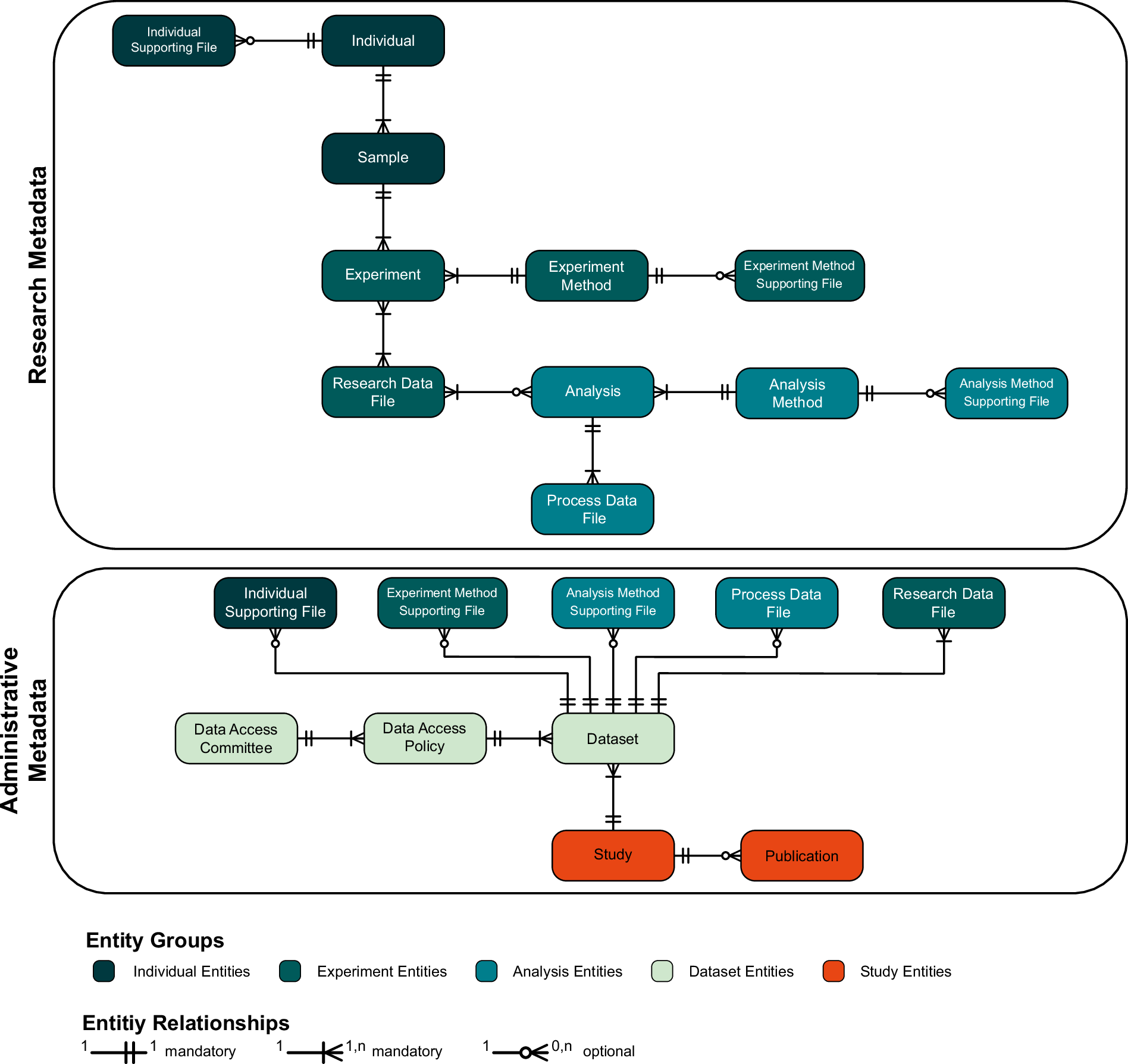
Semantic alignment of the German Human Genome-Phenome Archive metadata model in Europe’s genomics field
Legal and technical developments drive data sharing via federated infrastructures, especially in the field of human omics. This requires interoperability across technical, syntactic, organizational, and semantic layers. The German Human Genome-Phenome Archive (GHGA) has been building a national, federated infrastructure for secure sharing of human omics data. As part of its mission to enhance interoperability and to promote reliable data sharing, a detailed crosswalk analysis was conducted comparing the GHGA metadata model with four other domain-relevant standards and metadata models: EGA (Submission API and model draft), FAIR Genomes and ISA-tab. The analysis aimed at identifying semantic consensus fields to define datasets in the context of human omics by forward mapping (GHGA model to external models). Backward mapping (external models to GHGA) focused on spotting gaps in GHGA’s semantic metadata representation. Forward mapping showed overall similar property coverage across models, aligning with MINSEQE. Backward mapping showed greater model heterogeneity. None of the identified information gaps spanned across all models. These findings highlight the detail and adaptability of the GHGA metadata model.
Professionalising Community Management Roles in Interdisciplinary Research Projects
In this article we discuss community management in interdisciplinary research teams, focusing on recognising and professionalising roles referred to here as the Research Community Managers (RCM). Drawing insights and examples from research and data science projects, we discuss how RCM roles address some of the researchâs most pressing challenges, from promoting best practices for open research and reproducibility to engaging diverse stakeholders in community-led research and ensuring fair recognition for their contributions. We offer a Community Maturation Indicator and share examples of projects from The Alan Turing Institute, the UK's national institute for data science and Artificial Intelligence (AI), where institutionally supported RCM roles were established. With the aim to integrate RCM expertise in teams involved in data science and AI research, we provide an RCM Skills and Competencies Framework. We also propose a roadmap for professionalising RCM roles by improving recognition and rewards, potential career paths and organisational support structures. To systematically sustain and progress these roles, we recommend institutional investment in establishing RCM teams that are empowered to prioritise collaboration, transparency and community-based approaches in interdisciplinary projects, such as in data science and AI. As a team, RCMs are well placed to connect disparate teams, initiatives and resources across the organisation, building more resilient research communities that can achieve greater innovation, improved project outcomes and a strongly connected ecosystem, with impacts extending beyond their narrow contexts.
What if a PDS became more than a repository for posts? We propose using AT Protocol as a creator-controlled publication layer for declaration metadata describing digital works, making rights, provenance, and other trusted metadata independently verifiable and easier to discover.

From Personal Data Server to Personal Metadata Server
liccium.leaflet.pub