

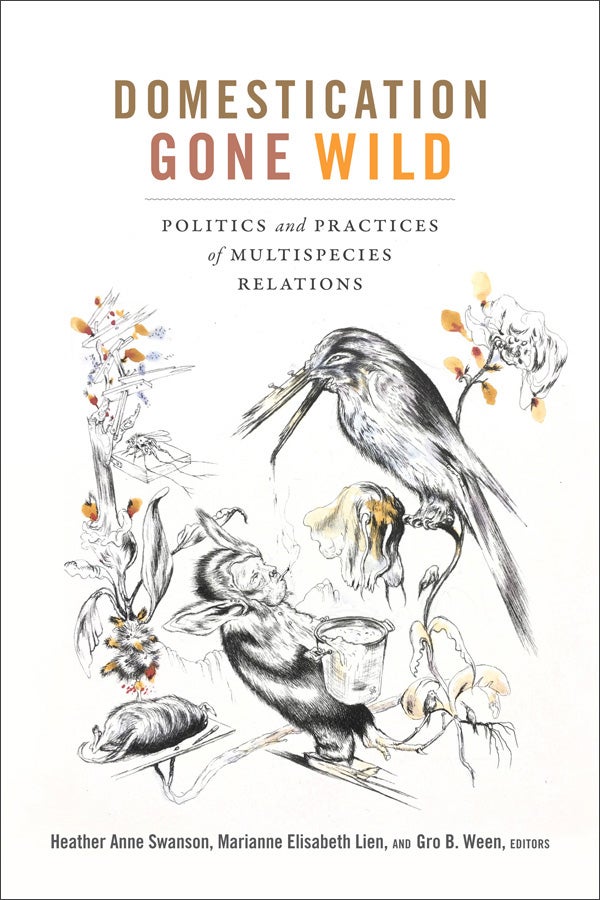
“What do Pacific salmon, British falcons, pine trees everywhere, Ifugao pigs and spirits, and Norwegian apples have in common? They perform ‘domestication’ in ways certain to change the narratives and politics of domestication for scholars of whatever discipline and for critter people all over the earth. Read this book for up-to-the-minute, deeply researched, very smart, contentious takes on the shapes of conjoined humans and nonhumans living and dying together in diverse histories of civilization, colonialism, capitalism, times-past, and times-yet-to-come. Perhaps what opens up in this book are real possibilities for caring more materially in urgent times.” - Donna J. Haraway, author of Staying with the Trouble: Making Kin in the Chthulucene
Sapiens [Tenth Anniversary Edition]: A Brief History of Humankind
New York Times Readers’ Pick: Top 100 Books of the 21st CenturyThe tenth anniversary edition of the internationally bestselling phenomenon that cemented Yuval Noah Harari as one of the most prominent historians of our time—featuring a new afterword from the author.One hundred thousand years ago, at least six human species inhabited the earth. Today there is just one. Us. Homo sapiens. How did our species succeed in the battle for dominance? Why did our foraging ancestors come together to create cities and kingdoms? How did we come to believe in gods, nations, and human rights; to trust money, books, and laws; and to be enslaved by bureaucracy, timetables, and consumerism? And what will our world be like in the millennia to come?In Sapiens, Professor Yuval Noah Harari spans the whole of human history, from the very first humans to walk the earth to the radical—and sometimes devastating—breakthroughs of the Cognitive, Agricultural, and Scientific Revolutions. Drawing on insights from biology, anthropology, paleontology, and economics, and incorporating full-color illustrations throughout the text, he explores how the currents of history have shaped our human societies, the animals and plants around us, and even our personalities. Can we ever free our behavior from the legacy of our ancestors? And what, if anything, can we do to influence the course of the centuries to come?Bold, wide-ranging, and provocative, Sapiens integrates history and science to challenge everything we thought we knew about being human: our thoughts, our actions, our heritage...and our future.
What ancient philosophy really thought about domestic life | Aeon Essays
The household is a community, as much as the state, and ancient philosophy had much more to say about it than we think
Refusing Settler Domesticity — Oakland Public Library
Refusing Settler Domesticity — Keliiaa, Caitlin, — In the early twentieth century, the Bay Area Outing Program coercively recruited over a thousand Native girls and women from boarding schools to labor as live-in domestic workers across the San Francisco Bay Area. Outing removed Native people from their communities and transferred them to white homes, farms, and businesses to work as menial laborers. In exchange for room, board, and meager pay, Native women and girls as young as twelve cooked, cleaned, and lived in the homes of their employers. Despite oppressive living and working conditions, Native women strategically resisted the worst aspects of outing, including Indian child removal, sexual surveillance, criminalization, and exploitation. Throughout, they forged social connections and navigated relationships to refuse domestication and assert their agency. In this groundbreaking work, Historian Caitlin Keliiaa examines Native women's lived experiences of federal policy and connects outing to the region's longer history of coerced Native labor. The book, as indictment, expands the existing work on Indian boarding schools, urban Indians, and the history of California and the West.
Michael Thrower Chowdhury on Twitter / X
This book is very good. I started it today and was hooked, am about halfway through already. Cooper assesses the ways in which beliefs in traditional family structures underpin the laissez-faire resurgence of the 1990s. Definitely recommend. pic.twitter.com/hPYnom4XGV— Michael Thrower Chowdhury (@BevansAdvocate) September 27, 2026

Farming is Why Humanity is Fucked
A mind-shattering concept from a first-year university class that upended how I think about humanity. Daniel Quinn's Ishmael trilogy argues that totalitari…
That Winter the Wolf Came — Oakland Public Library
That Winter the Wolf Came — Spahr, Juliana — <p>That Winter the Wolf Came is written for this era of global struggle. It finds its ferment at the intersection of ecological and economic catastrophe. Its feminist and celebratory energy is fueled by street protests and their shattered windows. Amid oil spills and austerity measures and shore birds and a child holding its mother’s hand and hissing teargas canisters, it reminds us exactly what we must fight to defend with a wild ferocity, and what we’re up against.</p><br /><p>"In her poems, love does not resist the world beyond; love lets it in. Politics demands feeling rather than denuding it." —<i>Los Angeles Review of Books</i></p><p>"Geography, economics, ecology, hydrology, local and international history; repetition, flat limited diction, lengthy chant; intersections of incompatible discourses, such as a field biologist’s checklist plus memoir, medical record plus ode, incantation plus site report: Spahr draws on these resources and procedures to make poems that feel like bizarre, careful essays, and essays that feel like sad, extended poems." —<i>The Nation</i></p><p>"...a work of crisp wit, bizarre conjunctions and ultimately enduring moral authority." —<i>Publisher’s Weekly</i></p><br /><br />Excerpt:<br /><br /> It was Non-Revolution. Or it was me. Or it was Non-Revolution and me. I was unsure what it really was. Maybe it was my thoughts. My thoughts at one minute about Non-Revolution. About the smell of Non-Revolution. Sweat, urine, sage, pot, rotting food, hay, all mixed together. Perhaps about Non-Revolution’s body. I am sure I am not the only one who has thought it exceptional, but I am also just as sure that by the standards of bodies, Non-Revolution’s is fine but not exceptional. That is the point. That is why Non-Revolution is called Non-Revolution, why they have revolution as a possibility in their name but it is a modified and thus negated possibility so as to suggest they are possibly neither good nor fucked. Still something about Non-Revolution’s smell and body had gotten into me.<br /><br/>Renewed poetry of struggle at the intersection of ecological and economic catastrophe—feminist, ferocious, and finally celebratory.<br />
Culture & truth : the remaking of social analysis
xii, 253 pages ; 22 cm; Argues for a new approach to thinking and writing about culture. Exposing old conceptions, the book argues that new ethnographic writing must come to terms with the dynamic nature of social reality - with history, spontaneity, and human emotions; Originally published: Boston: Beacon, 1989; Includes index; Self-Renewing 2017; Includes index

The Secret of Our Success: How Culture Is Driving Human Evolution, Domesticating Our Species, and Making Us Smarter
How our collective intelligence has helped us to evolve and prosperHumans are a puzzling species. On the one hand, we struggle to survive on our own in the wild, often failing to overcome even basic challenges, like obtaining food, building shelters, or avoiding predators. On the other hand, human groups have produced ingenious technologies, sophisticated languages, and complex institutions that have permitted us to successfully expand into a vast range of diverse environments. What has enabled us to dominate the globe, more than any other species, while remaining virtually helpless as lone individuals? This book shows that the secret of our success lies not in our innate intelligence, but in our collective brains—on the ability of human groups to socially interconnect and learn from one another over generations.Drawing insights from lost European explorers, clever chimpanzees, mobile hunter-gatherers, neuroscientific findings, ancient bones, and the human genome, Joseph Henrich demonstrates how our collective brains have propelled our species' genetic evolution and shaped our biology. Our early capacities for learning from others produced many cultural innovations, such as fire, cooking, water containers, plant knowledge, and projectile weapons, which in turn drove the expansion of our brains and altered our physiology, anatomy, and psychology in crucial ways. Later on, some collective brains generated and recombined powerful concepts, such as the lever, wheel, screw, and writing, while also creating the institutions that continue to alter our motivations and perceptions. Henrich shows how our genetics and biology are inextricably interwoven with cultural evolution, and how culture-gene interactions launched our species on an extraordinary evolutionary trajectory.Tracking clues from our ancient past to the present, The Secret of Our Success explores how the evolution of both our cultural and social natures produce a collective intelligence that explains both our species' immense success and the origins of human uniqueness.
Embers of society: Firelight talk among the Ju/’hoansi Bushmen
Much attention has been focused on control of fire in human evolution and the impact of cooking on anatomy, social, and residential arrangements. However, little is known about what transpired when firelight extended the day, creating effective time for social activities that did not conflict with productive time for subsistence activities. Comparison of 174 day and nighttime conversations among the Ju/’hoan (!Kung) Bushmen of southern Africa, supplemented by 68 translated texts, suggests that day talk centers on economic matters and gossip to regulate social relations. Night activities steer away from tensions of the day to singing, dancing, religious ceremonies, and enthralling stories, often about known people. Such stories describe the workings of entire institutions in a small-scale society with little formal teaching. Night talk plays an important role in evoking higher orders of theory of mind via the imagination, conveying attributes of people in broad networks (virtual communities), and transmitting the “big picture” of cultural institutions that generate regularity of behavior, cooperation, and trust at the regional level. Findings from the Ju/’hoan are compared with other hunter-gatherer societies and related to the widespread human use of firelight for intimate conversation and our appetite for evening stories. The question is raised as to what happens when economically unproductive firelit time is turned to productive time by artificial lighting.


annotations: Camille Landais : l'inégalité entre les sexes résulte des inégalités dans la garde d’enfants
Blog de sciences économiques et sociales de Martin Anota. Traductions, revues de presse.
Ecocivilization: making a world that works for all
""One of the greatest thinkers of our age" (The Guardian) presents a new way of living-one modeled on nature's design instead of capitalism's-for fans of Guns, Germs, and Steel and Doughnut Economics It has often been said that it is easier to imagine the end of the world than it is to imagine the end of capitalism-and yet that is what the historical moment urgently calls for. Climate change has reached an emergency state, inequality continues to grow, and, for many, the future has never seemed more bleak. Incremental policy improvements are no longer enough-we need a deep transformation of our current civilization to continue to survive. In Ecocivilization, leading thinker Jeremy Lent reimagines the basis of our civilization, and argues for a new global system of living, one based on life-affirming principles modeled after nature's own design. What enfolds is a robust framework incorporating Lent's own expertise, and the lived experiences of those on the ground already putting ecological civilization's core tenants into practice-justice, mutuality, diversity, and symbiosis. From the global economy to universal housing and income, from infrastructure to agriculture, every major aspect of our society could be redesigned to work together as a coherent whole, setting the conditions for all people to flourish. Ecocivilization shows how this future on a regenerated Earth is not only desirable, but entirely feasible"--

The Ecology of Freedom
Murray Bookchin The Ecology of Freedom The Emergence and Dissolution of Hierarchy 1982 Converted September 2018; footnotes, section spacing, and...

The Ecology of Freedom: The Emergence and Dissolution o…
"The very notion of the domination of nature by man ste…

Social Reproduction Theory: Remapping Class, Recentering Oppression
This groundbreaking collection explores the profound power of Social Reproduction Theory to deepen our understanding of everyday life under capitalism. While many Marxists tend to focus on the productive economy, this book focuses on issues such as child care, health care, education, family life and the roles of gender, race and sexuality, all of which are central to understanding the relationship between economic exploitation and social oppression. In this book, leading writers such as Lise Vogel, Nancy Fraser, David McNally and Susan Ferguson reveal the ways in which daily and generational reproductive labour, found in households, schools, hospitals and prisons, also sustains the drive for accumulation. Presenting a more sophisticated alternative to intersectionality, these essays provide ideas which have important strategic implications for anti-capitalists, anti-racists and feminists attempting to find a path through the seemingly ever more complex world we live in.