

"The conscious and intelligent manipulation of the organized habits and opinions of the masses is an important element in democratic society. Those who manipulate this unseen mechanism of society constitute an invisible government which is the true ruling power of our country. We are governed, our minds are molded, our…
It's the (Democracy-Poisoning) Golden Age of Free Speech
At a time when anyone can broadcast live or post their thoughts to a social network, we should be living in a utopia of public discourse. We're not.



To Repress or to Co‐opt? Authoritarian Control in the Age of Digital Surveillance
This article studies the consequences of digital surveillance in dictatorships. I first develop an informational theory of repression and co-optation. I argue that digital surveillance resolves dicta...

The Epstein rot goes deep
America must now ask itself if it can restore a culture of shame

State Capacity of Secret Surveillance
The state capacity-civil society tradeoff model tends to treat the “state” and “civil society” as separate entities who move to constrain one another. However, this modeling technique leaves out the nuances of individual action within a collective setting by treating each as a relative black box. This article explores this balance in the context of the surveillance state that has arisen in the 20th and 21st century. As state capacity in surveillance increases it better allows the state to respond to threats to citizens from citizens. However, the increased capacity also lessens the ability of societal pressure to check authoritarian advances even in a nation with a thriving civil society presence.
State Capacity of Secret Surveillance
The state capacity-civil society tradeoff model tends to treat the “state” and “civil society” as separate entities who move to constrain one another. However, this modeling technique leaves out the nuances of individual action within a collective setting by treating each as a relative black box. This article explores this balance in the context of the surveillance state that has arisen in the 20th and 21st century. As state capacity in surveillance increases it better allows the state to respond to threats to citizens from citizens. However, the increased capacity also lessens the ability of societal pressure to check authoritarian advances even in a nation with a thriving civil society presence.
Media Media
The authoritarians are winning, we can all see that. It wouldn't be the worst thing if the pro-democracy camp stopped being naive about social media.

Deference, Dissent, and Dispute Resolution: An Experimental Intervention Using Mass Media to Change Norms and Behavior in Rwanda
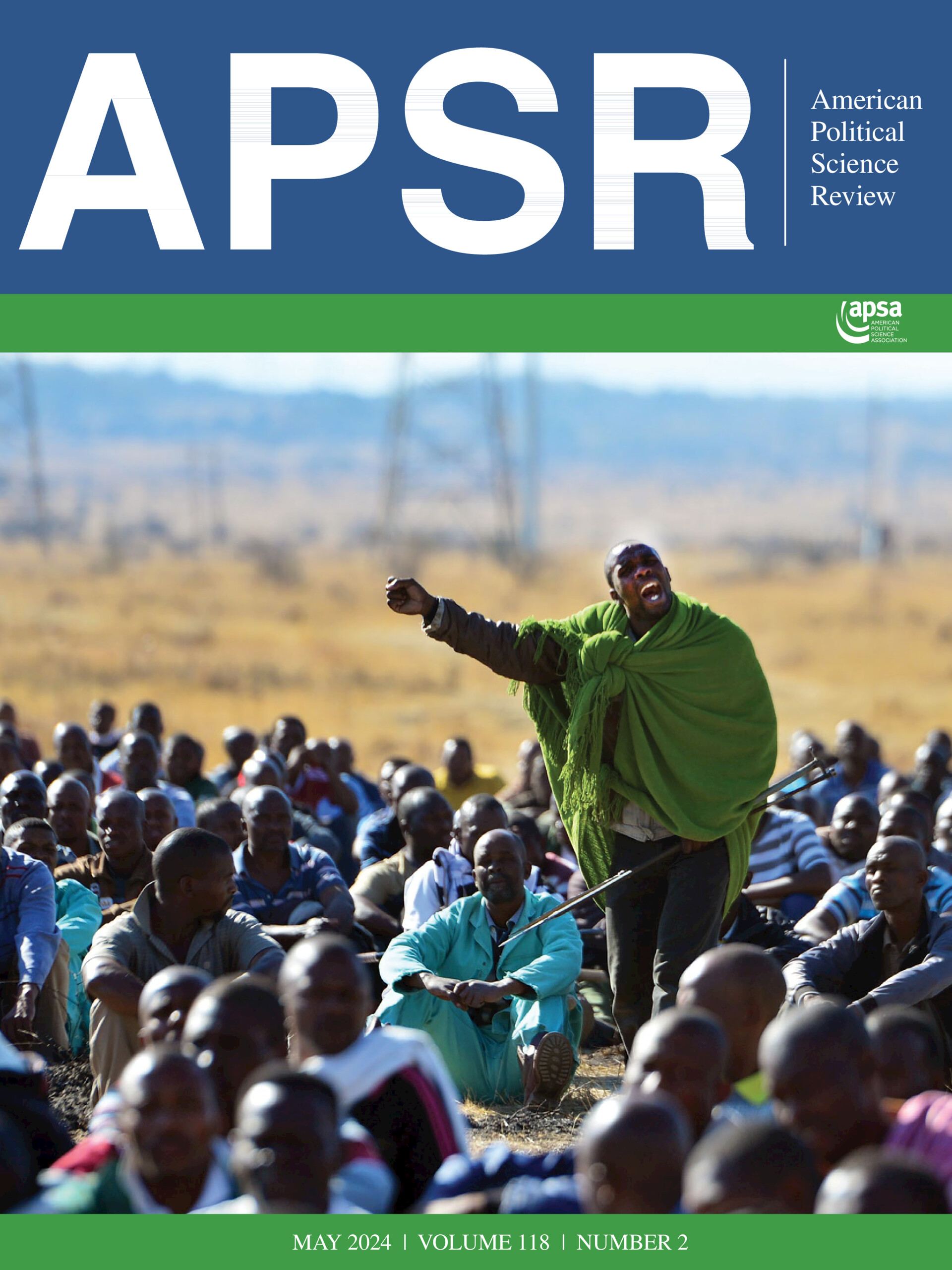
Deference and dissent strike a delicate balance in any polity. Insufficient deference to authority may incapacitate government, whereas too much may allow leaders to orchestrate mass violence. Although cross-national and cross-temporal variation in deference to authority and willingness to express dissent has long been studied in political science, rarely have scholars studied programs designed to change these aspects of political culture. This study, situated in post-genocide Rwanda, reports a qualitative and quantitative assessment of one such attempt, a radio program aimed at discouraging blind obedience and reliance on direction from authorities and promoting independent thought and collective action in problem solving. Over the course of one year, this radio program or a comparable program dealing with HIV was randomly presented to pairs of communities, including communities of genocide survivors, Twa people, and imprisoned génocidaires. Changes in individual attitudes, perceived community norms, and deliberative behaviors were assessed using closed-ended interviews, focus group discussions, role-play exercises, and unobtrusive measures of collective decision making. Although the radio program had little effect on many kinds of beliefs and attitudes, it had a substantial impact on listeners' willingness to express dissent and the ways they resolved communal problems.
An Attack on Tech Freedom, an Assault on Dissent
We live in a world of surveillance states, militarized police, and crackdowns on dissent. Meanwhile, corporate behemoths will often ally with the state to shut down dissident speech or aid and abet surveillance. In this context, it’s important for independent groups to develop and maintain encrypted communications platforms and independent web hosting. But the Trump...
Pluralistic: Surveillance is inequality’s stabilizer (26 Jun 2025) – Pluralistic: Daily links from Cory Doctorow
The "dictator's dilemma" pits a dictator's desire to create social stability by censoring public communications in order to prevent the spread of anti-regime messages with the dictator's need to know whether powerful elites are becoming restless and plotting a coup:
Social Media Vs Democracy
The Attention Economy and the Collapse of Cognitive Autonomy
Check out the first in a series on social media from Denny Center Student Fellow Rai Hasen Masoud (F'27) to learn more about the attention economy and it's impacts on our democracy.
Manufacturing Consent: The Political Economy of the Mass Media
A bold and eye-opening exposé on how power and propaganda distort the news, now more relevant than ever • With an updated introduction“[A] compelling indictment of the news media’s role in covering up errors and deceptions in American foreign policy.”—The New York Times Book Review Renowned scholars Edward S. Herman and Noam Chomsky reveal how U.S. news media, far from being independent watchdogs, often function as tools of elite influence. With probing analysis, they present their Propaganda Model, a framework that explains how systemic bias shapes the stories we’re told, the voices we hear, and the truths that remain hidden.Through deeply researched case studies, from the Vietnam War to coverage of “worthy” vs. “unworthy” victims, Manufacturing Consent exposes the structural forces that drive news organizations to reinforce power rather than question it. It’s a sobering portrait of a media system more interested in maintaining order than informing the public.This edition includes an introduction updating key examples and expanding the Propaganda Model’s relevance to issues like the coverage of NAFTA, the media’s treatment of global protests, and environmental regulation.Manufacturing Consent is a powerful assessment of how propagandistic the U.S. mass media are, how they systematically fail to live up to their self-image as providers of the kind of information that people need to make sense of the world, and how we can understand their function in a radically new way.Whether you’re a student, activist, or citizen looking to see beyond the headlines, this book will transform how you understand the media—and the world around you.

The authoritarians are winning, we can all see that. Maybe, just maybe, it wouldn't be the worst thing if pro-democracy people stopped being ridiculously naive about social media. berjon.com/media-media/

Media Media
berjon.com