

From one of California’s most celebrated librarians and public historians, a coming-of-age memoir about the thirst for knowledge and hometown pride.A Best Book of the Year, Oakland Public Library2023 Bronze Winner for the Foreword INDIES Award, Autobiography & Memoir"What You Don’t Know will inspire for its grace, zest and courage.
Book Review of Making All the World America
Steven T. Newcomb reviews Timothy Bowers Vasko’s Making All the World America: Native Information and the Doctrine of Discovery (University of Pennsylvania Press, 2026).
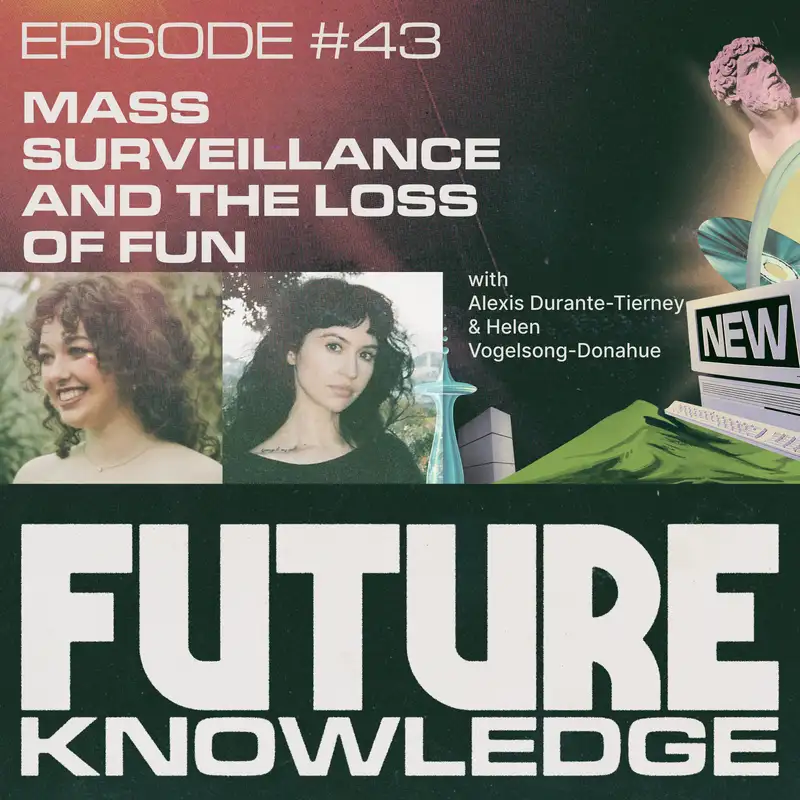
Future Knowledge | Mass Surveillance and the Loss of Fun
In this episode of Future Knowledge, Alexis Durante-Tierney and Helen Vogelsong-Donahue, hosts of the Born Digital podcast, explore how growing up under constant surveillance may be changing the wa...
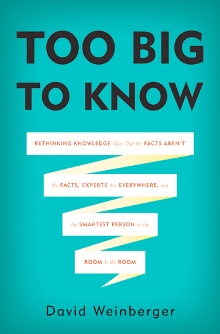
Too Big to Know
Too Big to Know: Rethinking Knowledge Now That the Facts Aren't the Facts, Experts Are Everywhere, and the Smartest Person in the Room Is the Room is a non-fiction book by the American technology writer David Weinberger published in 2012 by Basic Books.
Fear of Knowledge: Against Relativism and Constructivism
In recent times, relativist and constructivist conceptions of truth and knowledge have become orthodoxy in vast stretches of the academic world. In this unique volume, Paul Boghossian critically examines such views and exposes their fundamental flaws. This short, lucid, witty book shows that philosophy provides rock-solid support for common sense against the relativists; it is provocative reading throughout the discipline and beyond.

Indie Thinkers
A curated collection of quotes from the brightest minds on the internet.
Hayao Miyazaki and optimistic nihilism
Yesterday, I found the post i think we're obsessed with aesthetic on the Discovery Feed. It featured quite a few nice quotes. My favourite was this one: <...

A Brief History & Ethos of the Digital Garden
A newly revived philosophy for publishing personal knowledge on the web
Works in Progress: The Long Journey to Doing Good Better
The more I learn, the more I realize how much I don’t know. — Albert Einstein
A fact-based worldview for all | Gapminder
We live in a globalized world, not only in terms of trade and migration. More people than ever care about global development. But most people have severe misconceptions about contemporary global development. We know, because we have tested people’s knowledge. One of the main reasons for this is that students don’t learn to understand the world based on statistics and facts. Instead, we have a dramatic worldview formed by outdated school books and sensationalist news-stories. People intuitively believe that most things are getting worse. The dramatic worldview leads to irrational decisions by individuals, nonprofits, governments and business. For the first time in human history reliable statistics exist. There’s data for almost every aspect of global development. The data shows a very different picture: a world where most things improve; a world that is not divided; and a world where the fast population growth will soon be over. The world has never been less bad. But that doesn’t mean it’s perfect.
《X+Y: A Brilliant Young Mind》 Review
A story about self-discovery and the wider world.
The genie knows, but doesn't care — LessWrong
Followup to: The Hidden Complexity of Wishes, Ghosts in the Machine, Truly Part of You …
Developing creative identity
I was a theoretical physicist from 1992 to 2007. It was a romantic activity, exploring the fundamental nature of the cosmos! I became a university professor, wrote papers and books, and got to explore some of the most beautiful ideas ever discovered. In parallel, I also developed a fascination with the social systems humanity uses to make knowledge. Systems like the university or peer review are immensely deep inventions: our discovery system is itself one of the great inventions of humanity! But I believed a radically better discovery system must be possible. I became obsessed with this idea, eventually giving up tenure to work on it1. My first big project was to write a book helping develop and spread the fundamental ideas underlying the modern open science movement.
Ever thought we acquire generalizable knowledge by discarding details and compressing our experiences? In a new BBS paper, @sabinasloman.bsky.social and I argue otherwise, proposing a novel way of studying human learning inspired by double descent in ML. Disagree? Propose a commentary by May 15 :)
our system of knowledge production is under attack from an extraordinary array of forces and if the people putatively on the side of maintaining it cannot commit to the most basic standards (not using fake citations, writing your own words, etc) I fear there is no hope

Dr. Holly Walters
I'm sorry, what? In writing my first monograph, I spent six weeks trying to track down a citation in TWO languages I didn't know. And good thing too, because the citation was wrong. That's scholarship. That's research. You know, the thing we're trained to do?!?
Common Knowledge Futures


I’ve been quiet on social media lately, but today I’m launching Audit Clinical Evidence (ACE), an initiative I’ve been developing over the…
A New Paradigm for Scientific Publishing, Peer Review, and Impact Assessment

Nova Scotia’s Experiment in Research That Solves Real Problems
datasetpapers — a public research experiment
Helpful reminder from Elsevier that they have the "legal power" to do what they want with your journals. You have the collective power to…
Andreas De Block on Twitter / X

