

BioModels is a repository of freely-available mathematical models of biological and biomedical systems. It hosts a vast selection of physiologically and pharmaceutically relevant mechanistic models in standard formats.
A model qualification method for mechanistic physiological QSP models to support model‐informed drug development
Mechanistic physiological modeling is a scientific method that combines available data with scientific knowledge and engineering approaches to facilitate better understanding of biological systems, improve decision‐making, reduce risk, and increase efficiency in drug discovery and development. It is a type of quantitative systems pharmacology (QSP) approach that places drug‐specific properties in the context of disease biology. This tutorial provides a broadly applicable model qualification method (MQM) to ensure that mechanistic physiological models are fit for their intended purposes.

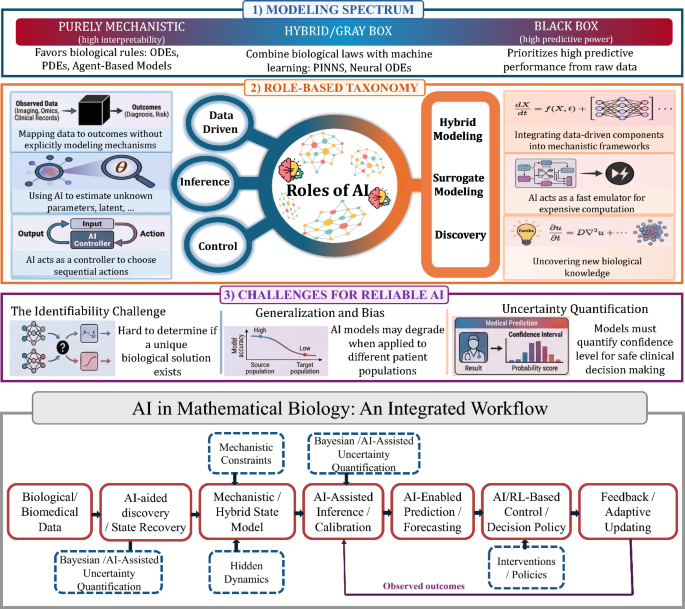
How AI Can Advance Mathematical Biology: Opportunities, Challenges, and Future Directions
Mathematical biology has long relied on mechanistic models, including ordinary and partial differential equations, stochastic systems, and agent-based models, to study biological processes across scales. These approaches remain central because they provide structure, interpretability, and biological insight. However, modern biological and biomedical data, including longitudinal clinical records, medical imaging, and multi-omics measurements, are often high-dimensional, noisy, heterogeneous, and incomplete. These features make model calibration, simulation, and uncertainty quantification increasingly difficult. As a result, artificial intelligence (AI) and machine learning (ML) are playing a growing role in mathematical biology, not as replacements for mechanistic modeling, but as complementary tools that can support prediction, hybrid modeling, inference, and control. In this review, we organize these uses of AI from a mathematical biology perspective and examine how data-driven and mechanistic approaches interact across different modeling tasks. The selected examples span biomedical, epidemiological, ecological, evolutionary, biochemical, and population-level systems, while the review is intended to be representative rather than exhaustive. We emphasize recurring challenges that strongly affect biological credibility and practical usefulness, including interpretability, identifiability, generalization, and uncertainty quantification. Our goal is to clarify the roles AI can play in mathematical biology and to highlight the opportunities and limitations that arise when flexible learning methods are integrated with biologically grounded modeling.
Evaluation framework for systems models
Abstract As decisions in drug development increasingly rely on predictions from mechanistic systems models, assessing the predictive capability of such models is becoming more important. Several frameworks for the development of quantitative systems pharmacology (QSP) models have been proposed. In this paper, we add to this body of work with a framework that focuses on the appropriate use of qualitative and quantitative model evaluation methods. We provide details and references for those wishing to apply these methods, which include sensitivity and identifiability analyses, as well as concepts such as validation and uncertainty quantification. Many of these methods have been used successfully in other fields, but are not as common in QSP modeling. We illustrate how to apply these methods to evaluate QSP models, and propose methods to use in two case studies. We also share examples of misleading results when inappropriate analyses are used.

An attempt to explain category theory to biologists in 15 minutes | David Spivak
A review of mathematical modeling of bone remodeling from a systems biology perspective
Bone remodeling is an essential physiological process in the adult skeleton. Due to the complex nature of this process, many mathematical models of bone remodeling have been developed. Each of these models has unique features, but they have underlying patterns. In this review, the authors highlight the important aspects frequently found in mathematical models for bone remodeling and discuss how and why these aspects are included when considering the physiology of the bone basic multicellular unit, which is the term used for the collection of cells responsible for bone remodeling. The review also emphasizes the view of bone remodeling from a systems biology perspective. Understanding the systemic mechanisms involved in remodeling will help provide information on bone pathology associated with aging, endocrine disorders, cancers, and inflammatory conditions and enhance systems pharmacology. Furthermore, some features of the bone remodeling cycle and interactions with other organ systems that have not yet been modeled mathematically are discussed as promising future directions in the field.
<i>In silico</i> models of bone remodeling from macro to nano—from organ to cell
Abstract Computational modeling is a tool through which researchers can achieve a greater understanding of the mechanisms governing biological systems. In the field of bone biology, a plethora of models exist which attempt to replicate and investigate bone's dynamic behavior at different scales. At organ level, models are continuum based and describe the variation of bone's apparent density as a function of both biological and external mechanical stimuli. At tissue level, models include bone microarchitecture and more descriptive parameters such as trabecular thickness, osteoclast resorption depth, and activation frequency. Finally, at cell level, models employ partial differential equations to describe complex cellular interactions in the temporal domain. Although informative, these models exist in isolation. Consequently, their interpretation is limited. In this review, we present an overview of the organ‐, tissue‐, and cell‐level models and assess their ability to reflect bone's metabolic processes reliably. Existing interscale synergies are then presented along with a computational framework which could be exploited to achieve a fully integrated, multiscale modeling approach. WIREs Syst Biol Med 2011 3 241–251 DOI: 10.1002/wsbm.115 This article is categorized under: Analytical and Computational Methods > Computational Methods Models of Systems Properties and Processes > Organ, Tissue, and Physiological Models

Selecting synthetic data for successful simulation-based transfer learning in dynamical biological systems
Accurate prediction of the temporal dynamics of biological systems is crucial for informing timely and effective interventions, e.g., in ecological or epidemiological contexts, or for treatment adjustments in therapy. While machine learning has proven its capabilities in generalizing the underlying non-linear dynamics of such systems, unlocking its predictive power is often restrained by the limited availability of large, curated datasets. To supplement real-world data, informing machine learning by transfer learning with synthetic data derived from simulations using ordinary differential equations has emerged as a promising solution. However, the success of this approach highly depends on the designed characteristics of the synthetic data.

A review of mathematical modeling of bone remodeling from a systems biology perspective
Bone remodeling is an essential, delicately balanced physiological process of coordinated activity of bone cells that remove and deposit new bone tissue in the adult skeleton. Due to the complex nature of this process, many mathematical models of bone remodeling have been developed. Each of these models has unique features, but they have underlying patterns. In this review, the authors highlight the important aspects frequently found in mathematical models for bone remodeling and discuss how and why these aspects are included when considering the physiology of the bone basic multicellular unit, which is the term used for the collection of cells responsible for bone remodeling. The review also emphasizes the view of bone remodeling from a systems biology perspective. Understanding the systemic mechanisms involved in remodeling will help provide information on bone pathology associated with aging, endocrine disorders, cancers, and inflammatory conditions and enhance systems pharmacology. Furthermore, some features of the bone remodeling cycle and interactions with other organ systems that have not yet been modeled mathematically are discussed as promising future directions in the field.

The lost art of mathematical modelling
We provide a critique of mathematical biology in light of rapid developments in modern machine learning. We argue that out of the three modelling activities – (1) formulating models; (2) analysing models; and (3) fitting or comparing models to data – inherent to mathematical biology, researchers currently focus too much on activity (2) at the cost of (1). This trend, we propose, can be reversed by realising that any given biological phenomenon can be modelled in an infinite number of different ways, through the adoption of a pluralistic approach, where we view a system from multiple, different points of view. We explain this pluralistic approach using fish locomotion as a case study and illustrate some of the pitfalls – universalism, creating models of models, etc. – that hinder mathematical biology. We then ask how we might rediscover a lost art: that of creative mathematical modelling.
Toward a Mathematical Modeling of Diseases’ Impact on Bone Remodeling: Technical Review
A wide variety of bone diseases have hitherto been discovered, such as osteoporosis, Patget’s disease, osteopetrosis, and metastatic bone disease, which is not well defined. Some of these diseases are secondary to other pathologies, including cancer, or to some clinical treatments. To better understand bone behavior and prevent its deterioration, bone biomechanics have been the subject of mathematical modeling that exponentially increased over the last years. These models are more and more involving the impact of bone diseases on its quality. The current paper provides a meaningful and critical analysis of previously developed bone remodeling mathematical models, particularly those addressing bone diseases. Besides, mechanistic pharmacokinetic/pharmacodynamic (PK/PD) models, which englobe either bone disease and its treatments’ effect on bone health. Therefore, the review starts by presenting bone remodeling cycle and mathematical models describing this process, followed by introducing some bone diseases and discussing models of pathological mechanisms affecting bone, and ends by exhibiting the available bone treatment procedures and the PK/PD models considering these lasts.

Automated Scale Reduction of Nonlinear <span style="font-variant:small-caps;">QSP</span> Models With an Illustrative Application to a Bone Biology System
Integrating quantitative systems pharmacology ( QSP ) into pharmacokinetics/pharmacodynamics ( PKPD ) has resulted in models that are highly complex and often not amenable to further exploration via estimation or design. Because QSP models are usually depicted using nonlinear differential equations it is not straightforward to apply some model reduction techniques, such as proper lumping. In this study, we explore the combined use of linearization and proper lumping as a general method to simplification of a nonlinear QSP model. We illustrate this with a bone biology model and the reduced model was then applied to describe bone mineral density ( BMD ) changes due to denosumab dosing. The methodologies used in this study can be applied to other multiscale models for developing a mechanism‐based structural model for future analyses.

Biohub releases a world model of protein biology
Open AI models used for a wide range of scientific applications, including accelerating the design of therapeutic molecules.

A review of recent developments in mathematical modeling of bone remodeling
In this article, we summarize the developments in the mathematical modeling of the mechanics of bone and related biological phenomena. We will devote special attention to the results of the last 10–15 years, although we will cover some relevant classical work to better frame the more recent researches. We will propose a division of the literature based on the main aim of the model (mechanical/biomathematical) and the type of biological phenomena considered (stimulus, growth, cell population dynamics). Finally, we will suggest some possible directions for future investigations.

150 Years of the Mass Action Law
This year we celebrate the 150th anniversary of the law of mass action. This law is often assumed to have been “there” forever, but it has its own history, background, and a definite starting point. The law has had an impact on chemistry, biochemistry, biomathematics, and systems biology that is difficult to overestimate. It is easily recognized that it is the direct basis for computational enzyme kinetics, ecological systems models, and models for the spread of diseases. The article reviews the explicit and implicit role of the law of mass action in systems biology and reveals how the original, more general formulation of the law emerged one hundred years later ab initio as a very general, canonical representation of biological processes.
Mathematical modeling of postmenopausal osteoporosis and its treatment by the anti‐catabolic drug denosumab
SUMMARY Denosumab, a fully human monoclonal antibody, has been approved for the treatment of postmenopausal osteoporosis. The therapeutic effect of denosumab rests on its ability to inhibit osteoclast differentiation. Here, we present a computational approach on the basis of coupling a pharmacokinetics model of denosumab with a pharmacodynamics model for quantifying the effect of denosumab on bone remodeling. The pharmacodynamics model comprises an integrated systems biology‐continuum micromechanics approach, including a bone cell population model, considering the governing biochemical factors of bone remodeling (including the action of denosumab), and a multiscale micromechanics‐based bone mechanics model, for implementing the mechanobiology of bone remodeling in our model. Numerical studies of postmenopausal osteoporosis show that denosumab suppresses osteoclast differentiation, thus strongly curtailing bone resorption. Simulation results also suggest that denosumab may trigger a short‐term bone volume gain, which is, however, followed by constant or decreasing bone volume. This evolution is accompanied by a dramatic decrease of the bone turnover rate by more than one order of magnitude. The latter proposes dominant occurrence of secondary mineralization (which is not anymore impeded through cellular activity), leading to higher mineral concentration per bone volume. This explains the overall higher bone mineral density observed in denosumab‐related clinical studies. Copyright © 2013 John Wiley & Sons, Ltd.

Pharmacometrics and systems pharmacology for metabolic bone diseases
Mathematical modelling and simulation (M&S) of drug concentrations, pharmacologic effects and the (patho)physiologic systems within which they interact can be powerful tools for the preclinical, translational and clinical development of drugs. Indeed, the Prescription Drug User Fee Act (PDUFA VI), incorporated as part of the FDA Reauthorization Act of 2017 (FDARA), highlights the goal of advancing model‐informed drug development (MIDD). MIDD can benefit development across many drug classes, including for metabolic bone diseases such as osteoporosis, cancer‐related and numerous rare metabolic bone diseases; conditions characterized by significant morbidity and mortality. A drought looms in terms of the availability of new drugs to better treat these devastating diseases. This review provides an overview of several M&S approaches ranging from simple pharmacokinetic to integrated pharmacometric and systems pharmacology modelling. Examples are included to illustrate the use of these approaches during the development of several drugs for metabolic bone diseases such as bisphosphonates, denosumab, teriparatide and sclerostin inhibitors (romosozumab and blosozumab).
